

Bullets:
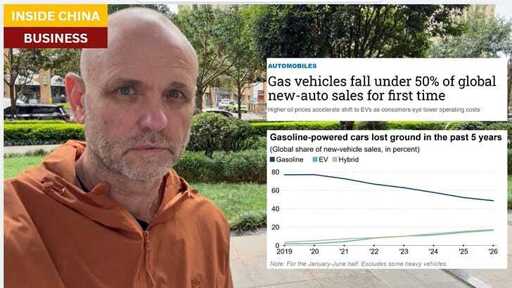
For the first time in recorded history, global unit sales of gas vehicles are under 50%, as pure electrics and hybrids soar in popularity.
In the beginning of 2026, Chinese EV carmakers forecast double-digit sales growth, as they hoped exports would ramp up
But energy prices skyrocketed after the War on Iran began, and demand for Chinese electric cars boomed. The goals for the expansion of Chinese exports were achieved years ahead of schedule.
Now Chinese firms are targeting the hybrid car industry, where lower tariffs may be a boon to models from China.
Inside China / Business is a reader-supported publication. To receive new posts and support my work, consider becoming a free or paid subscriber.
Report:
Good morning.
This is my 15th year in China, and when I arrived the status symbol for a Chinese family, or a young professional, was driving a new foreign-built car. China was a dream come true for luxury carmakers from Europe and Japan, and American companies, and dozens of people close to me were buying high-end cars from the same automakers that I already knew—from Germany, Japan, and GM and Ford.
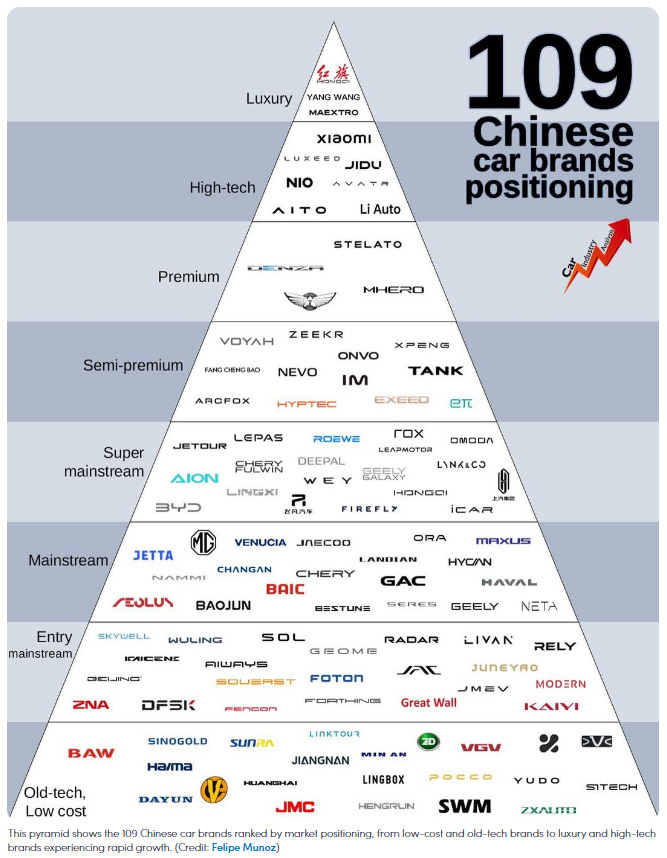
That’s ancient history now. One of the worst jobs today must be the BMW or Mercedes salesman in China, who is head-to-head against the scores of new Chinese electric cars. China builds more electric cars than anyone, and at far lower price points, and buyers enjoy a far lower total cost of ownership over time. And what I saw happen here, firsthand, over the past few years, is a sneak preview of what’s on the way everywhere else.
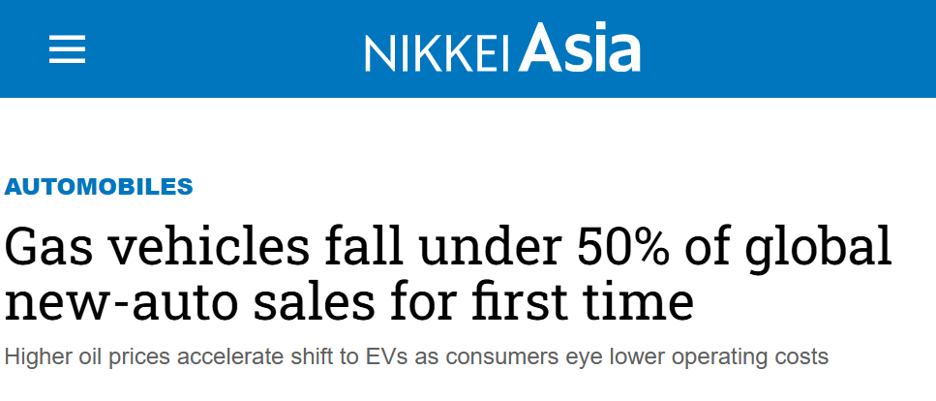
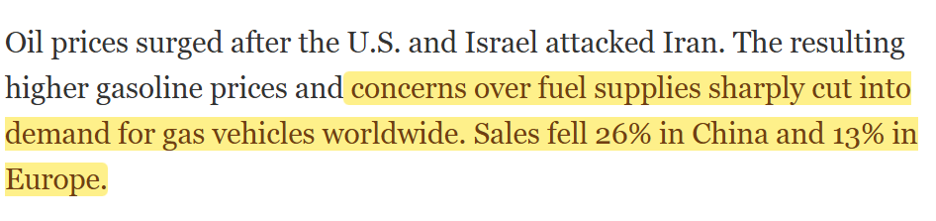
Sales of gas-powered cars are now under half, across the world. The War on Iran has blown up fuel markets, and the so for the first time since they started keeping records, electric and hybrid vehicles are over 50% of total vehicle sales.
China is already way ahead in its domestic markets. Now the world is catching up. So far in 2026, sales of gas cars dropped 10%, and are now at 49% worldwide. Five years ago, about 3/4ths of all the vehicles sold globally were gas, and that’s just the way it always was for everybody alive today.
But that may be ancient history, too, depending on how long it takes for energy markets to get fixed. Electric vehicles are now at the “mass adoption” phase of growth. In North America, EV sales dropped 15%. But in Europe—up 32%. Southeast Asia up 81. Oceania, up over 100%. Whether or not Chinese electric cars are ever allowed to be sold in the United States, nobody really knows. But China’s EV industry is taking over markets everywhere else, and already sell more than the rest of the world combined.
High energy prices are forcing consumers everywhere to rethink, and do the math on how higher-for-longer gas prices impact their budgets. In Europe, gas-powered car sales dropped by 13%.
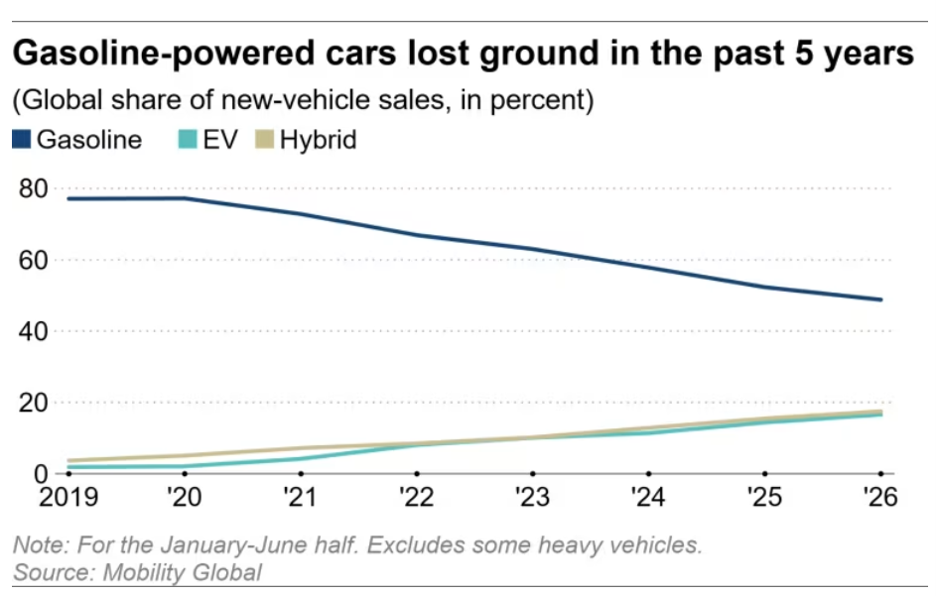
Whenever we see a chart like that one in finance, we’re supposed to say that “past performance is no guarantee of future results”. Because it is always possible that the Middle East and Russia somehow get sorted before Christmas, and happy days are here again at Audi and Cadillac. On the other hand, those trend lines started before Ukraine and Iran, and includes vast new car markets in South America, Africa, East Europe, and Asia, where millions of families are buying cars for the first time.
Geely and BYD and a handful of other Chinese brands are in the best position. Together they build 60% of the world’s EV’s and hybrids. North American viewers of the channel probably aren’t familiar with BYD or Geely—yet–but they are already household names outside Western Europe and the United States.

And that’s the problem for the legacy carmakers: electric car buyers don’t go back to gas vehicles. That’s to say that a first-time car buyer of an electric vehicle is probably a customer for life. And the subsidies don’t matter—policymakers in the United States and Europe can shut off incentives for EV’s, but the economics of gas-powered cars just don’t work in an age of high gas prices. The incentives are in the headlines, and they’re structural.
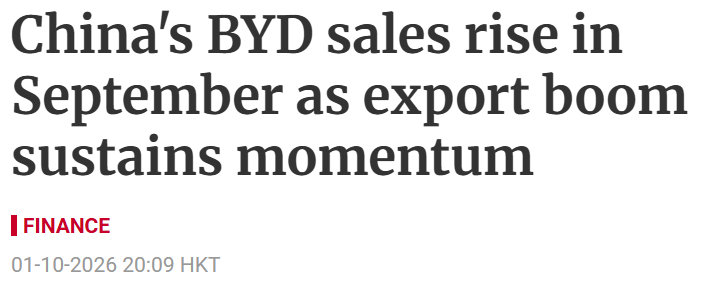
At the beginning of the year, Chinese brands had an aggressive strategy to grow their exports. The Chinese market is highly competitive, and sales are slowing down. The only way to grow their top lines, then, was through exports. So they built up extra capacity, with the idea of slowly expanding into new markets. Then came the war in the Persian Gulf, and those same Chinese companies are the only ones now able to meet the new demand.
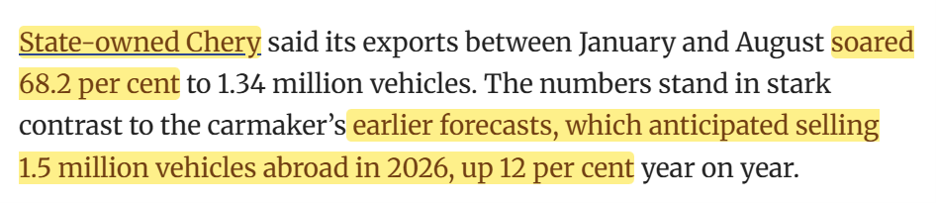
Exports in the first eight months blew past their own optimistic forecasts. Chinese exports of all vehicle types jumped 51% over last year. They are “several years ahead of their schedule”, right now, just after a few months. Electric vehicle exports are up 70% since 2025. BYD saw an 85% jump. That compares to their own forecast of 24% growth for all of 2026. Executives at Chery thought they might increase exports by 12% for all of 2026. Through just the first eight months, Chery exports were up 68%.
So the very unintended beneficiary of the US and Israeli war on Iran has been China’s electric car industry. They had ambitious goals for export growth, but the wars have turbocharged their sales, and we need to remind ourselves, again, that the so-called Chinese manufacturing overcapacity that Western policymakers like to complain about, is simply their way of having factories ready to fill new demand at any time.
What’s more, the trends are accelerating. At BYD, exports of passenger cars and light trucks are up two and a half times, over a year ago August. Industrywide, Chinese car exports overall are up 12 times in six years.
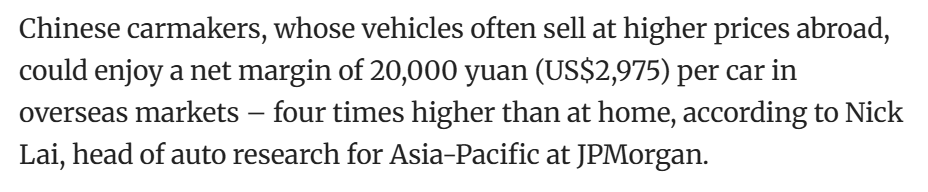
And that data point helps explain why Chinese carmakers are so anxious to export, in the first place. The domestic market is ruthlessly competitive, and profit margins are slim. Outside Mainland China, the profit margins quadruple, to about $3,000 per vehicle.
Chinese EV carmakers are exporting as fast as they get their giant ships loaded, and pointed East or West or South. And next it’s the foreign hybrid carmakers who are in trouble.
Prius is built by Toyota, and Geely and Changan are going after Japan. Chinese hybrid models are probably already superior in affordability and in fuel economy. Hybrids have not taken off in China, like the fully electric cars have, because they’re not defined as “new energy vehicles”, and therefore do not come with buying incentives.
This is an example, then, of a market that is outside subsidies and tax exemptions, but is big enough, and with profit margins high enough, that makes it profitable for Chinese brands to go after it.
The industry is dominated by Japanese models, now, but the Chinese companies believe that they have already passed them. They offer more attractive features, and already demonstrate the highest fuel efficiency. And there’s a quirk, there, which is likely to help them in the European market. Chinese EV sales are booming in the EU, despite those tariffs of between 17 and 45%. But for Chinese hybrids, the tariff is just 10%.
Be Good.
Resources and links:
Fuel Price Shock Pushes Global Gas Car Sales Below 50% for First Time
https://oilprice.com/Energy/Energy-General/Fuel-Price-Shock-Pushes-Global-Gas-Car-Sales-Below-50-for-First-Time.html
Gas vehicles fall under 50% of global new-auto sales for first time
https://asia.nikkei.com/business/automobiles/gas-vehicles-fall-under-50-of-global-new-auto-sales-for-first-time
China’s carmakers eye record 12 million overseas sales in 2026 as ‘go global’ plan pays off
https://www.scmp.com/business/china-business/article/3369423/chinas-carmakers-eye-record-12-million-overseas-sales-2026-go-global-plan-pays
China’s BYD sales rise in September as export boom sustains momentum
https://www.thestandard.com.hk/finance/article/344365/Chinas-BYD-sales-rise-in-September-as-export-boom-sustains-momentum
H1 sales of petrol cars less than 50% of market for first time
https://www.electronicsweekly.com/news/business/h1-sales-of-petrol-cars-less-than-50-of-market-for-first-time-2026-10/
S&P global mobility forecast to confirm electronics weekly data
https://www.mobilityglobal.com/en-us/products/autonomy-forecasts
China’s Chery predicts over 1 million EVs sold abroad as energy crisis persists
https://www.scmp.com/business/china-business/article/3354280/chinas-chery-sees-its-foreign-ev-sales-topping-1-million-world-wary-energy-crisis
After gaining EV dominance, Chinese carmakers shift goal to take on full-hybrid behemoths
https://www.scmp.com/business/china-business/article/3364906/after-gaining-ev-dominance-chinese-carmakers-shift-goal-take-full-hybrid-behemoths
New Mercedes TV Film (China)
The multiverse of the Chinese car brands
https://www.ecomotorsnews.com/en/expertise/multiverse-chinese-car-brands
Our Oil Columnist Got an EV. A Bad Omen for Big Petroleum?
https://www.bloomberg.com/opinion/articles/2026-10-05/what-my-new-ev-says-about-oil-demand-after-the-iran-war
The Gulf Oil Shock Is Pushing E.V. Sales to New Heights Globally
https://www.nytimes.com/interactive/2026/08/18/climate/ev-car-sales-oil-prices.html
Inside China / Business is a reader-supported publication. To receive new posts and support my work, consider becoming a free or paid subscriber.
From Inside China / Business via This RSS Feed.
Hell Yes!
