

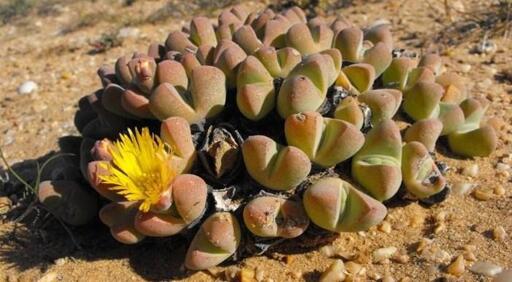
The brown clockfig, an extremely rare succulent growing in the hot, arid border region of Namibia and South Africa, was recently assessed as critically endangered by the IUCN, the global wildlife conservation authority. The western Gariep Valley is a vast landscape spanning the southern part of Tsau ǁKhaeb National Park in Namibia and the Richtersveld region of Northern Cape province in South Africa. It’s in this harsh environment, shaped by extreme heat and dryness, that the brown clockfig (Cheiridopsis brownii) grows on quartz ridges, shale, gravel, and sandy soils, and in cracks and fissures in desert mountains. The IUCN estimates the species, with thick leaves and daisy-like yellow flowers, has a total range of 424 square kilometers (164 square miles) in the valley, but occupies only around 60 km2 (23 mi2) of this area. Habitat loss due to overgrazing is among its major threats. Another is the demand for mineral resources such as diamonds, with mining permits being issued across the region. That’s placed more of the species’ already limited habitat under pressure in both South Africa and Namibia. “The vast desertification of the Aniesvlakte [plain in South Africa’s Richtersveld region] as a direct result of severe overgrazing, as well as the mass desertification caused by sand moving from the coast due to unrehabilitated mines, are threatening to swallow most of the remaining population in South Africa,” Pieter van Wyk, a botanist with South African National Parks (SANParks), who carried out the most recent assessment, told Mongabay via email. Another…This article was originally published on Mongabay
From Conservation news via This RSS Feed.