

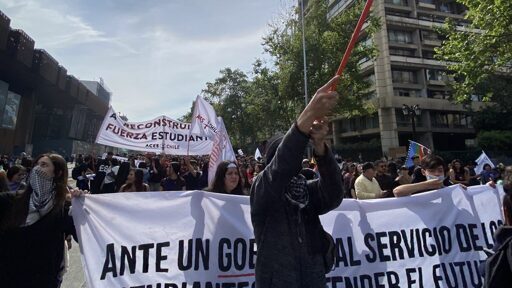

Tens of thousands of students took to the streets of Chile on Thursday, October 1, to demand that the government of the ultra-conservative José Antonio Kast not cut the education budget. More than 30 civil society organizations joined the call issued by the Chilean Student Confederation (CONFECHA) in support of the “national strike.”
Among the supporters were the United Workers’ Union (CUT), the Chilean Teachers’ Association, the High School Students’ Assembly, the 8M Feminist Coordinating Committee, the National Federation of Education Workers, and the National Association of Kindergartens, among others.
“We see that on September 30, the government presented a new bill to Congress, and the only certainties we have are the precedents set by this government in its first six months – which are cuts: cuts for working families, cuts for students in the areas of health, in education, housing, and social security,” said Laura Mlynarz, spokesperson for CONFECHA and president of the Chilean Student Federation.
She added: “In the face of that, we respond with social unity, we respond with organization, we respond with mobilization – especially in the face of an authoritarian government that refuses to listen to its citizens and refuses to create spaces for dialogue.”
The slogan “Not a single peso less for education” was chanted by thousands of people who filled Alameda Avenue, one of the main streets in the capital, Santiago. Kast, true to his neoliberal orthodoxy, announced budget cuts to Chile’s public education system.
In a presidential address, Kast announced the 2027 Budget Law, which calls for an investment of 17.3 trillion pesos in education – a figure lower than the 17.4 trillion allocated in 2026. While this may not seem like much, when inflation and other factors are taken into account, it may prove more alarming than it appears at first glance.
“These figures are insufficient and, I would say, misleading; they don’t even make up for a year’s loss in purchasing power,” said Mario Aguilar, president of the Chilean Teachers’ Association.
However, according to the president, the measure was taken to safeguard other social services: “We hope you understand that in the budget we have done everything possible to uphold social rights and that the issues of pensions and free education are covered. But when you protest, you also have to respect those who think differently.”
Kast is referring to the clashes between the police (Carabineros) and students that, according to some reports, resulted in at least 31 arrests.
But the student movement rejects Kast’s statements, which clearly place the blame for the clashes on the students. Laura Mlynarz said the government is seeking to silence the students through repression.
“This government criminalizes the student movement, and we are the ones who are most concerned about moving toward an equitable Chile – toward fair, dignified, and solidarity-based development,” said Mlynarz. Regarding Education Minister Aria Paz Arzola, she said: “The minister doesn’t want to listen to us; the minister doesn’t want to meet with us; and the precarious state of public education just keeps getting worse.”
The first incidents of violent repression were reported just a few minutes after the rally began. The police fired tear gas canisters, while students with their faces covered threw the tear gas canisters back and hurled other objects. The police also used water cannons, a move described as “brutal repression” by some media outlets.
Clashes were also reported between the protesting students and groups of right-wing students from private universities who, in support of Kast’s far-right government, asserted that “We don’t want a paralyzed Chile; we want a Chile that prospers.”
In this way, the Chilean student movement once again made its presence felt in the South American country and demonstrated that it still retains a significant portion of its capacity to mobilize in the face of attempts to radicalize the neoliberal model, as has happened in past years.
In 2019, tens of thousands of Chilean students launched a full-scale social uprising demanding profound changes in one of the key countries where neoliberalism was institutionalized thanks to the bloody Pinochet dictatorship (1973–1990), which left thousands dead and missing. The protests led to calls for a Constituent Assembly.
For now, Kast has attempted to implement his neoliberal agenda (which includes cuts to education and other social services) cautiously, mindful of the recent past and fearful of a new outbreak of unrest.
From BT News via This RSS Feed.