

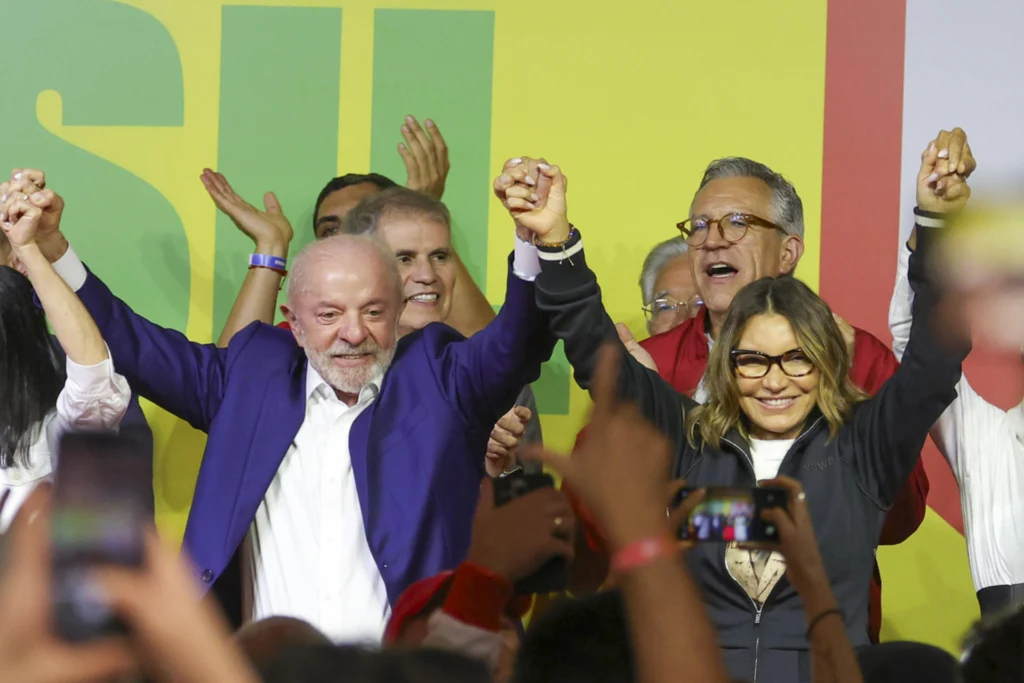
Brazil’s President Luiz Inácio Lula da Silva acknowledged on Sunday night that finishing second to Flávio Bolsonaro in the first round was an “unexpected” result, and said a new campaign begins Monday ahead of the October 25 runoff.
Speaking at an event at the Renaissance Hotel in São Paulo’s Jardins neighborhood, Lula said he had been convinced he would win in the first round.
“Starting tomorrow, we begin a new campaign, between only two candidates, where we can show the difference between the proposals that exist for Brazil,” he affirmed.
RELATED: Flávio Bolsonaro Promises Fewer Ministries as Brazil Vote Goes to Runoff
According to the count, Bolsonaro collected more than 56 million votes, while Lula received more than 53 million. Since neither candidate managed to exceed 50% of the valid votes, both candidates will have to decide on the presidency in a run-off scheduled for October 25.
“We have just received a lesson on democracy in Brazil with the vote of the Brazilian people”, Lula stated. “Sometimes the outcome is unexpected. I was convinced that I could get a direct victory,” he admitted.
Lula said he had hoped to win outright in past elections too, citing 1989, 1994, 1998, 2002, 2010, 2018 and 2022, but it did not happen. “I am good at the knockout rounds,” he said. “The game has begun. Now we are in extra time. We will convince the Brazilian people that we must continue.”
Ver esta publicación en Instagram
Una publicación compartida de teleSUR English (@telesurenglish)
Brazilian President Luiz Inácio Lula da Silva set out his strategy for the October 25 runoff on Sunday night, contrasting his decades of political experience with what he called the “uncertainty” and “dark past” of his opponent, Flávio Bolsonaro.
In his sense, Lula detailed the themes on which he intends to fight the second round: education, research, technology and industrial policy. He promised to continue investing in universities, federal institutes and secondary education, and said he would seek to expand Pé-de-Meia, a program aimed at reducing school dropout rates. He also promised to focus on a technology project built on rare earths and critical minerals, a new oil discovery and a new Brazilian industry.
“It will be through education that we are going to change this country,” Lula said. He also linked education to expanding Brazil’s productive and technological capacity and reaching a higher level of social well-being.
Hunting for Votes
The campaign now enters a three-week phase in which both candidates must broaden their alliances and try to win over more voters. The left rallied behind Lula to try to stop the return of the far right to power, but much of the vote from minor candidates who failed to reach the runoff is expected to go to Bolsonaro.
The Brazilian President also drew attention to abstention. Roughly 28 to 33 million people did not vote, out of about 160 million eligible voters, according to figures cited in different reports. “Voting is necessary right now to define the future of this country,” he told supporters.
Lula sought to project optimism to his base, which also did not expect the result and had even dreamed of winning in the first round. “A new campaign begins tomorrow,” he affirmed.
Ver esta publicación en Instagram
Una publicación compartida de teleSUR English (@telesurenglish)
The new vote on October 25 will decide who holds the presidency of Brazil for the next term. Both camps now face a short window to define their messages, consolidate support and persuade undecided or disengaged voters.
For Lula, who built his career as a union leader before reaching the presidency, the challenge is to turn a narrow first-round deficit into a runoff victory. For Bolsonaro, the task is to hold his lead and expand his coalition beyond the vote he won on Sunday.
From teleSUR English via This RSS Feed.