

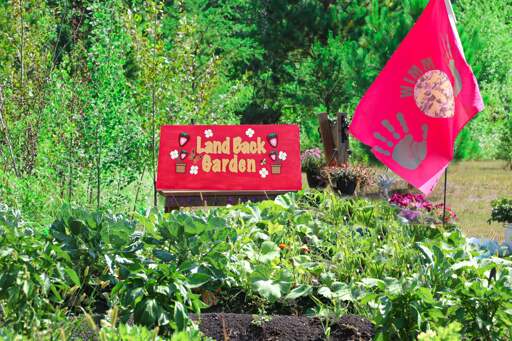

Anishinaabe Elder Gwawich’s Land Back Garden on the outskirts of the Grassy Narrows First Nation. Photo by Taina Da Silva
I’m thinking about the power of my treaty rights as I drive to meet with Anishinaabe Elder Gwawich — Roberta Keesick — on a late summer day on the outskirts of Grassy Narrows.
Gwawich is an activist and trapper who has substantial experience of being on the land and creating land-based learning systems for our community. She grew up in our territory with a traditional Anishinaabek family, and she works to restore our traditional ways.
As I pull into the site, Gwawich offers me some ripe vegetables — a squash, green beans and tomatoes — that she’s harvested from an extensive garden nearby.
Gwawich and I are ten minutes outside of the reserve line of Grassy Narrows First Nation, a small and semi-remote community in northwestern Ontario. We sit at an off-grid campsite and community garden which Gwawich started by herself to host her Seven Grandfathers Teachings Program.
The Seven Grandfather Teachings — love, respect, bravery, truth, honesty, humility, and wisdom — are what Gwawich’s social program follows, and she hopes her program will impact Grassy in a way that will bring us Anishinaabek back to the land and culture.
“Colonization has changed our ways of thinking,” she says.

A lake in the traditional homelands of Grassy Narrows First Nation. Photo by Taina Da Silva
As the lake glistens in the background, Gwawich talks about how she is determined to decolonize our community from decades of learned behaviour — stemming from the reserve system that relocated people in our community, to the residential “school” system and devastating mercury pollution, which have all been an upheaval to our traditional ways.
Her campsite is available for any band members who want to get away from the reserve, and the garden is another free resource where members are often invited to pick fresh food.
“Land Back Garden” is painted on a wooden sign and it sits front-and-centre of the garden. Another sign near the campsite greets visitors to the “Seven Grandfather Teachings Program — Land Based Family Healing Initiative.”
This program is how families from Grassy are now able to access different opportunities designed to bring land based learning to the community, and it is what our aboriginal land title permits us to do in our territories.

Anishinaabe Elder Gwawich’s program is helping Grassy Narrows members return to their traditional ways. Photo by Taina Da Silva
What started as a community-wide gardening initiative in 2020 has grown into the off-grid garden and campsite, a monthly food program in the community, and a small sewing building right in the reserve — all operating through outside funding.
Children from the reserve are able to experience what it might have been like for the older generations to gather traditionally, share food, and play games like the old days — and with some contemporary additions.
Today, there are community events with bungee trampolines, rock climbing, horse rides and even a zipline, Gwawich tells me with true pride.
Gwawich speaks excitedly about a farmers’ market coming up, where she will be taking vegetables from the Land Back Garden to give away to Grassy families.
She reminds me that “being out on the land makes our rights stronger,” and that running the site is a way to protect the land — and our rights under Treaty 3.
This is an area of land which I mistakenly used to associate as a settler hunting camp on so-called “Crown land,” before I learned about traditional land use areas and our history of ancient rock paintings, burial grounds and artifacts found across our territory.
It takes community members like Gwawich to figure out ways to navigate the colonial systems that have been imposed on us, and decolonize our ways of thinking.
Gwawich remembers a time when the entirety of Grassy Narrows spoke our language and lived off trapping and fishing incomes when she was a child in the 1960s and 70s.
“Even my siblings were helping with trapping and fishing when they were nine and ten years old,” she said, and we laughed at the idea of that happening now — because that is a lost tradition for Anishinaabek families.
Residential “schools” — an intentional violation of our human rights — and the resulting language and culture loss are not easily forgotten about in our communities. Repairing the losses and devastation is not a simple feat; however, colonization will never deter people like Gwawich who are challenging the idea of total culture loss.
Grassy Narrows has a history of blockading our lands to stop logging, and finding our voice when it comes to holding people accountable for the mercury pollution that has harmed our community.

Ribbon ties near the garden. Photo taken and edited by Taina Da Silva
Treaty 3 guarantees our rights to hunt, trap and fish on our homelands. But those rights are often twisted — and this led to Gwawich getting charged by the Ministry of Natural Resources back in 2009 for building a small cabin on her trapline near Red Lake.
Red Lake is five hours away from Grassy, and Gwawich explains how it is part of our traditional homeland; however, since the 1970s there has been a shift in Grassy members using our territories.
Trappers are often people who are simply following what the government allows them to do, but Gwawich is a trapper activist who understands that we have treaty rights before trapper rights when we are out there on the land. The Ministry of Natural Resources (MNR) enforces a quota for trappers, but First Nations do not have these quotas if we choose to practice our treaty rights.
Unfortunately, there are some settlers that seem to muddy the system and confuse land rights with trapping or “Crown” rights.
A complaint was sent to the MNR about Gwawich’s off-reserve camp, but MNR realized it was Gwawich exercising her treaty rights which allows us to add shelters to our traditional territory — whether it is a trapline or not.
Obviously, our people have treaty rights. But in 2009 there was a legal dispute between the MNR and another Indigenous family in the province.
Gwawich’s case was eventually dropped when the other case won in court which proved First Nations peoples have the right to shelter and practice our rights. This made Gwawich truly realize how powerful our treaty rights are — and what it means for land protection and cultural revitalization.
“We have the right to be out there and we should protect it,” says Gwawich.
“We don’t need permits to build our shelters.”

Anishinaabe Elder Gwawich’s Land Back Garden is a demonstration of our sovereignty to utilize our lands — as guaranteed under Treaty 3. Photo by Taina Da Silva
Our right to use the land goes beyond what a trappers’ license permits because we are from this land, and we have been here surviving as best as we can.
“MNR doesn’t do anything because we are on our land,” Gwawich confirms.
Indigenous futurism can look like a lot of things, and in this case it means there is an Elder kwe (woman) who uses her treaty rights to garden and provide land based activities for community members.
More off-grid gardens are just one of the ideas that Gwawich wishes to pursue because it will mean our treaty rights are actively being accessed throughout our territory.
“Why not anywhere?” Gwawich asks, and we further discuss the idea of “culture back.”
Reintegrating food sovereignty through gardening seems like the most simple solution for culture back, but the act of using our land freely is what truly empowers our people.
Adding more off-grid campsites or shelters would be another solution. Also, land based activities are part of Indigenous futurism and culture back, which Gwawich hopes to continue as an Elder who wants to revitalize our community.
Gwawich is confident that regrowing our identity will emerge through programs like hers, while finding ways to promote land and culture back. The old ways seem replaceable in a way that does not look like the past of our ancestors, and due to the displacement from our traditional ways there are loopholes we need to discover to bring back some of the old ways.
Encouraging families to use the off-grid campsite and Land Back Garden will emulate what our ancestors were living like for hundreds of thousands of years.

Decolonizing can be as simple as taking a swim in our traditional waters, or eating food from the land. Photo by Taina Da Silva
Eating food from the land, swimming in the clear lake, and disconnecting from the online world are all small steps that us Anishinaabek can take to decolonize.
Talking to Gwawich about land rights brought out a refreshing sense of reality that treaty rights matter — outside the box of the Indian Act.
The Seven Grandfather Teachings Program plays a large role in repairing trauma within our community, and starting the process of decolonization.
Remembering what we lost through colonialism is crucial for us to understand how to cheat-code our way out of colonial ways of thinking. Trapping is one way Gwawich connects to the land, but after the charges against her were relinquished there was a spark in her to start using the land off-reserve and protect it.
Gwawich wishes to continue to promote the idea of land back and culture back through gardening and off-grid camps where community members grow their love for using the land again.
The future is a daunting topic because sometimes it feels hopeless to talk about our rights as Anishinaabek, but this conversation with Gwawich has brought up feelings of inspiration as she continues land based initiatives of her own and supports the initiatives of community members.
Her work has helped me to envision a future where everyone has some sort of off-reserve shelter in our territory, where we use the land similarly to the past, and continue community gatherings and events.

Vegetables sprout in the Land Back Garden. Photo taken and edited by Taina Da Silva
Using our treaty rights rather than ignoring our right to use the land will help us to reject colonial systems that tell us we are wrong for being who we are, and rebuild a future where we are able to continue to use our traditional territories without harassment from colonial forces.
I look around the territory surrounding us — with dense pine forests, sprawling blue sky and tall rock faces. The occasional blue jay flies by, and a chipmunk runs through the garden.
As we wrap up our conversation, Gwawich returns to tend to the garden which made me stop and think about the simplicity of taking care of our land.
We take care of this Land Back Garden, and in return it takes care of us.
The post Near Grassy Narrows, an Elder shows us how using the land also protects it appeared first on Indiginews.
From Indiginews via This RSS Feed.