

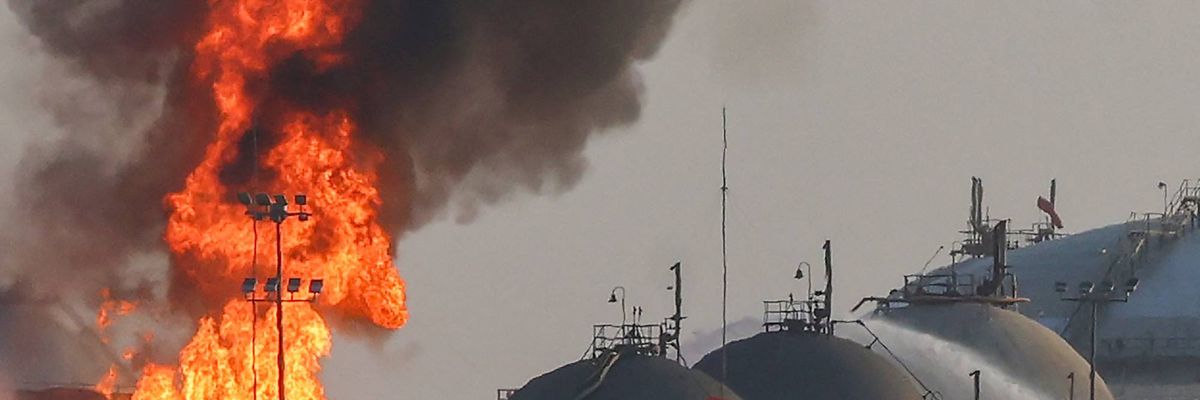
Yemen is spiraling back toward full-scale war after its Saudi-backed government launched a major offensive on Sunday to retake territory captured by the Iran-backed group Ansar Allah, also known as the Houthis.
President Rashad al-Alimi said the armed forces would seek to retake all Houthi-controlled territory, which is home to about 70% of Yemen’s population, including the capital Sanaa. He said the offensive would continue “until the country is liberated from the grip of the terrorist militia."
Houthi officials said Saudi forces have launched 50 air and missile attacks in the last 12 hours. As al-Alimi announced the new offensive, the Houthis responded by launching ballistic missiles and drones at Saudi Aramco oil facilities, including one near the capital Riyadh that was engulfed in flames.
Last month, the Houthis captured major strategic areas along the Red Sea coast, giving them unprecedented leverage over one of the world’s busiest shipping routes and adding to the economic stranglehold Iran is asserting by restricting travel through the Strait of Hormuz in response to US-Israeli attacks.
Earlier this month, it was reported that President Donald Trump had rebuffed Saudi Crown Prince Mohammed bin Salman’s request for the US to launch airstrikes against the Houthis.
However, US officials told Axios on Friday that the military is providing Saudi Arabia with “everything short of direct combat, mainly intelligence and targeting data.”
While the Saudis conduct a new campaign of airstrikes, Yemen’s government could reportedly mobilize as many as 100,000 troops, one of the largest military buildups since the 2022 truce that halted the nation’s brutal eight-year civil war.
That war, in which the US also provided extensive military support to a merciless Saudi air campaign, is estimated by the United Nations Development Program to have caused about 377,000 excess deaths by the end of 2021: 154,000 from the fighting itself and 223,000 from indirect effects such as hunger, disease, and the collapse of healthcare and basic infrastructure. An estimated 259,000 of those deaths were of children under 5.
Even before Sunday’s escalation, renewed fighting was already fueling a major displacement and hunger crisis. More than 149,000 people have been driven from their homes, according to the International Organization for Migration. Meanwhile, the World Food Program says fighting has disrupted food delivery routes, placing 18.3 million Yemenis at risk of acute food insecurity.
From Common Dreams via This RSS Feed.