

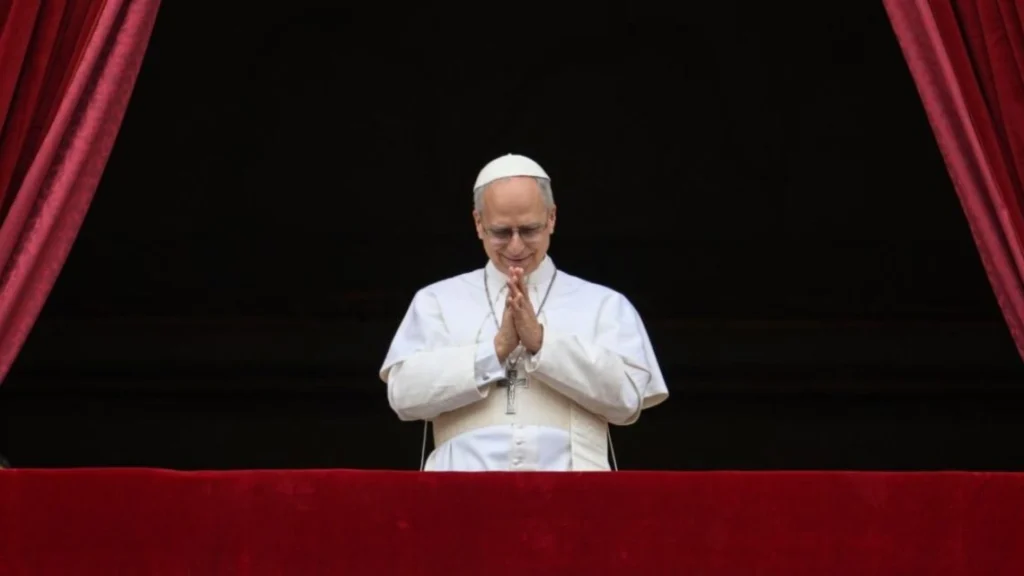
Pope Leo XIV peace appeal urges an end to war, prayers for the Holy Land and protection for innocent victims of violence worldwide.
Related: Pope Leo XIV vs France Abuse Crisis: 5 Urgent Steps for Church Accountability
Pope Leo XIV Peace Appeal: St. Francis’ 800-Year Legacy Challenges a World at War
Pope Leo XIV peace appeal called for wars to end and urged prayers for the Holy Land and “the innocent victims of violence” during the Angelus in St. Peter’s Square on Sunday, October 4. The message coincided with the 800th anniversary of the death of Saint Francis of Assisi, whose witness of fraternity and reconciliation the pontiff presented as urgently relevant in a world marked by armed conflict and civilian suffering.[vatican][vaticannews]
The appeal was not framed as an abstract religious reflection. By linking Saint Francis’ legacy to today’s wars, Pope Leo XIV peace appeal described peace as a collective moral responsibility—one involving believers, governments, institutions and societies alike.
The Pope renewed the call he made a week earlier in Lourdes, France, inviting Catholics and Christian communities to dedicate October to praying the Rosary “that wars may cease and that peace may be established among peoples in conflict.” He also called for the prayer to be accompanied by concrete acts of mercy, dialogue and reconciliation.[vatican][vaticannews]
Speaking from the Apostolic Palace before pilgrims in St. Peter’s Square, Leo XIV thanked children taking part in the international initiative One Million Children Praying the Rosary. He invited the faithful to follow their example and ask for the Virgin Mary’s intercession so that “peoples may be freed from the scourge of war.”[vatican][thegoodnewsroom]
“In particular, let us pray for the Holy Land and for the innocent victims of violence,” the Pope said. The wording did not name a particular armed actor or military operation, but it clearly placed the humanitarian impact of conflict at the center of the Vatican’s public concern.[vatican][vaticannews]
Pope Leo XIV Peace Appeal Centers Holy Land Victims
Official Vatican text of the October 4 Angelus | Vatican News report on the Angelus appeal | Vatican appeal from Lourdes
Pope Leo XIV peace appeal came at a time of acute international concern over the Holy Land, where violence, displacement, humanitarian hardship and deep distrust between communities continue to shape daily life.
The Pope’s direct reference to the Holy Land carries particular significance. It refers not only to a geographical territory, but to a region sacred to Jews, Christians and Muslims—and to people living amid the effects of war, uncertainty, restricted movement, loss and prolonged insecurity.
By emphasizing “innocent victims of violence,” the Pope reinforced a central humanitarian principle: civilians must not be treated as an incidental consequence of armed conflict. Children, families, older people, people with disabilities, patients and displaced communities bear a disproportionate share of war’s human costs.
The Vatican’s language has traditionally sought to keep attention on human dignity without reducing complex conflicts to a single political narrative. The Holy See’s position combines concern for Christian communities in the region with calls to protect civilians, respect humanitarian law, preserve Jerusalem’s special character and recognize the dignity and rights of both Israelis and Palestinians.
The Pope Leo XIV peace appeal therefore belongs to a broader diplomatic and moral approach. Prayer is not presented as a substitute for ceasefires, humanitarian access, hostage releases, negotiations or political solutions. Rather, it is paired with an appeal not to normalize violence or accept civilian suffering as inevitable.
The Pope’s message also reaches beyond the Middle East. His prayer for the victims of violence includes civilians affected by wars, bombardments, hunger, displacement and the destruction of hospitals, schools and essential services in multiple regions.
The mention of the Holy Land gives the appeal an immediate urgency, but it does not displace other crises. Instead, it highlights a global problem: the continuing use of war as an instrument of power and the inability of international institutions to consistently protect people who do not participate in hostilities.
The Rosary call has a wider communal meaning as well. To audiences unfamiliar with Catholic practice, it may appear to be only a devotional act. But in the Church’s tradition, collective prayer also creates a transnational network linking parishes, families, schools, migrant communities and humanitarian organizations around shared concerns.
The initiative involving children carries a particularly strong message. The people most exposed to the consequences of war are not portrayed merely as passive recipients of protection. They become voices calling adults, leaders and societies to reject war and protect human life.
On October 1, some 1,300 people—including about 700 children—gathered at the Lourdes Grotto in the Vatican Gardens to pray the Rosary in five languages. The event highlighted the experiences of children in Ukraine, families in Lebanon, Syria and the Holy Land, persecuted Christians in Pakistan, reconciliation efforts in South Sudan, and families in Cuba and Venezuela.[vaticannews]
Prayer alone does not end war. The practical test of the Pope’s call is whether it encourages real solidarity: humanitarian aid, protection for civilians, refusal of hate speech, support for dialogue and a willingness to defend those suffering outside the spotlight of daily news.
Saint Francis Offers a Path of Fraternity
Vatican News on Saint Francis and the Angelus | Official Vatican Angelus text | America Magazine report on the 800th anniversary
The date gave the Pope Leo XIV peace appeal special symbolic force. October 4 is the Catholic feast day of Saint Francis of Assisi, one of the most influential religious figures in Western Christianity and the patron saint of Italy.
This year marks the 800th anniversary of Saint Francis’ death. He died at the Portiuncula in Assisi on October 3, 1226, at the age of 45.[americamagazine]
Leo XIV welcomed the numerous initiatives organized for the anniversary, especially celebrations in Assisi attended by senior Italian state officials. He also greeted amateur radio operators in Assisi and Foligno who were helping transmit Saint Francis’ message of peace.
This detail reflects the Vatican’s effort to move the commemoration beyond formal liturgy. The anniversary is being used as a public conversation about fraternity, coexistence and reconciliation, not simply as a historical tribute.
In his reflection, the Pope described Saint Francis as a worker in the Lord’s vineyard who “repaired” the Church through faith in Jesus Christ and healed the “cracks of discord” through fraternal love.[vatican][americamagazine]
The image of repair has a double meaning. In Franciscan tradition, it refers to spiritual renewal: rebuilding a Church and society damaged by division, indifference and the pursuit of power. In today’s context, it also points toward repairing broken social bonds shaped by violence, exclusion and political hostility.
Saint Francis lived in medieval Italy, a period marked by conflicts among cities, class inequality, ecclesial tensions and power struggles. His response was not a geopolitical blueprint. It was a life centered on voluntary poverty, closeness to people who suffered, fraternity and what could be called an inner disarmament.
Eight centuries later, his legacy continues to resonate because it presents peace as more than the silence of weapons. Peace requires reconciliation, care for excluded people and the willingness to speak with those seen as opponents.
Saint Francis’ influence also extends beyond Catholic identity. He is widely associated with care for nature, dialogue between communities and an ethic of simplicity in a world shaped by consumption and environmental degradation.
Leo XIV used this broad legacy to describe peace as a process of building harmony among peoples, not as a fragile pause imposed by force. Vatican News said the Pope invited believers to “perseveringly ask for the gift of peace and sincerely commit ourselves to building harmony among peoples.”[vaticannews]
The Rosary as Public Mobilization
The Pope Leo XIV peace appeal places October at the center of a sustained campaign for prayer and peacebuilding. The Pope first made the invitation during his September 27 pilgrimage to Lourdes, where he asked all believers and Christian communities to pray the Rosary throughout the coming month.
His Lourdes message included a practical qualification: prayer should be accompanied by “concrete acts of penance and mercy” and a commitment to foster dialogue and reconciliation.[vatican][vaticannews]
That language is important because it rejects a passive understanding of faith. The Pope did not call for withdrawal from the world’s conflicts. He encouraged a moral response that combines spiritual reflection with practical solidarity.
The campaign One Million Children Praying the Rosary, supported by Aid to the Church in Need, runs from October 1 to October 7. It aims to mobilize children and families around prayer for peace, unity and communities suffering violence.[thegoodnewsroom][catholicconnect]
There is an unavoidable tension in such calls. Religious language can inspire solidarity, but it can also remain purely symbolic if it is not followed by meaningful action. The Pope’s appeal places responsibility on faith communities to ensure that prayers result in sustained attention to victims and support for reconciliation.
For Catholics, the month becomes a period of focused prayer. For public authorities and international actors, the message is an ethical warning against indifference. For humanitarian groups and communities living through conflict, it offers symbolic support for civilian protection and uninterrupted access to aid.
A Church Called to Repair
The Pope Leo XIV peace appeal also has an internal dimension for the Catholic Church. In his Angelus reflection, the Pope portrayed Saint Francis as someone who repaired divisions through love and whose spiritual legacy continues to bear fruit eight centuries later.
The Church faces its own disputes over doctrine, reforms, the role of women, responses to abuse, financial governance and engagement with secular societies. By emphasizing fraternity, Leo XIV suggested that disagreement must not be allowed to turn into hostility.
This is not a call for artificial uniformity. It is a proposal for what the Church calls fraternal correction: addressing differences while recognizing the equal dignity of those involved.
The Vatican also announced that the Pope will convene the heads of Eastern Catholic Churches and presidents of bishops’ conferences for a synodal process of discernment. The meeting will coincide with the 10th anniversary of the apostolic exhortation Amoris Laetitia and will focus on families, the transmission of faith and accompanying younger generations.[vatican][ground]
The announcement complements the peace message. In the Pope’s approach, harmony is not created only through international negotiations. It begins in families, religious communities, schools and everyday social relationships.
Geopolitical Context: From Symbol to Action
The Pope Leo XIV peace appeal turns the anniversary of Saint Francis into an intervention in contemporary global affairs. By calling for the end of wars and directing attention toward the Holy Land, the Pope connected spirituality, fraternity and public responsibility in a period of widening conflict.
The geopolitical importance lies in the Vatican’s role as a moral and diplomatic actor. The Holy See does not possess military power, but its statements can influence public debate, mobilize faith-based humanitarian networks and support diplomatic principles such as civilian protection, dialogue and respect for international humanitarian law.
The appeal also highlights the limits of military logic. No military gain can justify treating civilian lives as expendable. The Pope’s framing insists that durable peace requires repairing damaged relationships, protecting vulnerable people and refusing to make hatred or violence a normal part of public life.
Eight centuries after Saint Francis’ death, Leo XIV returned to one of the saint’s hardest lessons: peace is not passivity in the face of injustice, nor merely the absence of gunfire. It is an active commitment to human dignity, reconciliation and the defense of those who suffer most when wars are allowed to continue.[vatican][vaticannews]
From teleSUR English via This RSS Feed.