

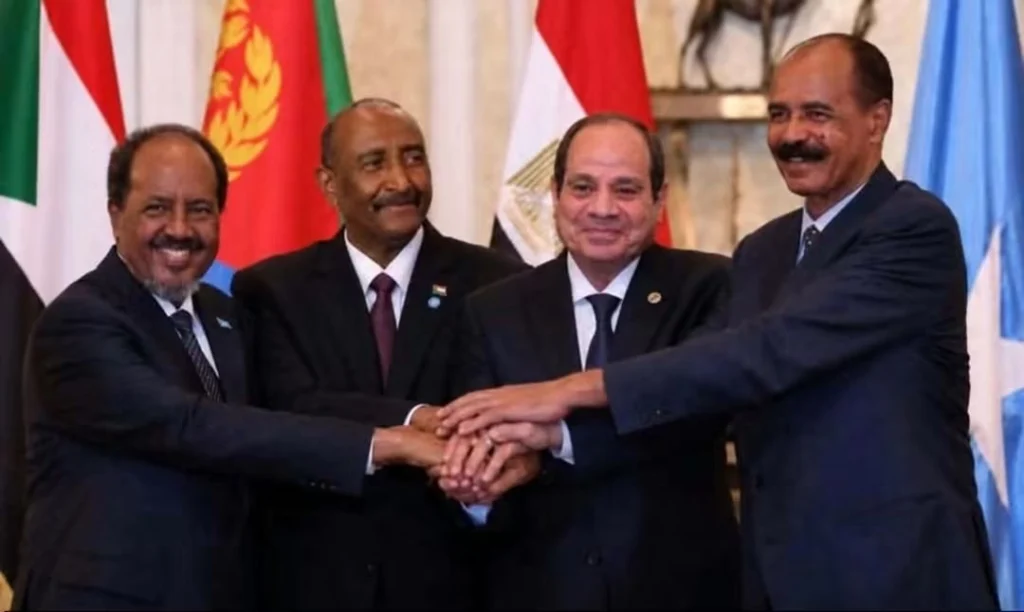
The leaders of Egypt, Sudan, Eritrea and Somalia rejected at a four-party summit on Sunday any unilateral measures that would undermine current uses of water from the Nile River, at a time of great tension between these countries and Ethiopia precisely because of the construction by Addis Ababa of the Great Ethiopian Renaissance Dam (GERD).
[Egypt Warns Ethiopia Not To Allow It To Control the Nile: Egypt, Sudan, Eritrea and Somalia Reject Ethiopia Unilateral Actions on the Nile](https://www.telesurenglish.net/egypt-sudan-eritrea-and-somalia-reject-ethiopia-unilateral-actions-on-the-nile/)
Egyptian President Abdelfatah al Sisi received Eritrean President Isaias Afwerki, Somali President Hassan Sheikh Mohamud, and the President of the Transitional Sovereign Council of Sudan, Abdelfatah al Burhan, this Sunday in the Mediterranean city of New Alamein, within the framework of the Eighth Mid-Year Coordination Summit of the African Union (AU).
At the conclusion of the meeting, the leaders emphasized the importance of “respecting international law on transboundary rivers, including the Nile River, particularly the principle of not causing significant harm and the obligation to cooperate through prior notification, consultation, and consensus,” according to a joint statement released by the Egyptian Presidency.
They also “categorically rejected any unilateral measures that undermine the current water uses of the Nile riparian states,” which include Egypt, Sudan, and Eritrea.
They also agreed to “continue strengthening consultation and coordination among the four nations and other brotherly African states.”
Egypt, Sudan, Eritrea and Somalia agreed to reject unilateral measures that harm existing uses of Nile waters and reaffirmed their commitment to international law and prior consultation over transboundary rivers, in a direct message to Ethiopia over the Grand Ethiopian… pic.twitter.com/ETitNJZWyF
— khaled mahmoued (@khaledmahmoued1) October 4, 2026
The meeting takes place at a time of great tension between Egypt, Sudan, and Eritrea, on one hand, and Ethiopia, on the other, due to accusations from Addis Ababa against these states of supporting armed groups and opposition factions clashing with the regular army in the north of the country, which these countries deny.
Relations cooled between Cairo and Addis Ababa due to the construction of the Grand Ethiopian Renaissance Dam and its plans to establish other hydroelectric megaprojects for economic development and to turn the country into Africa’s largest electricity exporter.
Egypt, which depends on the Nile for more than 90% of its drinking water supply, considers that the Ethiopian projects will reduce its water share, and therefore warns that it is an “existential threat” and a “matter of national security and survival,” the Presidency indicated in a previous statement.
The four leaders also addressed the situation in Sudan and Somalia and expressed their support for the unity, sovereignty, and territorial integrity of both countries, while rejecting any attempt to create parallel entities or recognize the secessionist region of Somaliland.
From teleSUR English via This RSS Feed.