

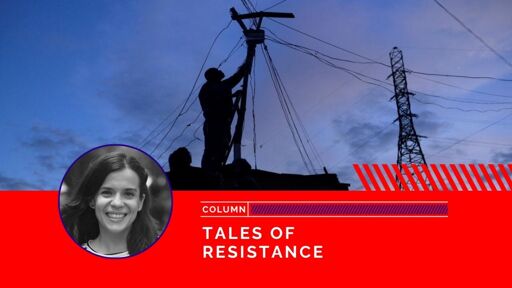
Friday morning. The electric fluctuations were so frequent that I decided to go to the gym and work out for a bit. Though I was tempted to get angry with my work being interrupted, I remembered that Caracas is a bubble when it comes to electricity. In other parts of the country, blackouts happen sometimes twice a day, sometimes lasting for 16 hours in total.
In their anguish, people have taken to the streets, burning tires and blocking highways. Without fans or air conditioning it is hard to survive the Super El Niño phenomenon, which recently joined our catalog of misfortunes by raising temperatures across the board. Children who can’t sleep at night end up falling asleep in school the next day.
Not only that, these blackouts and power surges damage appliances and put water pumping stations offline, leaving communities without water supply. What makes everything worse is that authorities do not publish rationing schedules, making it impossible for families and businesses to undertake any minimal planning.
To “explain” things, the acting Delcy Rodríguez government celebrated the fact that national electricity demand exceeded 16,424 megawatts (MW) on September 22, calling it a “historic milestone” and highlighting a 9% increase compared to the peak demand in 2025.
What officials failed to mention is that in 2013 Venezuela recorded a demand of 18,700 MW, far, far higher than the figure announced this month, without any blackouts.
Furthermore, the supposed economic improvement is that oil production rose to 1.23 million barrels per day, but it appears that the United States is the only one benefiting from the additional revenue. The vast majority of the Venezuelan population is seeing absolutely no economic benefit, neither before nor after the twin earthquakes. Between shady business deals and power outages, we are truly in the dark.
Meanwhile, Interior Minister Diosdado Cabello assured that he “wouldn’t sugarcoat things for the people” and admitted that the electricity crisis “is a serious problem.” However, his solution was to ask mayors and governors to request that private companies with power plants generate their own electricity. We will then surely see a “record high” diesel demand, which will leave the agricultural sector without fuel.
The truth is that the blackouts are causing massive paralysis, costing the industrial sector up to 44% of its productive hours. In a country that has advocated “economic diversification” for years, the little energy that is available is prioritized to keep oil production going in the oil-producing regions – lest Trump and the corporations get upset – and to try and mitigate the impact on the country’s capital.
What is rarely mentioned is that although Venezuela has a nominal installed capacity of approximately 35,000 MW, a figure that doubles the national peak demand, actual stable generation barely reaches 12,000 MW. This operational deficit is what causes the constant blackouts the population is currently enduring. The 1,300 MW that the authorities promise to bring back online in the coming months will only slightly alleviate the issue.
The deterioration of the National Electric System (SEN) is structural and affects both transmission and distribution. The transmission grid exceeds its technical safety limits almost daily by transmitting more power than allowed, causing voltage fluctuations. At the same time, the distribution system has been deteriorating for years. There is a shortage of basic spare parts, transformers, and distribution cables resulting from years of US sanctions.
To add to the paradox, what is the proposed solution? Privatization! At a time when service is at its worst, the National Assembly has preliminarily approved reform of the Organic Law of the National Electricity System and Service to open up generation, transmission, distribution, and commercialization to private operators. The incentive is a new tariff structure designed to reflect “the real costs” of the service and generate “reasonable returns” for investors.
Truth be told, if we were to pay “the real costs” of the current service, we would have to be compensated day after day. Perhaps people will go from having no electricity due to the condition of the power grid to having no electricity because they cannot afford the bill.
Even in a country where we’ve grown accustomed to hearing extravagant promises – ranging from millions of barrels of daily crude output to imminent economic prosperity – the outlook for electricity is far from encouraging. Preliminary assessments from experts suggest that a complete overhaul to prevent blackouts and modernize the grid in the medium and long term could cost up to $40 billion.
Maybe the US would be willing to “lend” us some of our own money to do this? Even if it did, we would obviously have to do it through US corporations, because if there’s one thing Washington knows how to do, it’s paying itself and keeping the change.
The best example is the recent oil deal, “the biggest in history” according to Trump. From what has been reported, Venezuela is going to hand over 17 prime oil fields, some producing extra-heavy crude in the vast Orinoco Belt and others producing light crude in Lake Maracaibo, to a company that seems straight out of a lazy Hollywood movie script.
The company in question is NABEP, owned by Alejandro Betancourt – who deserves a column all to himself – and which will now be under the control of the Pentagon. The US will have preferential access to the oil produced, including 20% at cost. The most screwed-over country in the hemisphere, handing over subsidized oil to the superpower that kept it under a vicious blockade for more than a decade.
Which brings us back to the electricity problem. From the oil deal to the state of the electrical grid, propagandists want us to believe that once the US is satisfied, once the transnational corporations and their local allies are making enough money, things will improve for the Venezuelan people. We have seen that movie before and it turns out differently. Let the last one out turn off the lights.
Jessica Dos Santos is a Venezuelan university professor, journalist and writer whose work has appeared in outlets such as RT, Épale CCS magazine and Investig’Action. She is the author of the book “Caracas en Alpargatas” (2018). She’s won the Aníbal Nazoa Journalism Prize in 2014 and received honorable mentions in the Simón Bolívar National Journalism prize in 2016 and 2018.
The views expressed in this article are the author’s own and do not necessarily reflect those of the Venezuelanalysis editorial staff.
The post Last One Out, Shut Off the Lights appeared first on Venezuelanalysis.
From Venezuelanalysis via This RSS Feed.