

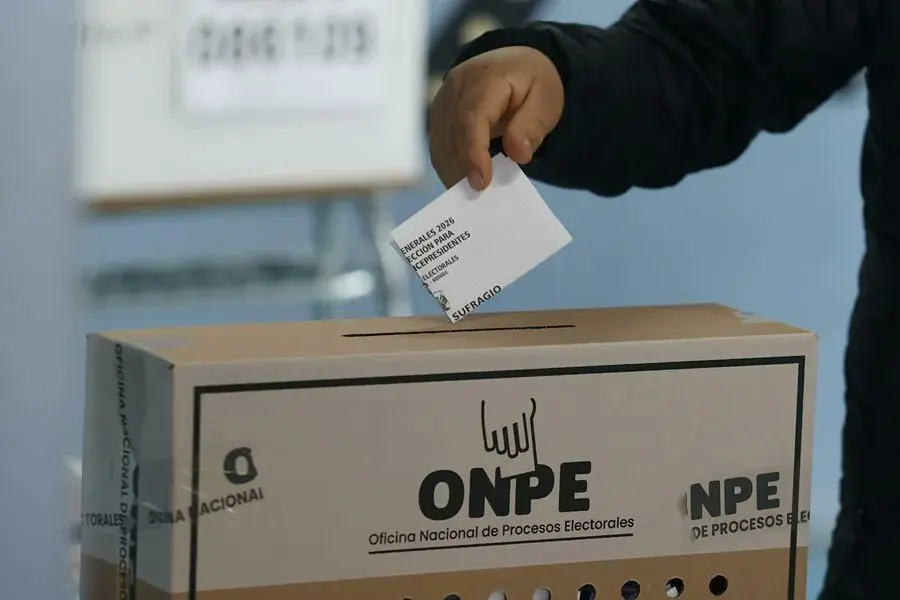
Voting in Peru’s municipal and regional elections began this Sunday, where more than 26.3 million Peruvians will choose 25 regional governors, 196 provincial mayors, and 1,892 district mayors for the 2027-2032 period.
[Peru Unions Mobilize Against Fujimori Government Policies: Peruvians Head to the Polls In Regional Elections](https://www.telesurenglish.net/peruvians-head-to-the-polls-in-regional-elections/)
Starting at 7:00 local time (12:00 GMT), more than 10,700 polling centers installed in Peruvian territory began to open, which will receive voters over ten hours, until 17:00 local time (22:00 GMT), at which time the polls will close and a slow scrutiny is expected to begin.
In Lima, the far-right former presidential candidate Rafael López Aliaga is the favorite to become mayor of the capital again, despite the Constitution prohibiting repeat terms, a controversy that is also repeated among dozens of mayors seeking a “hidden re-election” without the electoral authorities having ruled against it so far.
🗳️ ¡Listos para las Elecciones Regionales y Municipales 2026!
💙 Este sábado 3 de octubre, nuestros #ChalecosAzules iniciaron desde temprano el acondicionamiento de los locales de votación en todo el país, instalando ánforas, cabinas, señalética y mobiliario. #ERM2026 pic.twitter.com/139yrxwZcG
— ONPE (@ONPE_oficial) October 4, 2026
Voting starts at 7:00 a.m. and ends at 5:00 p.m. across the country. After 17:00, new voters are not allowed in, but those already inside the polling station will still be able to cast their vote.
The department of Lima has the largest number of voters with 8,713,671, followed by La Libertad and Piura, while Madre de Dios has the smallest number with 150,073 voters.
93% of the 97,317 candidates are people without previous experience in popular election positions, which indicates a massive renewal. The National Police of Peru is in charge of the security of the process, and the ONPE and the JNE supervise the logistics and operation through 125 decentralized offices.
The official results will be progressively disseminated after the closing of the polls through the digital platform enabled by ONPE. National Office of Electoral Processes (ONPE) offers its institutional website (www.onpe.gob.pe and erm2026.onpe.gob.pe) and a consultation platform for bureaux and members (consultaelectoral.onpe.gob.pe).
From teleSUR English via This RSS Feed.