

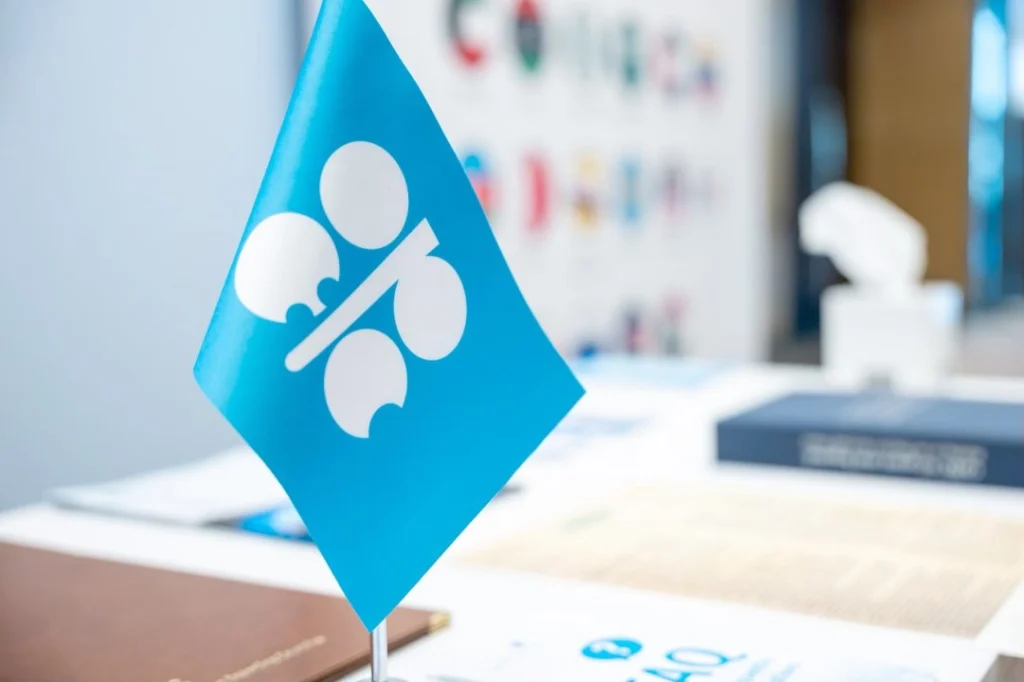
The OPEC+ alliance, led by Saudi Arabia and Russia, decided this Sunday to maintain its crude oil supply level unchanged in November, for the second consecutive month.
[Venezuela and OPEC Fund Assess Partnerships to Address Climate Change: OPEC+ Decides To Keep Its Oil Supply Frozen in November](https://www.telesurenglish.net/opec-decides-to-keep-its-oil-supply-frozen-in-november/)
The decision, identical to the one adopted a month ago for October, was agreed upon by the sector ministers of Saudi Arabia, Russia, Iraq, Kuwait, Kazakhstan, Algeria, and Oman, as reported by the Vienna-based Organization of the Petroleum Exporting Countries (OPEC).
These are seven key partners of OPEC+ who, in more than a year, have gradually reversed, up to and including last September, two voluntary production cuts—totaling 3.85 million barrels per day (mbd)—that they applied in 2023 to shore up crude prices.
With today’s decision, the September supply level remains frozen until November inclusive, the ministers stated in their final declaration.
68th Meeting of the Joint Ministerial Monitoring Committee
Read Press Release➡️https://t.co/14X0EMiTdP
— OPEC (@OPECSecretariat) October 4, 2026
‘The Seven’ will continue to hold monthly meetings “to analyze market conditions. The next meeting will take place on November 1, 2026,” they added.
At the end of that same month—November 30—the plenary ministerial conference of all 21 members of the OPEC+ alliance will take place to review the cuts that are still in effect until December 31, decided at the end of 2022 for a total of 2 mbd.
The objective will be to set new production quotas starting January 1, 2027, that better reflect reality, as a gap has opened between the figures on paper and physical production due to supply disruptions in the Persian Gulf caused by the wars in Iran and Yemen.
The prolonged and violent crisis, and especially the blockades of maritime traffic through the Strait of Hormuz and the Red Sea, has diminished the production and export capacity of many OPEC members.
According to the latest calculations published by the organization, in August the group’s total production stood at 24 mbd, a level that, while increasing by 1.46% compared to the previous month, is 15% lower than in January, just before the US and Israeli attacks on Iran that caused the war began.
From teleSUR English via This RSS Feed.