

Caracas (OrinocoTribune.com)—The acting president of Venezuela, Delcy Rodríguez, reaffirmed the country’s historical rights over the Essequibo territory on Saturday, October 3, the day Venezuela remembered 127 years of the Paris Arbitration Award that Caracas condemns as a fraudulent instrument of colonial dispossession.
In a social media post, Rodríguez reiterated that Venezuela recognizes the 1966 Geneva Agreement as the only valid legal framework for resolving the territorial controversy with Guyana through a “practical, satisfactory and mutually acceptable arrangement for both parties.”
“Venezuela will not endorse the anachronistic repetition of this territorial fraud through Guyana’s unilateral action before the ICJ. Any effective solution must arise from negotiations between both countries,” she stated.
Later, Venezuela’s Ministry for Foreign Affairs released a statement reaffirming its rejection of the 1899 Arbitration Award and its commitment to defending the country’s territorial rights.
“127 years after that artifice, vitiated by nullity from its origins, Venezuela ratifies its historical rights over Guayana Esequiba,” the statement read. The ministry called upon Guyana for direct dialogue under the Geneva Agreement, with the aim of resolving the controversy and establishing stable relations based on cooperation and shared economic development.
Guyana’s position and the pending ICJ ruling
Guyana brought the case before the International Court of Justice (ICJ) in March 2018, with the aim of establishing the validity of the 1899 award and the borders that it established. Venezuela continues to reject the ICJ’s jurisdiction in the case while participating in the proceedings so that Venezuela’s position can be heard by the international community. At the same time, Venezuela maintains that its participation in the proceedings does not constitute acceptance of the ICJ’s authority. Oral hearings concluded on May 11, 2026, and the court is now deliberating, according to the Department of Public Information of Guyana.
Guyanese President Irfaan Ali said in September that he hoped for a ruling early in 2027 and expressed confidence in Guyana’s case. Georgetown maintains that the 1899 award remains valid and argues that the Geneva Agreement authorized the UN secretary general to select judicial settlement after earlier diplomatic efforts failed. It therefore considers the ICJ proceedings consistent with that agreement, an interpretation disputed by Venezuela, which considers that Guyana’s ICJ case violates the letter and spirit of the 1966 Geneva Agreement that had been recognized by Guyana.
The controversy unfolds in the backdrop of the expansion of US oil interests offshore Guyana. ExxonMobil operates the Stabroek block and holds a 45% stake in its consortium. Venezuelan President Nicolás Maduro has repeatedly denounced the oil multinational’s influence in the ICJ case and the involvement of the US Southern Command, calling them drivers of provocations against Venezuela and its territorial rights.
Foreign Minister Yván Gil: Venezuela Has Historically Demonstrated Sovereignty Over Essequibo
The 2023 popular mandate
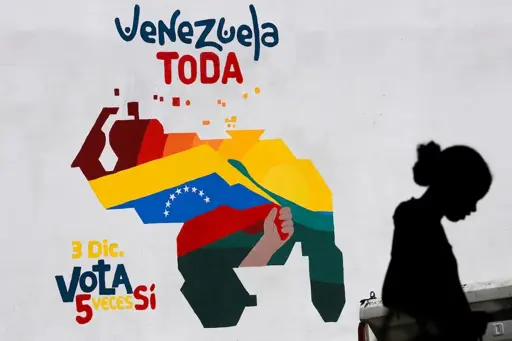
Venezuela’s defense of Guayana Esequiba also rests on the consultative referendum held on December 3, 2023. All five questions in that referendum received more than 95% approval, meaning that an overwhelming majority of voters support Venezuela’s measures defending its sovereign rights over the disputed territory.
Voters endorsed rejection of the 1899 award and the ICJ’s jurisdiction, reaffirmed the Geneva Agreement, and backed opposition to Guyana’s unilateral extraction of resources in the undelimited maritime areas. Voters also approved the creation of the state of Guayana Esequiba and measures to grant Venezuelan citizenship to its inhabitants. President Maduro had celebrated the result as a popular mandate to advance the country’s historical claim.
The full unofficial translation of the Venezuelan Foreign Ministry statement follows:
The Bolivarian Republic of Venezuela reaffirms before the international community its historic, firm, and irrevocable rejection of the null and void, fraudulent Paris Arbitration Award of 1899.
One hundred and twenty-seven years after that contrivance, invalid from its inception, Venezuela ratifies its historical rights over Guayana Esequiba and reaffirms the full validity of the 1966 Geneva Agreement as the only valid legal framework for resolving the territorial controversy through a practical, satisfactory, and mutually acceptable settlement.
Venezuela reiterates its invitation to direct dialogue with the Cooperative Republic of Guyana as the only path toward establishing solid and stable foundations for good neighborly relations, cooperation, shared economic development, and the promotion of investment in the region.
The Venezuela’n sun rises in the Essequibo!
Caracas, October 3, 2026
Special for Orinoco Tribune by staff
OT/JRE/SC
From Orinoco Tribune via This RSS Feed.