

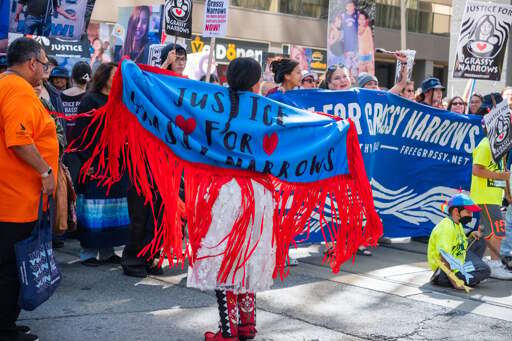

On Wednesday, Sept. 23, members of Grassy Narrows First Nation, Whitedog, and organizers in Tkarón:to came together for the annual Grassy Narrows River Run. Photo by Daniel Opasinis
On the front lawn of Queen’s Park in Tkarón:to stands a tall statue of Sir James Pliny Whitney, Ontario premier from 1905 to 1914, whose government promoted mining and forestry development in northern Ontario.
Over a century later, Glenn Cameron, councillor for Wabaseemoong First Nation (Whitedog), stood below that same statue. Holding a microphone connected to a portable sound system, he addressed a crowd gathered to demand action on the mercury contamination that continues to affect his community.
On Wednesday, Sept. 23, members of Grassy Narrows First Nation, Whitedog, and organizers in Tkarón:to came together for the annual Grassy Narrows River Run. They are calling on Ontario and “Canada” to fairly compensate people in Grassy Narrows for the mercury crisis and stop the Dryden mill.

People rally for justice for Grassy Narrows in Toronto on Sept. 23. Photo by Daniel Opasinis
Between 1962 and 1970, Dryden Chemicals Limited discharged approximately nine tonnes of mercury into the Wabigoon River. The contamination spread through the river system, poisoning fish that people in Grassy Narrows and Wabaseemoong relied on for food and their livelihoods.
Eating contaminated fish exposed people to methylmercury, a highly toxic form of mercury that accumulates in the food chain and can damage the brain and nervous system. Exposure during pregnancy can also harm developing children.

People rally for justice for Grassy Narrows in Toronto on Sept. 23. Photo by Daniel Opasinis
Earlier that day, participants gathered in Grange Park in the downtown core holding signs and papier-mâché fish. Some played instruments as people got to know one another. It wasn’t long before the crowd filed along McCaul Street, led by a banner reading “Justice for Grassy.”
At the head of the march, participants carried photographs fixed to wooden dowels of loved ones from Grassy Narrows and Whitedog who had died.
Cameron said malnutrition and mercury contamination from the Dryden Pulp and Paper Mill have been a constant concern within his community.

People rally for justice for Grassy Narrows in Toronto on Sept. 23. Photo by Daniel Opasinis
“Now, you can actually see the effects of it — from 1970 and onward,” Cameron said. “A lot of birth defects, a lot of problems in the community, the body, nerve, eyesight, you name it.”
Research conducted with Grassy Narrows has examined how exposure before birth may affect vision decades later. A study published in the International Journal of Environmental Research and Public Health compared adult retinal scans with historical measurements of mercury in participants’ umbilical-cord blood. Among the 59 participants studied, higher prenatal exposure was associated with thinner retinal layers in adulthood.

People rally for justice for Grassy Narrows in Toronto on Sept. 23. Photo by Daniel Opasinis
Outside of the Native Canadian Centre’s Dodem Kanonhsa’ — a cultural facility dedicated to Elders and knowledge preservation — the march paused to honour community members who had died, with non-Indigenous allies invited to sit in the roadway for a moment of silence.
The march resumed along Bay Street, with protestors chanting in unison.
“What happens to the water—happens to the people!”
People chant in unison at the rally on Sept. 23.
Continuing along University Avenue, the crowd finally settled outside the Ontario Legislative Building at Queen’s Park.

People rally for justice for Grassy Narrows in Toronto on Sept. 23. Photo by Daniel Opasinis
“We travel from afar. Whitedog and Grassy united together as one. To fight this process of getting the provincial government and the federal government on board to do something about this,” Cameron said.
Organizers in the city had been instrumental in planning the rally, Cameron added.
“Being one, as we walked through this corridor, and we all sat down, gathered here. That was the message today.”

People rally for justice for Grassy Narrows in Toronto on Sept. 23. Photo by Daniel Opasinis
The mill’s wastewater remains central to the shutdown demand. A 2024 study led by Western University researcher Brian Branfireun found that sulphate and organic matter in mill effluent increase the conversion of mercury already in contaminated river sediments into methylmercury. Eliminating those discharges would reduce the problem, the report found, although the historical contamination would still require cleanup.
IndigiNews reached out to the Dryden mill for comment but did not receive a response by publication time.

Grassy Narrows First Nation Chief Sherry Ackabee addresses the crowd. Photo by Daniel Opasinis
Invited by organizers, Grassy Narrows First Nation Chief Sherry Ackabee stepped in front of the crowd.
“We need their mill shut down, because that’s where all the poisoning is coming from, and it’s still open today,” Ackabee said as a chant broke out.
“Shut it down! Shut it down!”
The post Grassy Narrows River Run brings demands for mercury justice to Tkarón:to appeared first on Indiginews.
From Indiginews via This RSS Feed.