

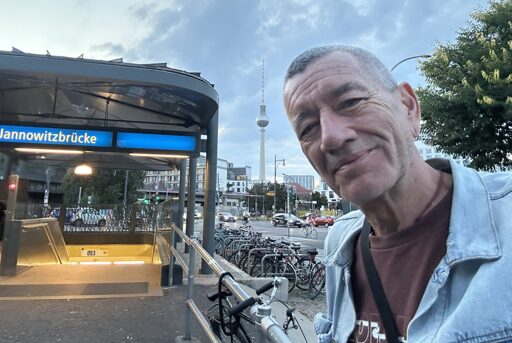

Tainui Stephens, a happy temporary resident of Tempelhof and Kreuzberg, Berlin, where he spent several weeks this year, writing. (Photo supplied)
Tainui Stephens has been telling Māori stories since the 1980s — through TV programmes like Waka Huia and Koha*, through his extensive body of docos and feature films, and in more recent years, through his regular columns for* E-Tangata*. Now, some of the best of those stories are in a book,* Kua Tau*, published by Bridget Williams Books and launched in Ōtaki last week. Here’s Tainui talking to Dale.*
Tēnā koe, Tainui. I’ve really enjoyed your book, man. You’ve lived a life!
Thank you, mate. Yeah, it comes as a bit of a surprise when you see it all in one place, I suppose.
It’s a collection of lovely and accessible stories. Tell us about developing your own style of writing commentary of this type.
In the broadcasting business, you do a lot of writing — proposals, scripts. You try to distil your writing, to be concise. Sometimes you write to get a yes out of someone. So, writing has been a part of what I do. And there came a point in my life, several years ago, when I was talking with Tapu Misa (E-Tangata editor) over a cup of coffee, and she asked me if I’d like to start writing for E-Tangata.
It came along at a good point in my life. Partly it’s an ageing thing. You reflect on the growth of generations and the things we’ve seen. We’ve seen our Māori world grow, and we’ve grown as people. And it suits my mindset, I suppose, to be able to sit down, think of something that I feel to be important, and that I might have something to contribute to the kōrero about it, and just put it out there.
In some ways, the E-Tangata articles, because they’re not super long, encourage me to be concise, but in the end they become short stories of a sort. I don’t so much try to tell my life story, but parts of my story, because I don’t have the capacity to sit down and try to think of my life as one narrative without missing things out. Because there are so many things.
I think of this collection of stories as being windows, mirrors, and shards. They’re things that I observe or reflect on, and they’re shiny things that interest me. And I like to think that the things that I’m interested in are things that other people might be interested in, too.
And another thing I think about is that you’d like to be able to pass on things that you pick up. Two of the people that I wrote about were my first bosses, Hiwi Tauroa and Ernie Leonard.
Both of those guys were wonderful bosses and father figures, and their influence was very beneficial and loving. I was very grateful to have that kind of influence in the early days, and the things that I gathered from them I’ve passed on. You always learn by passing stuff on and sharing what you know.

Hiwi Tauroa was the race relations conciliator from 1980 to 1986. He and Ernie Leonard, a television producer and Tainui’s boss on the weekly TV programme Koha, were “wonderful bosses and father figures whose influence was very beneficial and loving”, says Tainui. When Tainui started at Koha as a reporter and researcher, Ernie told him: “Your ultimate responsibility is to the people, not the producer.”
I like that. You’re expressing gratitude to influential people in your life, yeah?
One of the things I’m grateful for most of all is that I got into this storytelling industry early. I got to do what I wanted to do right from the very beginning — to contribute to a kaupapa of our storytelling that I knew was growing. And to be able to investigate the Māori world and at the same time consolidate my place in it. I knew it was a place of privilege.
In our industry, we’re surrounded by people that we admire for various reasons, particularly in terms of craft, whether they’re photographers, journalists, sound recorders, designers, whatever they happen to be, whatever they bring by way of craft and devotion and discipline.
To work alongside people you admire has been wonderful. And in the world of Māori screen storytelling there’s nothing better than getting a team together, kia hoehoe tahi te waka, te whai i ngā tikanga, all those kinds of experiences.
To be able to work in helping our people tell their stories, whether it was through programmes like Waka Huia or Koha, to be able to travel the country and share the stories of our people, is so empowering. So empowering.

The crew and cast of the 2022 feature film Whina. Tainui was a producer of Whina, as well as River Queen (2005), The Dead Lands (2014), and Holy Days (2025). His directing credits include the documentaries When the Haka Became Boogie (1990), The New Zealand Wars (1998), Hitler and the Gumdiggers (2014) and Taumata 3001 (2025).
May I compliment you on your 21-year-old substantial handlebar moustache?
The hairy days of my youth, yeah man!
Tēnā koe. The cover is an artwork by Darcy Nicholas. How did you come to choose that for the cover?
Darcy is a dear friend from way back. He happens to be our kaumātua artist for the Toi Matarau Art Gallery here in Ōtaki in Māoriland, and we spend a lot of time with Darcy. A while ago, he gifted me a lovely little book of some of his work, and he drew a little sketch inside it, which is reproduced on the back of my book. When it came time to think of a suitable cover image, my mind just went to Darcy. He’s a special part of my life, so I looked at a few of his works that could suit the kaupapa of the book, and that particular one came to the fore.
It’s a superb collection of 40 stories. It’s a celebration of your E-Tangata writing across time.
Yes.
Writing is different to programme making. It’s different to audio programmes. Is it a natural style you’ve developed or have you taken some counsel from other writers. When did you find the formula that works for you? And when do you write? Is it morning, noon or night? What’s your writing technique?
Oh, man. There’s such a lot to say to respond to that whakaaro.
When you write your scripts or your articles, you have your introduction, you have the body of whatever it is that you’re writing, and you have your conclusion, so you learn to use words. That’s one thing, the craft of it.
But there are other things, too. You pick up advice. Ernest Hemingway once said that a good writer needs a built-in shockproof shit detector. Stephen King said that the adverb is not your friend. I’ve loved the reading that’s inspired me over the years to write.
I get pleasure out of putting some thoughts on paper and fine-tuning the words. I don’t know if it gets any more complicated than that, really. You’ve got a few things on your mind, and you just want to get them on paper, and if you can do that well, that’s that.

Tainui and the handlebar moustache on his 21st birthday, with Dale, Māmari and mum Adrienne, in 1979. (Photo supplied)
I’m a lover of short stories, because a lot of us don’t have time to sit and spend hours on a novel or a memoir. The accessibility of short stories is really appealing. Is it the same for you?
It’s the same with film. Short films have a particular power, quite different from longer feature films. Short stories are a powerful part of literature.
It’s the same with music. I love learning classical piano. Some of my favourite pieces in the world of piano literature are one-page works of genius. Everything is compressed, and that can be so profound.
And like I say, I don’t know if I’ve got the discipline to sit and write a long narrative, and I admire those who do.
But I’ll tell you another thing, Dale. I’m just so pleased and proud that we’re in an era when the stories of our people are more and more evident. I’m thinking about the books written about the rangatira Pouroto Ngaropo by Brad Haami, or rock icon Jon Toogood’s memoir. Stories of our own people. And I think that’s fabulous.
So do I. There are stories in here about solo parenting, nights on marae, reo, weed, masturbation. One that struck me was destroying your brother’s golliwog. I always thought of you as a pleasant and courteous person, not someone capable of such an act of savagery.
It was an act of unalloyed violence. It really was, Dale. Years later, I asked my brother about it, and he said he didn’t remember. And I thought it really must have traumatised him, and he scrubbed it from his mind. Yes, it was an act of cruelty, I do confess.
Is your life an open book? Were there any no-go zones really for you, Tainui?
No, bro. And that’s part of the title, Kua Tau. You get to a point in your life where you’re at peace with whatever your life has become. I remember an interview once with Pā Henare Tate, and he talked about finding peace in Hokianga. Peace with the past and peace with the present. And I like to think that I’ve been fortunate enough to live a life with stories, or via stories, and to have found a peace in my life. Hei ko tāku, mōku anō: kua tau.
As you and I know, when you work in a broadcasting space, you’re sharing a little bit of yourself as you apply your craft. You’re creating something and you’re putting it out into the world. And it’s not that you get inured or impervious to critique or criticism. You just get used to getting a response and seeing how the work is received, and you carry on.

“In a broadcasting space, you share a little bit of yourself as you apply your craft.” Tainui getting made up as a corpse for The Dead Lands, which he produced.
Is the richness of your experiences elevated by your decision long ago to move out from the big smoke and the fumes and the traffic snarls? Because at times it feels like there are elements of a love story involving Ōtaki. Are you living in a place that has allowed you a bit more room to exercise this skill of being able to share your thoughts in a revealing way?
Again, there’s a privilege about that. It was around 1998 when I left Auckland. I realised that all I needed to do my work was a modem and a route to an airport. I travelled to wherever I needed to go on set, filming or whatever it was, but a lot of my work could be done with just a laptop.
I wanted to get out of the busyness of an urban space. My life was going towards small-town New Zealand. I think I might have said to you once in an interview that to be able to go to the supermarket in your pyjamas, and no one cared, was one marker of that. And as long as I had a supermarket, a post office, and a video shop at the time, I could live my life and work from home.
It’s a wonderful thing to have a sense of place and to be able to be comfortable with the traditions of the people of this place.
I’m fortunate in that I love where I live. I love my home. I feel sad that it’s not easy just to get in the car and pop back to Ahipara, but, yeah, I’m fortunate that I’m in the space I am.

Tainui and Ephraim Te Paa in Ahipara in the late 1970s. Tainui began his journey to reconnect with his Māori whakapapa in the 1970s, not knowing who his tribe was, not able to speak te reo, and with no idea where to start. Ephraim helped to fill in the gaps. (My pepeha is my world)
You mentioned your love of keyboards. When we’re young, we tend to think of stardom, but as we get a bit older, we realise that some of the joys in life are the simplest. I loved how you described it: “I’m my only audience, and that’s a big enough crowd for me.”
What would you say about musical instruments and the role they can play in our lives?
It was very much thanks to my mother who encouraged the musical side of me. She made me learn, no matter how much I rebelled against going to piano lessons. She made me go for it, and I’m very grateful that she did. I’m looking at my piano now, and he’s beautiful. He’s a beautiful boy, shiny, lovely teeth . . .
How come he’s a boy?
Well, it’s just the way he was born. His name was Tama. There’s a clue.
Are there gender assignments to pianos?
Well, there are. Just as my motorbike was called Luther after Vandross, because he was big and black with a beautiful voice, too.
I’m a big believer in making music, whether it’s your voice, whether it’s guitar, whatever it happens to be. If you’re able to do it and get joy and pleasure from it, it’s a fortunate thing. The piano happens to be my thing.
I’ve got a couple of pieces that I go to in moments of great sadness or happiness, and it’s not just a stress release. There’s just something very satisfying about getting it right. It’s not always a matter of correct notes, it’s about the feeling. To have enough skill to be able to tell a story on your instrument of choice is wonderful.
I’ve spoken with many songwriters, and often they think of themselves as a conduit between some otherworldly space and the keyboard or the lyric sheet. Do you think that the ability to string words together in a meaningful way comes from afar? Or does that sound a little bit wishy-washy or romanticised?
That’s a really good question, and there is certainly something ineffable about the writing process. I sometimes spend what I think is too much time surfing the net. Not that I’m getting lost in a wormhole, but I’m looking for expression. I’m looking for ideas, because sometimes you see something, you read a word, and it might be just one word in isolation somewhere, and it triggers something.
I think it’s all about energy, and somehow, if I’m tuned in, I can pluck things out from interesting spaces and put them together with what I’m thinking about, with what I’m feeling, with what I’m needing to say. It can take me to a thought, which takes me to another thought, and so on and so on and so on.
I used to write with a pen. It was such a hideous waste of paper. I’d write things on paper and then I’d screw them up and throw them on the floor, and it was a ritual to pick up all the paper and throw it in the bin when I had my final copy.
God bless cut and paste on a computer, because I live by it, and there’s a type of magic in it. If you write your thoughts on digital paper and you put your paragraphs in order and it’s not working, oh well, I’ll just shift this up there. Holy shit, that works! You know, those are moments you live for.

A small whānau pic from 1991. “We’re a lot older now, and spread out, but still tight,” says Tainui.
One of the thoughts we have as we approach our 70s is that perhaps the best is yet to come. You’re renowned for your programme-making, and now moving into the writing space. Do you sense that the best could still be ahead?
As I said earlier, writing is always a part of filmmaking and screen production, and as much as I want to carry on doing that work, writing for a reader is something that I can more comfortably take with me as I slow down or my lifestyle changes.
I’ve been spending some time in Berlin recently. I gave myself a little bit of a writing sabbatical to stay with friends in a place that’s not super crowded and overwhelming and has lots of good music and things to do once your working day and your inbox has been dealt to.
I’ve become interested in travel writing. Travel writing was big in the 19th century when the world was opening up, and travel writing could be big again before the world loses itself. And as much as we can travel anywhere by YouTube and online, I think there’s still a place for that sort of writing.
Well, you’ve got the touch, because I’ve felt it in the pieces you write in E-Tangata. How much do you think about the reader when you’re writing something?
Always. If you’re making any kind of story for whatever medium, there’s an audience, there’s a viewer, there’s a reader. It’s an act of communication.
I’ve got a range of people in my mind who I imagine reading what I’m writing. Ranginui Walker’s a good one. Whenever I had an idea for some kind of documentary, I’d pop over to Rangi at Auckland University and discuss it with him, and that gave me a more secure basis for the structure of the story in important ways. And he’s just one, but there are all sorts of people that I imagine reading my work, and a lot of those people aren’t experts — they’re ordinary people, people in the audience.
In one of the stories, there’s a reference to a corny old image or picture of a Native American chief in the race relations office on Karangahape Road back in the early ‘80s. And the caption under the picture of this noble chief said: “Oh Great Spirit, help me not to criticise my neighbour until I have walked a mile in his moccasins.”
And that thought stuck with me. Knowing your audience, who you’re telling your story to, is very important.

Kua Tau is a collection drawn from some of Tainui Stephens’ best E-Tangata columns, published by Bridget Williams Books. Artwork by Darcy Nicholas.
Hopefully, we’re creating vehicles for our people’s representation. The way to encourage more Māori writing is to have more Māori writing, and so we contribute to the growing catalogue of Māori authorship. As a longtime storyteller across multiple mediums, how important is it to you to be part of that?
Firstly, there’s a feeling of pride and gratitude to be part of this growing body of Māori writing and books. There are so many wonderful writers around now, and it gives me a thrill to walk into most bookshops and find a full range of Māori or kaupapa Māori books in te reo Māori or te reo Pākehā. It says good things about where our country’s headed with our storytelling.
In some ways, I’ve felt that the readers for this book could be younger people who are figuring out pathways for their own lives. Whatever shit life can throw at you, there are ways around it. Whether it’s your identity and the relationships you have with your family, the people you work with, the people that you encounter, the ups and downs of an ordinary life, and all that kind of stuff.
I like to think some of the solutions I found could be things that younger people could take some heart from.
(This interview has been edited for length and clarity.)
The post Tainui Stephens: An open book appeared first on E-Tangata.
From E-Tangata via This RSS Feed.