

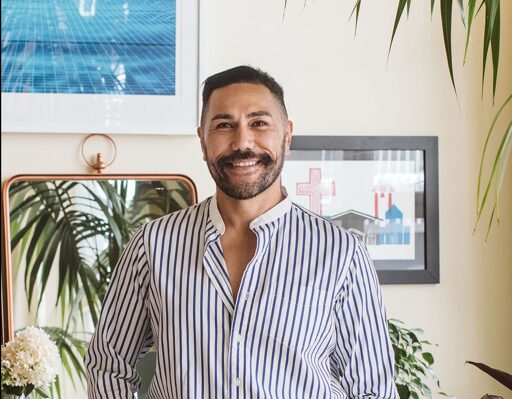

Andre Afamasaga (Photo supplied)
“It’s been 40 years since the Homosexual Law Reform Act was passed, and it’s only in the last few months that I’ve come to realise just how much I missed out on as a gay man who spent much of that time in the closet,” writes Andre Afamasaga.
A strange part of getting older is realising that history was happening around you while you were busy growing up.
I was nine years old when the Homosexual Law Reform Act came into law on August 8, 1986. I had no idea that 49 members of parliament had voted for my human rights — I didn’t even have the words then to explain that I was gay.
I grew up in a conservative Sāmoan family and community in Wainuiomata, Wellington, where talking about sex was taboo. It’s hard to imagine anyone in our church talking openly about whether consensual sex between two men should be decriminalised, which is what the law change achieved 40 years ago.
Yet I’ve often wondered what my parents and their friends thought about the law change, and who in our communities was standing up for us.
Unfortunately, by the time I came out as gay, at 41, they had already passed away, and I could no longer have those conversations with them.
I’d left it too late, and that’s a story in itself.
Despite the homosexual law reform, I internalised the anti-gay stigma that was common at the time by suppressing my sexual orientation. Those who were brave enough to come out still faced discrimination (and sometimes violence) that wasn’t uncommon in society back then, even though the law was on their side.
In my family, religion was all-encompassing, and the family’s needs came first. There was no room for discussions about sexuality and homosexuality because we were busy fighting to survive financially and navigating the very real racism that we faced. Against that, my thoughts about my sexual orientation felt individualistic and self-indulgent.
Like many Rainbow people, I didn’t feel safe to be myself. When I was 14, my older brother John and his girlfriend took me to a gay club to help me accept myself, but I was too ashamed to enjoy it. That openness from my brother eventually allowed me to come out to my siblings at 18, though not to my parents. And at 25, I went back into the closet again when I became a born-again Christian and, later, a pastor. That led me to 15 years of conversion practices, or “conversion therapy”, in an attempt to “pray the gay away”.
I had been indoctrinated to believe that being gay was a sin and that God could make me straight. I didn’t hear these messages from my parents or siblings but from conservative Christian radio, books and courses.
After 15 years of “trying” to be straight, I decided to come out very publicly at 41, in a 2019 column in the Sydney Morning Herald. Again, my siblings fully supported me. Although we were raised in the same household, they had a bigger picture of God than I did. They believed God accepted and loved me as gay.
I regret missing out on the chance to come out to my parents, whose response I now know would have been loving and understanding, because that’s who they were.
While my parents never taught me the vocabulary of human rights, they taught me its principles — dignity, equality, non-discrimination, and the courage to stand beside people when systems fail them, and no one else will.
*
It’s been 40 years since the Homosexual Law Reform Act was passed, and it’s only in the last few months that I’ve come to realise just how much I missed out on as a gay man who spent much of that time in the closet.
This came home to me this year when I produced a podcast with my Human Rights Commission colleagues to mark the 40th anniversary of the Homosexual Law Reform Act — Rights & Realities: Remembering 1986.
As we were putting the podcast together, I kept thinking: Where were Pacific people?
I think every Pacific person thinks this when they open a report or see a historical narrative and don’t see themselves there.
I had come into the project wanting to add our contributions to the record of trailblazers like Dame Fran Wilde, Bill Logan, Peter Wall, Gavin Young, Linda Evans and Geoff Young**,** but I couldn’t find us in the historical record.
Was it because we were so conservative? Or were we simply too preoccupied with survival that we had deemed this human rights issue as not important enough, or perhaps had seen it as a “Pālagi issue”?
I genuinely had no one to ask.
And then this July, at an event at Government House in Wellington, I met Vernon Tile (whose matai titles are Tile and Vamaua).
He was exactly the kind of Pacific Rainbow activist I’d been searching for, yet I had never come across him before. I was astounded that someone with a similar background to mine existed and knew of my advocacy. I had inherited part of his legacy without knowing it.
Vernon is Sāmoan and Pālagi, and like me, he was raised a Seventh-day Adventist. But his father had also made sure that he grew up grounded in fa’a-Sāmoa and knew the history of the Mau movement and colonialism in Sāmoa. As a freezing worker, union activist, and teacher, he’d spent his life resisting homophobia, racism, and economic injustice.
Vernon was a member of Gay Liberation in the 1970s and founded the Manawatū Gay Rights Association. In June 1985, a year before the Homosexual Law Reform Act was passed, he helped organise a pivotal public meeting in Palmerston North. As he explained in a 2023 Stuff op-ed, that meeting shifted the campaign’s trajectory by mobilising organisations beyond the established gay movement — unions, Māori activists, women’s groups, and other social organisations.

Vernon Tile (right) with other Homosexual Law Reform campaigners Gavin Young and Geoff Smith, pictured at an event in Government House, Wellington, in July 2026, celebrating the 40th anniversary of the law’s passage. (Photo supplied)
I couldn’t help wishing that I’d found his story earlier.
Twenty years after Vernon helped organise that Palmerston North meeting, I had become a pastor in Sydney and was deep in conversion practices, believing my sexual orientation should be cured. This was decades after homosexuality had been decriminalised in both New Zealand and Australia.
If I had known then of Vernon’s courage and pride in who he was, it might have shown me that I didn’t need to trade off parts of my identity to belong.
I started to realise how important it was to tell our Pacific Rainbow stories.
After meeting Vernon, the connections began to open up.
While I couldn’t find a coherent narrative about Pacific people’s involvement in the Homosexual Law Reform, I began to discover pieces of information — little nuggets scattered around like crumbs, in oral histories, archives, and personal memories.
Once I learned to look differently, I found that Pacific advocacy was happening in women’s groups, HIV education, unions, nightclubs, and in private acts of acceptance among families and friends.
*
Fuimaono Dr Karl Pulotu-Endemann is an example of that kind of Pacific advocacy. I first met him as a child, tagging along with my mum to a PACIFICA meeting in Naenae. He was the first fa’afafine I had seen, and I was in awe of him. As he told E-Tangata in 2022, his confidence came from his grandparents in Sāmoa, who encouraged him to sing, dance, and know himself as fa’afafine.
Fuimaono was one of the first Pacific psychiatric nurses in New Zealand. I knew he was active during the time of Homosexual Law Reform but couldn’t remember exactly how. Then I recalled that, in the 1980s, he had run HIV and sexual health education courses in the community.
Fuimaono worked through trusted women leaders and groups such as PACIFICA to educate our communities about HIV and helped establish the Pacific Islands AIDS Trust with Louisa Crawley, Eti Laufiso and Molly Fiso, all of whom have since passed away. That culturally grounded outreach has been credited with helping keep HIV transmission low in Pacific communities.
Decades later, Fuimaono became a mentor. When Australian filmmaker Rachel Lane wanted to make Alofa, a documentary about my journey of self-acceptance, I immediately asked him to appear. It was a full-circle moment.

Dr Karl Pulotu-Endemann with Rev Dr Feiloaiga Janette Taule’ale’ausumai at a service to mark Transgender Day of Remembrance 2024, at St Andrew’s on The Terrace in Wellington.(Photo Gareth Watkins)
I found Sāmoan lesbian activist Moana Avia through Gareth Watkins’ 2016 documentary Thin Edge of the Wedge. In 1985, Moana and her takatāpui friends reminded Pākehā campaigners that there was life after homosexual law reform, and challenged them to direct some of their political energy towards Māori self-determination and Pacific struggles.
Change was also happening in South Auckland, where Pacific Rainbow youth who would later become famous drag queens were finding ways to flourish despite the conservatism in their families and communities.
Lealailepule Edward Cowley (aka Buckwheat) told Brodie Kane’s Kiwi Yarns that nightclubs offered safety and belonging to those forced to live secret lives. He had snuck out to gay clubs under the guise of attending youth group, and after missing church for three weeks, his father confronted him.
Edward told him he was gay, and his father said it was between Edward and God. In a very Sāmoan compromise, his father told him he could stay home from church as long as he cooked Sunday lunch. His father modelled for their church community how to accept and uplift rather than reject.

Edward Cowley as Buckwheat and Andre Afamasaga.
I never met Harold Samu, whose fabulous alter ego was Bertha, but his sister, Tuiloma Linda-Jodi Vaine Samu, is a former colleague of mine at the Human Rights Commission. In a Spinoff essay, she recalled how her deeply religious parents led a petition against the Homosexual Law Reform in Māngere East and forced her to sign it as well.
Later, when Harold came out as gay, her parents had to choose between their fundamentalist beliefs and love for their son.
Love won, and they would later accompany Harold to the funerals of friends lost to HIV and AIDS.
Harold was still developing his “Bertha the Beast” drag persona then. The outfit Bertha wore to celebrate law reform was recreated as Law Reform Girl 1986, one of 13 dolls made by fellow fa’afafine artist Yuki Kihara for the 2023 exhibition BERTHA, honouring Harold’s life, and advocacy.
Edward and Harold’s stories show the complexity of growing up in loving Sāmoan families that were also deeply religious and conservative. Their parents showed that faith need not outweigh love: What good are convictions if they distance you from your children or require them to deny who they are?

Love won, and they would later accompany Harold to the funerals of friends lost to HIV and AIDS. (Photo supplied)

Stephen Stehlin with Bertha (Harold Samu) and Buckwheat (Edward Cowley).

“Edward and Harold’s stories show the complexity of growing up in loving Sāmoan families that were also deeply religious and conservative. Their parents showed that faith need not outweigh love,” writes Andre Afamasaga. Pictured, the Samu family.
Their stories help fill in the gaps, allowing me to imagine the conversations I might have had with my parents.
I don’t doubt that my parents would have loved and eventually accepted me. What I regret is not accepting myself earlier, so we could have had the deeper conversations that only now occur to me.
When I was gathering photos for this piece, Tagata Pasifika producer Stephen Stehlin sent me photos of AFA, a Pacific community action group set up in 1996 to provide HIV and AIDS education and support, particularly for Pacific gay men and fa’afafine.
Looking at the photos of Stephen and the others — Edward Cowley, Harold Samu, Lindah Lepou, Patrick Ah Kuoi, Joseph Fraser, Iosefa Enari, Siaosi Mulipola and Chanel Logo — I lamented to my partner that I wish I had known them in the ‘90s.
I almost grieve for what could have been.
I had missed out not only on the chance to show my true self to my parents, but also on knowing a whole community of Pacific Rainbow people who were standing proudly in their sexuality and supporting one another.
I hadn’t known about them or their stories. Nor that there were elders in our community — pioneers who had advocated and fought for our right to stand as ourselves.

AFA was a Pacific community action group set up in 1996 to provide HIV and AIDS education and support, particularly for Pacific gay men and fa’afafine. “Looking at the photos of Stephen Stehlin and the others — Edward Cowley, Harold Samu, Lindah Lepou, Patrick Ah Kuoi, Joseph Fraser, Iosefa Enari, Siaosi Mulipola and Chanel Logo — I lamented to my partner that I wish I had known them in the ‘90s. I almost grieve for what could have been.” — Andre Afamasaga.
There are more histories still to gather, particularly those of Pacific transgender, MVPFAFF+ and lesbian leaders such as Peseta Betty Sio and Alofa Aiono.
Alofa’s wife, takatāpui scholar Professor Elizabeth Kerekere, is interviewed in our podcast, while Niuean fakafifine advocate Phylesha Brown-Acton speaks with wahine takatāpui lawmaker Louisa Wall. They reflect on hard-won advances, including the passage of Louisa’s marriage equality bill in 2013, while stressing that progress remains uneven.
Reclaiming Indigenous identities eroded by colonisation and the work of missionaries is essential to ongoing legal and social reform across the region. Phylesha’s coining of MVPFAFF+ was part of that work, giving our realities language that a Pālagi LGBTIQ framework couldn’t fully hold.
As a minority group within a minority, our experiences are often missing from LGBTIQ histories, while our own communities can dismiss them as western or Pālagi.
Legal reform can happen in parliament long before social reform reaches our churches, families and inner lives, which is why I’ve been visible and vocal about my own self-acceptance.
Without elders they can see and a history they can access, each generation of Pacific Rainbow people can feel as though they’re the first to navigate sexuality, culture, family and faith.
For me, there’s a sense of urgency. Some of these pioneers have died, and the ones who remain are getting older. I’d like younger Pacific generations, both Rainbow and non-Rainbow, to know who they were and what they did — and that Pacific people weren’t simply bystanders in this history.
Our elders worked for change in public and private, often while serving their families, churches and communities. Their names belong in our history alongside those of the Polynesian Panthers.
Knowing them gives younger Pacific Rainbow people what I went searching for — a lineage and whakapapa, and proof that we have always been here.
Andre Afamasaga has held senior roles at Te Kāhui Tika Tangata New Zealand Human Rights Commission. He runs the Alofa Project and writes and speaks on human rights, Pacific leadership and social cohesion.
The post Why our Pacific Rainbow stories need to be told appeared first on E-Tangata.
From E-Tangata via This RSS Feed.