

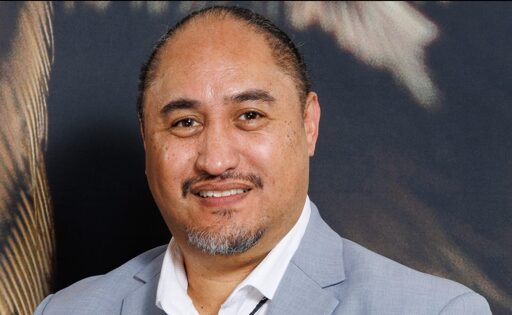

Leon Heketū Blake. (Photo supplied)
Leon Heketū Blake wasn’t born into te reo Māori — in fact, as a kid, he thought te reo was an “old people’s secret code”. Now a noted reo teacher, translator, and composer, he’s landed an award from the Royal Society Te Apārangi, Aotearoa’s top academic body.
Here he is talking to Atakohu Middleton, one of his kura reo students.
Leon Heketū Blake thinks it’s Professor Rangi Matamua’s fault, except Aotearoa’s “Mr Matariki” is denying it. Te Taura Whiri chair Professor Rawinia Higgins might have had a hand in it too, but he’s not sure.
Anyway, high-ups in the reo world got together and nominated Leon to become one of 13 new Takahoa a Te Apārangi — Companions of the Royal Society Te Apārangi — chosen for his “sustained and eminent contribution to the revitalisation of te reo Māori”.
The Royal Society is the top table of our academic ecosystem, disbursing research funding and awards and functioning as a brains trust on critical issues of the day. The people it elects as companions, an insider tells me, are considered to be performing “far beyond what could be expected from them doing their day job”.
Leon was named in July alongside the more high-profile Pānia Papa. She’s his close friend, long-time composition buddy, and co-lead of Te Reo Kairangi, the master’s degree in reo excellence at Te Wānanga o Aotearoa.
It’s humbling to be recognised, Leon says, “but I am very aware that there are many people who have done a lot of work over the years, and I’m just one.”
Leon lives in Hamilton and is a composed, shy sort of tāne, often seen with a guitar in hand and dark sunglasses perched on his head. I know him as a thoughtful, effective teacher at kura reo, the intensive five-day, full-immersion reo workshops that I attend at different places around the motu.
Outside the classroom, Leon doesn’t court attention — in fact, he actively avoids it.
“I like to keep a low profile,” he says. “I wouldn’t go so far as saying I’m an introvert, but I prefer being in the shadows to being in the light.”
To get him to agree to this interview, I might have wheedled a little. (“Please say yes!”)
*
Leon has whakapapa to Tūhoe, Tūhourangi, Ngāti Wāhiao, Ngāti Kahungunu, and Te Whānau-ā-Apanui. He is the second of five children born to Piripi Blake and the late Tiwha Hoeata, both musical and devoutly Christian. He arrived via caesarean in 1979, and was so bruised that Piripi likened him to the boxer Leon Spinks, who not long before had been given a hiding by Muhammad Ali. “I think somewhere there’s a bit of regret from my father about calling me that,” says Leon, jokingly.
Leon later took the first name of his paternal grandfather, Heketū Mihaka, which is the name he’s better known by in the reo-Māori world.
If you’re wondering which Blake whānau Leon is related to, the answer is none of them — well, not as far as he knows. He’s heard that after his grandad Heketū “got into a bit of trouble”, he changed his name to Danny Blake, a nod to his connection with and affection for the Blakes of Waitahanui, near Taupō.
“So when people ask: ‘Oh, are you the Blakes from Māhia or from Waitahanui?’, I have to say my grandfather just adopted the name.”
Leon’s mum is a McClutchie, and his dad is a McRoberts — broadcaster Mike McRoberts’ father and Leon’s dad are first cousins.
When Leon was born, his parents weren’t reo speakers, nor were any of his uncles, aunts, cousins or siblings. As a child, he spent a lot of time with Heketū and his grandmother Eileen (Zara) Paki, who were native speakers but didn’t pass the language down.
Leon mostly heard te reo when they watched the Māori-language news show Te Karere on telly and when they took him to tangihanga. “At that time, I thought it was an old people’s language, an old people’s secret code.”
Leon started getting a sense of te reo as something bigger in the mid-1980s, when he heard some of his younger cousins speaking Māori to his nan Eileen. They were attending one of the pioneering kōhanga reo.
The whānau lived in Porirua when Leon was born, but later moved to Longburn, near Palmerston North, where Piripi and Tiwha were both freezing workers at the Longburn meatworks.
When Longburn closed in the late 1980s, it left hundreds out of work. Leon’s parents had to find other options and made a series of decisions that would eventually turn them into reo trailblazers.
Needing to retrain, they did Māori Affairs work skills courses, Tiwha in hairdressing and Piripi, Leon thinks, in music. Both of them attended a “Māori club” once a week, where they learned some reo and waiata.
Keen to know more, Tiwha enrolled in a Māori language course, and Piripi followed. They learned quickly. “They would come home with their homework and use us as their ears, and we would learn little pieces,” Leon recalls.
By the end of the 1990s, Tiwha and Piripi had become confident speakers of te reo. In 2001, they founded Te Poutama Kahurangi, the immersion programme at Palmerston North’s Freyberg High School. They later worked at Te Aute — Tiwha as head of te reo and Piripi as principal.
They also decided to have one more child, who would be raised in te reo — that’s Rāniera, an audio technician. “As a consequence, we also had to learn te reo Māori to be able to speak and communicate with him,” says Leon, adding that there’s 18 years between his eldest and youngest siblings. “We can all speak Māori to a certain degree because of our youngest brother.”
At 13, Leon was a foundation pupil of the bilingual unit at Queen Elizabeth College in Palmerston North. “By the time I got there, I had enough to be able to recite my pepeha, and that was pretty much it,” he recalls. “Thanks to some really great teachers and mentors, my love for the language grew.” He singles out Irene Pēwhairangi, who is Pākehā, as one of his greatest inspirations.
High school honed Leon’s legendary composition and guitar skills. To embed new Māori words and phrases, he’d write them into songs. His first song was about Māori placenames in the North Island. His talents meant his teachers soon had him tutoring the school’s kapa haka.
Queen Elizabeth College is also where Leon met his wife, Helen Maxwell. They’ve been together for three decades and have two sons, Hoeata and Te Rangi-tū-ahiahi, both products of kōhanga reo and kura kaupapa. Hoeata works in the health sector and has three tamariki, all girls, and all reo speakers. Te Rangi-tū-ahiahi is at university.
Helen has been a huge supporter of Leon’s work. “She’s always been in the background, supporting me. She was the one raising our boys whilst I was gallivanting around the country and the world trying to help te reo Māori revitalisation.”

Leon and Helen with their mokopuna. (Photo: Supplied)
Inspired by his primary-school teachers, Leon got an education degree and began his teaching career as a secondary school teacher before becoming a reo teacher at Te Wānanga o Aotearoa in Palmerston North.
He’ll never forget the day Tā Tīmoti Kāretu sent a letter to tell the campus director about his vision for an elite language school. The way Leon tells it, the campus director was a bit scared of Tā Tīmoti (he can be acerbic) and wanted someone “to suffer with him”. So Leon and his mate Hāmi Hawkins sat in on a hui with him.
That meeting started the process that led to Te Panekiretanga o te Reo, an invitation-only polishing school for the most fluent speakers. When Tā Tīmoti said he’d need some foundation students, Leon and Hāmi volunteered.
Te Panekiretanga ran from 2004 to 2019 under Tā Tīmoti, Te Wharehuia Milroy, and Tā Pou Temara, and trained many of our most visible orators and broadcasters in reo and tikanga. That’s where Leon met Pānia Papa, who’s also a leading teacher, composer and translator. They’ve been prolific composing partners ever since, creating a range of gorgeous songs, often to lyrics written by Tā Tīmoti.
The first fruit of what Leon calls their “compositional partnership” was a waiata tangi titled “He Rau Maharatanga” (There are hundreds of memories) for Wiha Te Raki Hawea Stephens, a reo expert and the first wife of filmmaker Tainui Stephens. She died of cancer in 2009, in her early 50s. Tā Tīmoti wrote the lyrics and Pānia and Leon composed the tune. It’s a slow, lilting and moving song that features Pānia’s beautiful alto voice.
Leon says the most meaningful song he has composed alone is “Hunaara”, a waiata tira (choral item) written for his late brother-in-law Nathanial Ponga, the husband of his sister Tina. Nathanial died of leukaemia in 2018, aged 39, just six months before his son, Nathanial Ponga Jr, was born. The tribute was performed by Te Tū Mataora, a kapa haka founded by Nathanial and Tina, at Te Matatini in 2019.
Leon had known Nathanial since they were teenagers. “We grew up together, and he was as much a big brother to me as I am to my younger brothers. Losing him was a big loss for our family.”

Pānia Papa and Leon Heketū Blake co-lead the Wānanga o Aotearoa masters degree in te reo excellence, Te Kairangi. This picture was taken in August 20206 at the latest cohort’s graduation at the wānanga’s Mangakōtukutuku campus, Hamilton. (Photo supplied)
Leon takes on a range of reo-related work, from translation and teaching to reo revitalisation strategies and professional development. Teaching remains his first love.
“Out of everything I do, I think teaching is what I get the most value from.”
The master’s degree that he and Pānia lead, called Te Reo Kairangi, is a two-year undertaking involving regular wānanga at Te Wānanga o Aotearoa in Hamilton. The pair also offer online reo courses under the name Mumu Reo.
Leon has also worked on projects with Kotahi Rau Pukapuka, under the direction of Pānia, which aims to produce 100 high-quality Māori-language books. So far, most are translations of popular books.
One of its early books was Leon’s reo version of Harry Potter and the Philosopher’s Stone, which came out in 2020.
The translation was a tough gig at times, given the need to put J K Rowling’s sprawling writing style and Potterverse-specific words into a Māori idiom while remaining faithful to the text, but he enjoyed the challenge.
Many new reo words were created as a result, and Leon says they were a collective effort with other reo experts. For example, “makuare” is the Māori word they coined for Muggles, people born into non-magical families with no magical powers of their own and seen as lesser by wizarding types. How did they come up with “makuare”?
“The balance we had to strike was how to translate the word so that it sounded like ‘muggle’, but also made sense to Māori,” Leon says. “So the word ‘ware’ is someone who is lowborn or of low status. The word ‘kūare’ is an ignorant person or an ignoramus. Ma matched the ‘m’ sound at the start of the word ‘muggle’. So we ended up with ‘makuare’.”
Genius.
The new Takahoa companions receive their awards this week at the Royal Society’s headquarters in Wellington, and each will present their work. Unfortunately for those who turn out, neither Leon nor Pānia will be present.
They’ll be on an overseas trip together. Leon says it’s “a bit of business and pleasure put together,” because “wherever Pānia and I are together, there’s no such thing as just pleasure.”
The Royal Society Te Apārangi named 13 new Takahoa Companions in July. No Pacific companions were named this year, but other Māori awardees include filmmaker Chelsea Winstanley, academic and documentarian Reuben Collier, academic Jenny Te Paa-Daniel, environmental advocate Melanie Mark-Shadbolt, and educationist Elizabeth McKinley.
The post Leon Heketū Blake: Working for te reo appeared first on E-Tangata.
From E-Tangata via This RSS Feed.