

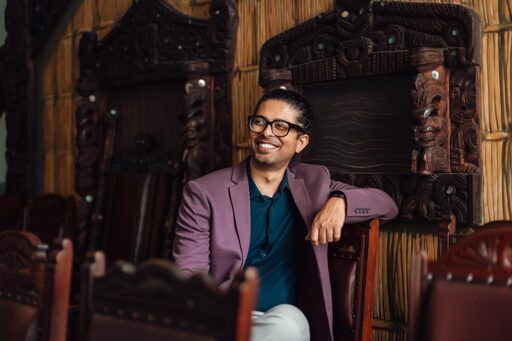

“I have no whakapapa to this land, but wherever in the world I travel to now, te reo Māori connects me to Aotearoa,” says Rituraj Sapkota, who migrated to Aotearoa from Nepal. (Photo: Julie Zhu, Matariki Matarau)
Te reo Māori is a language for all New Zealanders. Here, Rituraj Sapkota, who was born in Nepal, talks to Atakohu Middleton about why and how he learned te reo.
Rituraj, tell me about your childhood.
I am the youngest of three siblings. My mum, Bala, was a teacher, and Dad, Devendra, ran different businesses over the years. My childhood was spent in a lot of places — Bhutan, Nepal, and India.
My first language is Nepali, but I was always surrounded by many languages. Nepali was the language at home, English the language at school, and our TV antenna caught Hindi channels from across the border if you turned it in the right direction.
My teenage years were a time of civil war in Nepal. We lived in a town on the eastern border of Nepal, so we weren’t as badly affected as some other places, and that was a blessing. But school got disrupted quite a bit, so at the age of 11, I was sent to a boarding school across the border in Sikkim, India, and for many years I studied in India.
Soon after I left home, my eldest sister, Srijana, moved to Kathmandu. The following year, my second sister, Archana, went to South India to study, so we became a very spread-out family.

The Sapkota family in 1992: Bala, Rituraj, Archana, Devendra and Srijana.
I followed in the footsteps of Archana and moved to Hyderabad in South India when I was 16, where I was in boarding school again. There were very few Hindi speakers. Everyone in the hostel spoke Telugu, the major language of the area, and English was used only in class. I had to learn Telugu to make friends, to understand the jokes, and to make sense of what was going on around me.
I studied my undergraduate degree in mass communications in Hyderabad, too. My sister worked there and our oldest sister joined us, so the three of us made the city our home.
In the final year of my bachelor’s degree, a team from Wintec in Hamilton visited our college. Long story short, a classmate and I were offered a scholarship for a year of postgraduate study at Wintec.
I had never really thought of going to New Zealand, and I took a while to make my decision. It was a great offer. I could study one year of post-grad with my tuition waived.
New Zealand was far away from home — far away from everywhere, really — but it was a chance for me to spread my wings. I didn’t have to pay tuition, but there were other expenses to consider, and I didn’t have much in savings. My sisters and parents were supportive of me leaving, though, and they also supported me financially.
I arrived in Aotearoa in 2009 to do an honours year in media arts.
It was a busy year. I was making a documentary film about Bhutanese refugees who had lived in refugee camps in Nepal for close to 20 years and then were resettled in different countries around the world, including New Zealand.
I stayed for a year in Kirikiriroa, started a master’s in cinematography, then went back to Nepal. I’d had practically no interactions with te ao Māori or te reo Māori. I returned to Aotearoa in 2015 with slightly broadened horizons to finish my master’s, but again, I went through my course with very little exposure to te reo Māori, apart from the signs I saw on campus and around town.
After I finished my masters, I started working as an editor on the bilingual children’s show Tākaro Tribe. I was spending hours with a pair of headphones over my ears, listening to te reo Māori with the bilingual scripts in front of me, so I started picking up words.
When my colleagues’ children came into the office space and spoke to their māmā and to each other in te reo Māori, I went: “Hold on, this is a living language. There are kids speaking it, which means it’s the future.”
A couple of years later, I joined Whakaata Māori’s press gallery team as a camera operator and editor. The reports that I was editing — about Oranga Tamariki, Waitangi Tribunal hearings, and iwi settlements — opened up a world that was hitherto unknown to me.
I decided that since I was here and I was going to be editing the news in te reo Māori, I would do well to start learning the reo. I picked up a copy of the Māori language coursebook, Te Rangatahi, from the Wellington City library. You could say turning the first few pages of that book also turned a new chapter in my life.

Rituraj on the job inside Parliament Buildings, Wellington.
How did you learn the nuts and bolts of te reo?
Sheer practice. I would sit for at least half an hour every day, writing sentences that may or may not have made sense. I would try to speak short sentences or phrases to my colleagues.
It’s perhaps ironic that I learned a language that had been passed on orally for centuries through reading and writing. As for the grammar, I still don’t have it all right, and I probably never will, but I try to use as much of the language as I can.
My co-workers, the reporters and producers at Whakaata Māori, where I worked from 2019 to 2023, were instrumental in my reo journey. They taught me new words, new ways of saying things, and corrected me when I made common mistakes. And, most importantly, they urged me on, and gave me a platform to use the language.
At what point did you think, te reo is for me and I want to learn it? Was there a moment of clarity knowing that’s what you wanted to do, or was it more a slow burn?
It was a slow burn. After I went back to Nepal in 2010, I worked on documentary films that took me to parts of Nepal I had not visited before. It was also a time of political transition. Indigenous groups were finding a voice in mainstream politics, and there was strong consensus nationally that many of our languages were disappearing and we had to change that. Our diversity was starting to be seen as central to our identity in the world.
I then worked in Central India where similar narratives were emerging. Tribal languages were vanishing, and younger generations were leaning more towards Hindi and English, which gave them an edge at a national and international level. A colonial hangover lingered — Indigenous practices were seen as backwards and a hindrance to “development”.
“Development” was also changing ways of life. Adivasis, a term that describes the first tribes to inhabit South Asia, such as the Oraon, Munda, Santhaal, and Ho, were being displaced from their villages to make way for coal mines and other mines, and their way of life was being uprooted.
I taught documentary film research and broadcast journalism at a film school in a city called Ranchi. I travelled extensively around the tribal belt of India and also guided students as well as social organisations on documentary projects.
The kaupapa I mentioned above were overarching themes in most of these documentaries. I would encourage my students and others I worked with in the community to create content in their languages, including Kurukh, Santhali, and Munda.
It was with this mindset that I returned to Aotearoa to finish my master’s. In 2017, I also travelled to Mongolia and Inner Mongolia to work on a documentary film, and there, too, I saw the interplay of modernity and tradition, and what development does to the Indigenous way of life.
So when I started being exposed to te reo Māori, learning it seemed like a natural progression rather than a radical idea.

Rituraj in 2023 celebrating the Nepali festival Bhai Tika, which celebrates the bonds between brothers and sisters, with Srijana (left) and Archana.
As a migrant, what does te reo Māori mean to you?
As a person of colour, coming from a part of the world that is economically not as well off, your place in a first-world country is always questioned. I speak English, and I speak it well. But I’ll never belong. I have endless examples of being told to “go back to where you came from,” or “we do things differently here,” as will most other migrants.
However, when I speak te reo Māori, I feel like I belong. I feel like I have found a place here, or maybe even a right of existence. I have no whakapapa to this land, but wherever in the world I travel to now, te reo Māori connects me to Aotearoa.
It’s hard to explain, but I could paraphrase it as te reo Māori makes me feel like a part of Aotearoa, and Aotearoa a part of me.
Tell me about the support you had learning te reo.
I have received nothing but encouragement from those around me — my coworkers, friends and te ao Māori at large. If I didn’t have my colleagues to practice with, I would not be conversational, as I had no opportunities to speak it at home or anywhere outside of work. My video reports for Whakaata Māori have been met warmly — except in some Facebook groups that sometimes spew vile rhetoric, but who cares about them?
I’ve had the odd interaction where my attempts at speaking te reo Māori were met with subtle suggestions that I was encroaching upon a kaupapa that isn’t mine, but that was very rare, and I didn’t let it get to me.

Rituraj with his wife Bandita in the South lsland.
How do you use your reo in everyday life now?
I use te reo Māori at the slightest opportunity I get. Everywhere I have worked since leaving Whakaata Māori, I’ve had colleagues who speak te reo Māori, and I speak it with them.
When I worked in local government from 2025 to earlier this year, I was often dealing with hostile online crowds on social media. I realised that using te reo Māori often changed the dynamics and tone of the conversation. I’d see how it would defuse and de-escalate things.
The comments section would be going hard, abuse would be thrown around, there would be wild allegations about the elected members or council staff, or people having a go at each other, as they do on Facebook.
So I’d drop in a subtle comment: “Kia ora, e te whānau,” or “Ngā mihi i ngā whakaaro (thanks for your thoughts), but we’re going to be removing some of these comments.” Or I’d say: “Kia haumaru ō rā whakatā” (Have a safe weekend). These would be heart reactions from many people, and the angry ones would give up.
I use kupu Māori in my day-to-day communications work, such as whakataukī (proverbs) in press releases and columns, and I sit with colleagues who are interested in learning the language so they can practice with me.
I’m simply passing on the tautoko I received from my colleagues in the past.

Rituraj Sapkota with dad Devendra and mum Bala in Nepal in early 2020.
Rituraj Sapkota is a storyteller with a background in video production, news and communications. He has worked on documentary films in Aotearoa and Asia and was the press gallery videographer for Whakaata Māori in Wellington. He later worked as a reporter for Te Ao Māori News*, reporting on migrant and refugee stories as well as indigenous communities and practices around the world. He works as the communications lead for Central Pacific Collective, a Pasefika social agency.*
This is a longer version of an interview with Rituraj Sapkota that formed part of the New Zealand Listener cover story by Atakohu Middleton for Te Wiki o te Reo Māori, September 14-20, 2026. You can read that story, titled Te reo Māori is Aotearoa’s language: The rise and rise of non-Māori learning te reo in English here and in te reo Māori here.
The post ‘Te reo Māori connects me to Aotearoa’ appeared first on E-Tangata.
From E-Tangata via This RSS Feed.
You must log in or # to comment.