

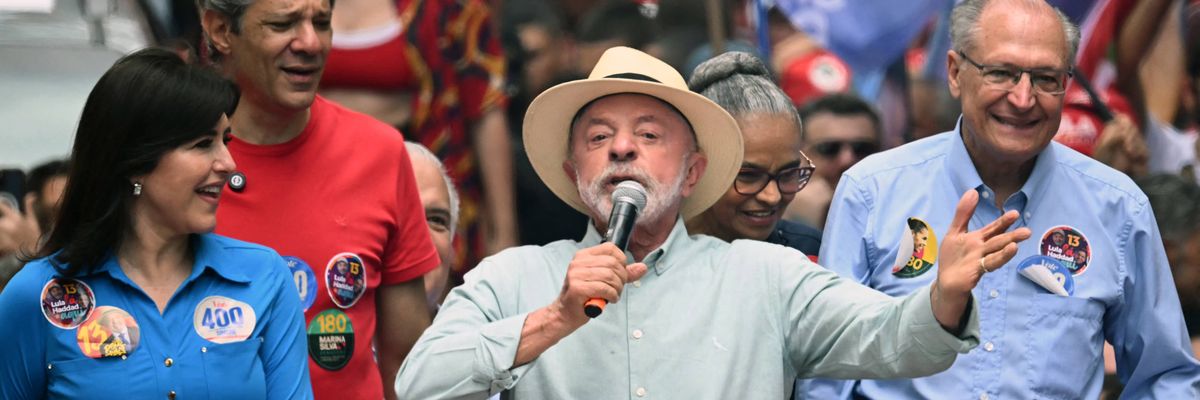
Just two days before Brazil’s closely watched presidential election, the campaign of its left-wing president, Luiz Inácio Lula da Silva, has asked the nation’s top election court to examine the sudden shutdown of US consular services as part of a broader investigation into alleged election “interference” by the Trump administration.
On Friday night, the US suspended in-person consular services at its embassy and consulates across Brazil on Friday and advised Americans to avoid US diplomatic facilities, citing unspecified “security concerns.”
In a petition filed to Brazil’s Superior Electoral Court, Lula’s campaign said taking such an action just days before Brazilians vote “projects instability over the electoral environment,” something it said was part of a larger "infrastructure of external intervention in the Brazilian electoral process.”
In recent days, Brazil’s intelligence agency said it confirmed the existence of interference by the US in Brazil’s election to support Sen. Flavio Bolsonaro, the son of former far-right President Jair Bolsonaro—who is currently serving a 27-year prison sentence under house arrest for orchestrating a coup attempt in 2022.
“Although Trump has not formally endorsed him, Bolsonaro is undoubtedly Washington’s preferred candidate,” explained Nick Cleveland-Stout, a research associate at the Quincy Institute for Responsible Statecraft, on Friday. “Often at the request of the Bolsonaro family, the US has engaged in a pressure campaign to weaken the Lula government, sparking fears of further interference.”
Trump responded with hostility to the prosecution of the disgraced ex-president—imposing tariffs of up to 50% on Brazilian imports in retaliation, sanctioning the Supreme Court justice overseeing the case, and threatening to use American “military might” against Brazil.
He’s also designated two Brazilian crime groups as “narcoterrorist” organizations, invoking a similar pretext Trump used to justify his invasion of Venezuela to kidnap its leader Nicolás Maduro in January.
As the election has approached, Trump has appeared to put his thumb on the scale in an effort to stop Lula from achieving what would be an unprecedented fourth term.
In July, the US consulate in São Paulo invited right-wing pro-Bolsonaro social media influencers to a closed-door roundtable meeting to discuss “freedom of expression and the digital environment.”
The Guardian reported on Thursday that the State Department was also diverting $1 million from its human rights fund to oppose “judicial overreach and censorship” by Brazil’s Supreme Court, an apparent reference to the court’s actions against Bolsonaro and his allies.
The Brazilian government has denied visas to two State Department officials whom it said were seeking to discuss “election integrity,” which it perceived as an effort to “undermine the electoral system.”
Trump and his allies have previously spread baseless conspiracy theories to cast doubt upon Lula’s victory in 2022, which helped to fuel the failed coup. They’ve done the same with the victories of other left-wing candidates in Latin American elections—including Bolivia’s Evo Morales in 2019 and Guatemala’s Bernardo Arévalo in 2023.
Lula’s campaign said the sudden US suspension of consular services was “yet another extremely serious development in the interference in Brazilian elections by the US government,” alleging that it was "coordinated, by all indications, directly by the brothers Flávio and Eduardo Bolsonaro.”
The filing noted that even “the legislative branch of the foreign state itself… recognizes the pattern of external pressure." It pointed to a letter sent earlier this week by Democratic US Sens. Jeanne Shaheen (NH), Peter Welch (Vt.), and Tim Kaine (Va.) to Secretary of State Marco Rubio, which said that “the administration’s most recent actions point toward an effort to interfere with, and potentially undermine, Brazil’s general election in October.”
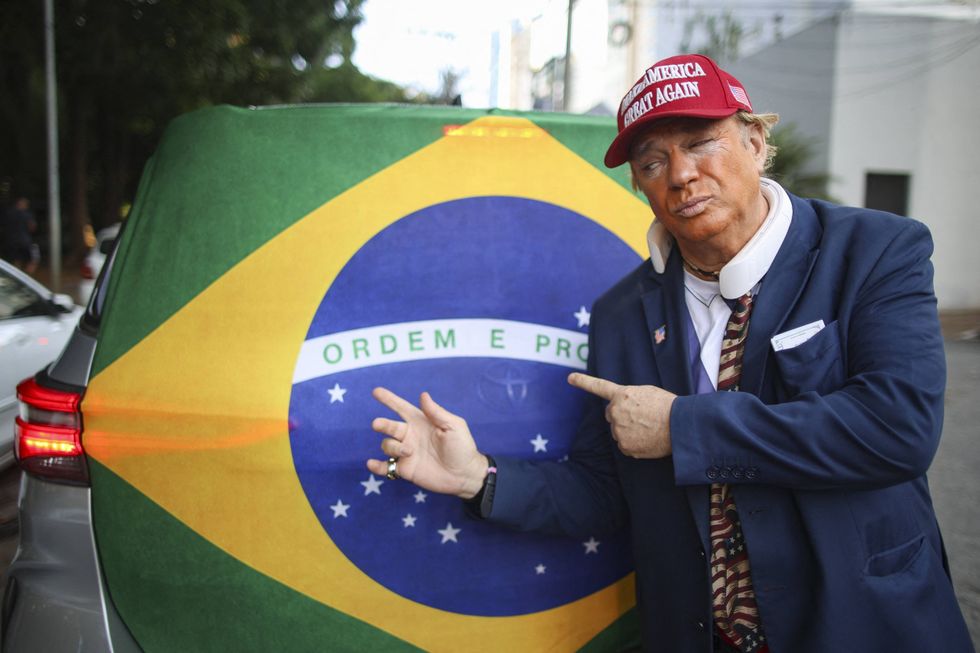 A man wearing a mask depicting US President Donald Trump attends a rally of Brazilian right-wing presidential candidate Flavio Bolsonaro in Goiania, Brazil, on September 27, 2026. (Photo by Sergio Lima/AFP via Getty Images)
The first round of Brazil’s election will begin on Sunday. Should neither candidate receive 50% of the vote, a runoff between the top two candidates will be held on October 25. Several major polls show Lula with a narrow first-round lead entering Sunday, although others have the race effectively tied or Bolsonaro slightly ahead.
But Lula has also seized upon Trump’s meddling to portray Bolsonaro as a tool of foreign powers, drawing on a history of US-backed coups and election interference that have undermined Brazilian democracy.
“Flávio Bolsonaro is Trump’s candidate and what Trump wants is to colonize Brazil, take our riches, steal our future and leave us in the dust," said a campaign ad that began airing last week.
The Trump administration, for its part, has continued to double down on public overtures toward imperialist ambition. On Thursday, an official US State Department social media account reposted a video created in August glorifying the 19th-century Monroe Doctrine and declaring that “American dominance in the Western Hemisphere will never be questioned again.”
Dov H. Levin, a political scientist at the University of Hong Kong who recently published research on the effects of foreign election interference, told the Brazilian newspaper Folha de S. Paulo that, if too overt, Trump’s intervention could backfire.
“There are cases of failure,” he said, “and cases where the reaction provoked by the intervention harms precisely the side it intended to help.”
From Common Dreams via This RSS Feed.