

William Serafino is a political scientist with a master’s degree in history. His research and analysis have focused on geopolitics. In this interview, he discusses Venezuela’s current relationship with the United States, including a major oil deal and what Donald Trump and Delcy Rodríguez seek to gain from it.
In New York, Venezuelan Acting President Delcy Rodríguez thanked Trump for his support and described their bilateral meeting as “historic.” Nearly nine months after the January 3 US bombing and kidnapping of President Maduro, how would you describe the current relationship between Caracas and Washington? Which elements are short-term Trump gimmicks, and which ones will structurally define the relationship in the future?
It is difficult to find a precise definition. Many speak of a protectorate-like condition; some even go so far as to describe it as a relationship of colonial or neocolonial subjugation. Others, however, define it as a process of political, economic, and energy normalization in which the Venezuelan acting government makes tactical concessions, but without formally compromising national sovereignty. I believe the devil is in the details, not in one-size-fits-all approaches. At the level of inter-state relations, what I observe is a strategic attachment of Venezuela to the US sphere of influence and an energy realignment that operates with significant geopolitical restrictions in what concerns relations with Russia, China, and Iran.
At the governmental level, an asymmetrical alliance (favorable to Trump) has been forged in the wake of the military defeat on January 3, from which Caracas and Washington derive immediate and existential gains: Trump cherishes the sole geopolitical achievement of his second term, and Rodríguez gains relief and fresh revenue to govern after more than a decade of suffocating sanctions, within a framework defined by US interests. This reality can hardly be classified as a protectorate, in which a foreign power takes control of diplomacy, defense, and other strategic elements of the subordinate state. Could one speak of a sui generis, or “soft,” protectorate? Perhaps, but that would be an acknowledgment that the concept is not entirely effective in explaining the situation.
The same is true of the thesis of a “retreat with full sovereignty,” which is difficult to sustain when the US is clearly shaping the portrayal of the new national political dynamic and controlling the country’s oil revenues. That is why I have ventured –at the risk of being wrong –to speak of “joint governance” or “co-government,” in which Washington and Caracas divide areas of responsibility and share the political costs of each move so that the alliance endures and each party can, albeit unequally, reap its corresponding share of the benefits.
Trump, despite his constant demeaning tone, needs the Rodríguez administration to be strong enough to lead the country in order to get what he wants; only under such conditions can he extract the oil. And she, too, needs Trump to remain in power so that the oil agreement and other commitments can move forward in the medium term. This is the only way to stay in power and hope to gain legitimacy through performance. I believe that, described in this way, we are talking neither of classic colonialism nor of uncompromised sovereignty, but of something more unique that requires developing other analytical categories.
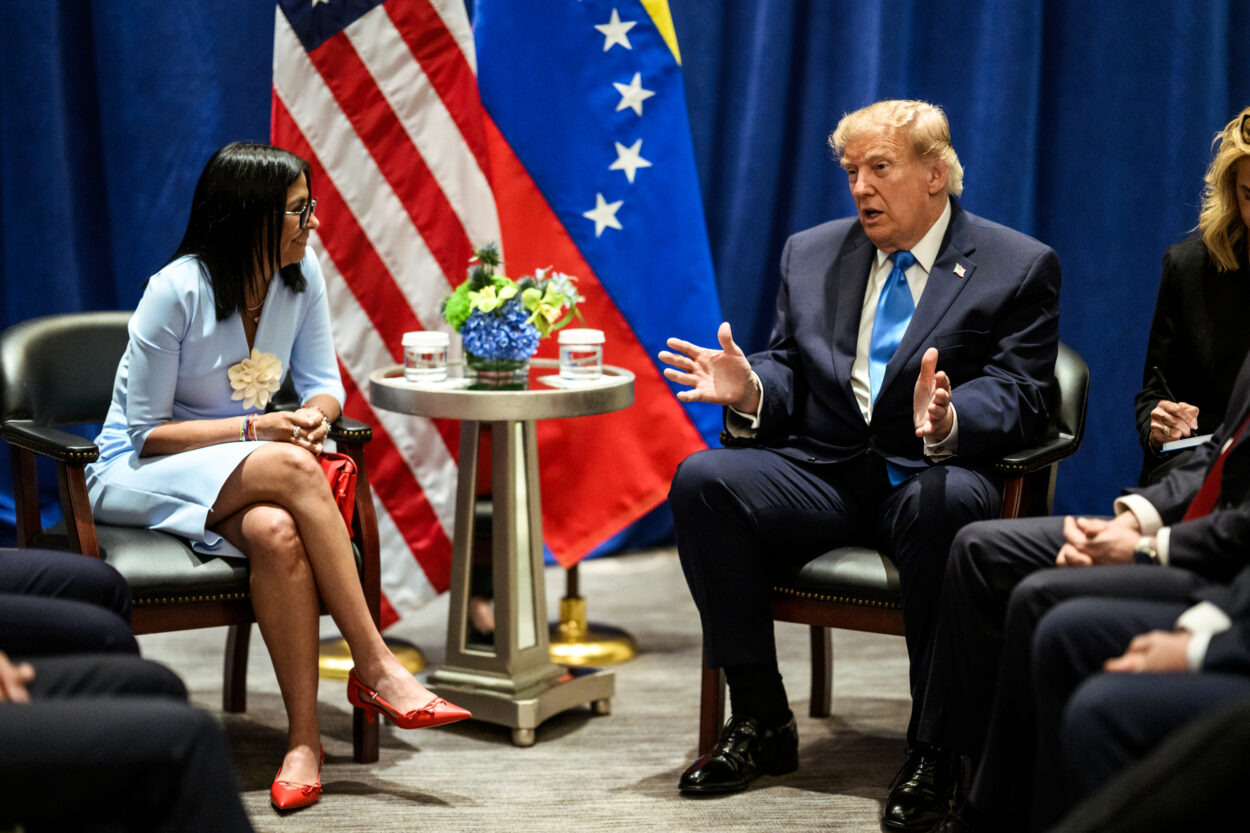
Rodríguez met Trump on the sidelines of the UN General Assembly in September. (Presidential Press)
In your articles, you have pointed out that the US-Venezuela oil deal must be analyzed beyond the announced figures. What do you consider to be the true political and geopolitical scope of this agreement, and what benefits do the various actors seek to extract from it?
I see it more as a political arrangement than a formal agreement. Its function is not legal or institutional, but political. The announcement gave Trump narrative ammunition to promise that gas prices will drop, a necessity driven by his debacle in Iran. By not having signed anything, he avoids going through Congress, sends a message to his core electorate that he is guaranteeing the country’s energy security, and reassures energy corporations to go ahead and invest in Venezuela because the relationship with Caracas is solid and unshakable. Rodríguez, on the other hand, benefits from the fact that the agreement shuts the door on María Corina Machado in Washington’s power circles and thereby helps reestablish her domestic legitimacy, promising a secure path to economic and social recovery underpinned by US investment.
I would go as far as saying that the agreement is Rodríguez’s trump card in a potential presidential campaign, where she will be able to present herself as the only political actor capable of boosting the economy, as opposed to potential rivals who lack influence in the White House and do not have a reliable plan to pull the country out of the spiral of inflation and economic frustration in which it finds itself after years of sanctions.
Both sides stand to gain politically, and the agreement appears to be designed to avoid institutional resistance: neither is forced to face the hassle of legislative approval nor the criticism from political opponents. Since there are no specific clauses, they can more easily divert attention and focus their message on the eventual economic benefits. This level of coordination is a sign of partnership, not of one-sided imposition. If that were the case, Trump could force Rodríguez to sign a bilateral treaty in the National Assembly, and that is not what we are seeing.
You have paid special attention to the role of the Pentagon and the involvement of its Office of Strategic Capital in the structure of the agreement. Why is it so significant that the US defense establishment is a formal actor in a Venezuelan oil deal?
It seems to me that the Pentagon’s involvement serves as a coercive cover—an insurance policy backed by force—to ensure, in the medium and long term, US commercial and financial advantages in the exploitation of the oil fields included in the agreement. Let us imagine that the current government, or another one in the future, wants to modify the arrangement and secure better terms. At that point, it would not be dealing with a conventional transnational corporation, but with one controlled by the Department of War. It doesn’t take much thought to realize that negotiating under such conditions would scare anyone off: the language of business would be replaced by the language of weapons, and after January 3, no one would want to venture into this murky territory.
Furthermore, I believe that the Pentagon’s involvement sends a message to companies to invest and feel secure in the knowledge that the Department of War guarantees their investments and capital commitments in the Venezuelan energy sector. For the US, Venezuela’s oil reserves are not being treated as an economic asset, but rather as a matter of “national security.” As we well know, when that term is used, any coercive tool is fair game against a country’s sovereignty.

Serafino argues that the oil deal with Trump could be a “trump card” for Delcy Rodríguez in a future electoral campaign. (El Salto)
You have argued that the relationship between Caracas and Washington is taking on the characteristics of a negotiation marked by a profound power asymmetry. And many official spokespeople or analysts ask, “But what alternative do we have?” whenever criticism is raised about the path the government has chosen. What real ability does Venezuela have today to negotiate different terms or reject certain demands from the United States?
Right now, those capabilities are very limited, because, as I said, it’s not just a matter of US impositions, but also of calculating how to obtain tangible benefits from an asymmetrical relationship. But politics also takes place outside institutional spaces, and I believe there is much to be done there. What I’m about to say won’t, I don’t think, resolve the dilemma you’ve raised, but it could be a path toward regaining political vitality and initiative: strengthening social consensus on national sovereignty, refusing to concede the battle for historical memory regarding a century-long history of US plunder, and fostering a broad discussion on the vision for the nation’s future. These steps could help break the inertia somewhat and prepare the country for more favorable political conditions in the near future. In contrast, suggesting specific policies or positions to the current government would be irresponsible, because I’m not the one who has to deal with a Trump and his violent ego.
My message is directed at all of us who do not hold such high-stakes positions and can contribute, from our own small spheres of influence or through our individual activism, to rebuilding a patriotic consciousness that must adapt to a new reality. How many open forums are being promoted to discuss the educational model, the economic model, and the model of income distribution? Which bodies are evaluating the trajectory of the bilateral relationship with the US in order to better address it? Are these discussions conceptually limited? Perhaps these debates will not change the current situation of Trump’s disproportionate influence, but they would give us autonomy in our vision and in shaping the future. If Venezuela does not have its own vision on major national issues, there is a risk that they will end up being imposed from Washington. That would be committing the perfect crime, and I believe we must avoid it: with national unity, transcending political divisions.
In your articles and social media posts, you have criticized political elites who, historically, have lacked “imagination” beyond offering lucrative deals to the US. How did Chávez manage to break that mold? How could Venezuela return to a more sovereign path?
To be fair, Chávez broke the mold but the political and geopolitical conditions were ripe for it. The weakness of the national elites, discredited by a society weary of inequality and injustice, coincided with the US being drunk on power at the end of the Cold War. In its plans to establish itself as a unipolar superpower, Latin America did not figure as the central battleground. The inattention of an empire more concerned with reshaping West Asia, forcing China into the “rules-based order,” and eliminating the last strongholds of the socialist bloc (Tito’s Yugoslavia) in turn allowed Chávez to implement his agenda without facing a full-scale war, although he did face numerous coup attempts.
The present conditions are different. There is a hemispheric imperial retreat underpinned by a militarized reinterpretation of the Monroe Doctrine, which drastically raises the cost of sovereignty-oriented proposals. Still, I believe that what is most commendable about Chávez, and which can be of use in this new context, is his ability to clearly identify favorable conditions and act upon them.
I believe that anyone who considers themselves a political figure must build upon these principles to take on the new challenges of the present, developing and defending a dignified vision of the nation’s future. I believe that, rather than waiting for another Chávez to emerge, we should instead study his thought in depth and draw on the best of it to renew political practices, always interpreting the situation for what it is: changing, volatile, and full of opportunities. Chávez is a great political school, but it has been reduced to a crude tool for private interests of all kinds.
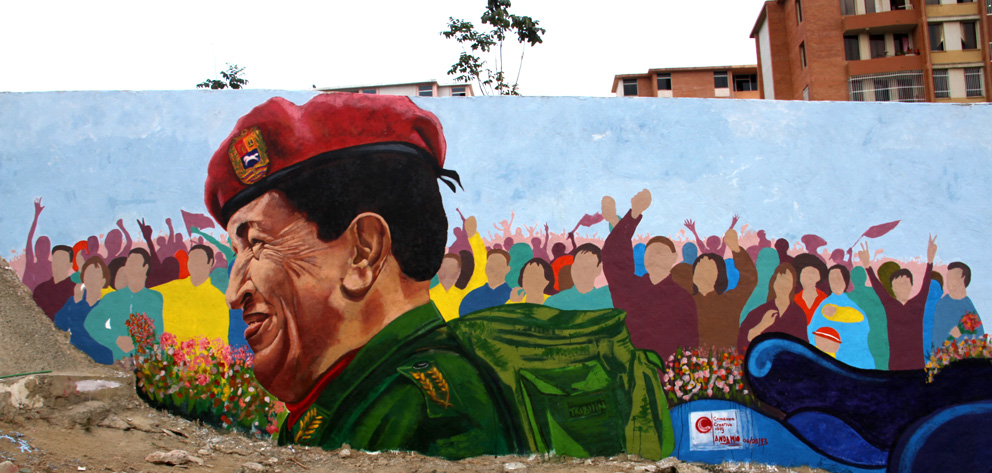
Serafino referred to Chávez as “a great political school.” (Comando Creativo mural in Ciudad Caribia)
The post William Serafino: ‘Caracas and Washington Are Co-Governing Venezuela’ appeared first on Venezuelanalysis.
From Venezuelanalysis via This RSS Feed.