

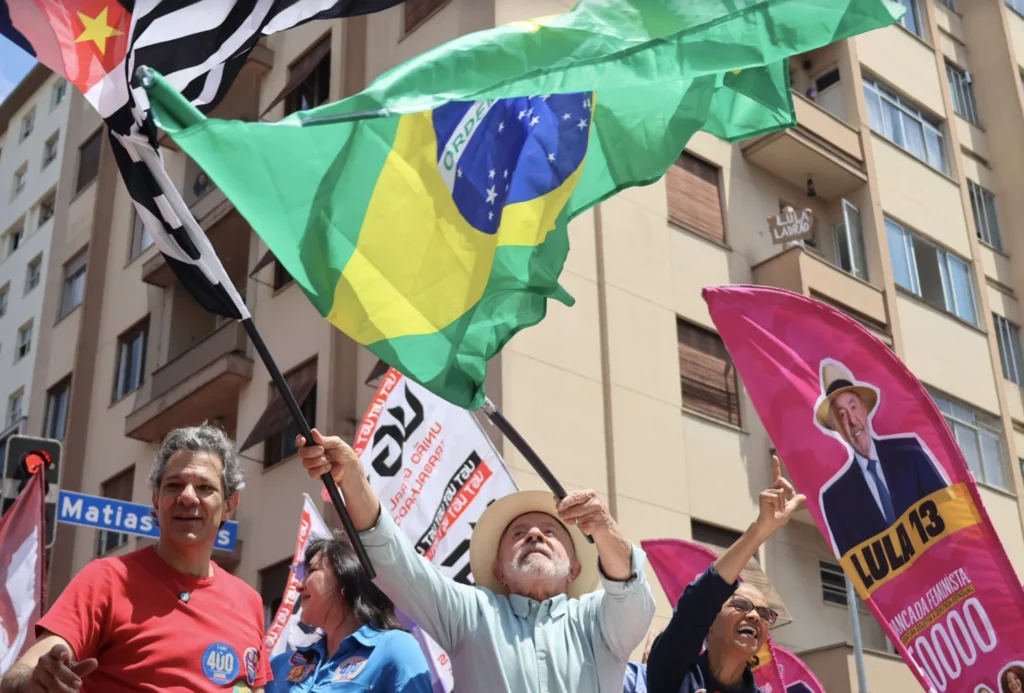
Lula São Paulo campaign closes with a huge march as Brazil heads to the polls, with Lula and Flávio Bolsonaro locked in a tight race.
Related: Venezuela & UNHCR Define Bilateral Cooperation Roadmap
Lula São Paulo Campaign Ends With Massive March Before Brazil Vote
Lula São Paulo campaign closed on Saturday with a massive march through central São Paulo, as President Luiz Inácio Lula da Silva sought to energize supporters hours before Brazil’s first-round presidential election. The mobilization came amid a tight race against far-right candidate Flávio Bolsonaro.
The march, called “Brazil Ready for More,” began around 10:00 a.m. on Avenida Paulista and moved toward Praça Roosevelt in the city center. Lula was accompanied by Vice President Geraldo Alckmin and São Paulo gubernatorial candidate Fernando Haddad, along with other allies from the Workers’ Party, or PT.[oglobo.globo]
São Paulo is the largest electoral college in Brazil, making it a decisive battleground in the race. The state, along with Minas Gerais and Rio de Janeiro, forms part of the Southeast region, which holds more than 66 million of the country’s 158 million registered voters.[g1.globo]
The Lula São Paulo campaign event was authorized by the São Paulo Regional Electoral Court, which required organizers to preserve traffic flow and follow instructions from the Military Police and the city’s traffic engineering company.[prensa-latina]
The march followed a similar rally in Rio de Janeiro the previous day, where Lula also drew large crowds. Both events were part of a final push to consolidate support before voters go to the polls on Sunday.[oglobo.globo]
Lula São Paulo Campaign and the Race Ahead
Brazil Superior Electoral Court | O Globo election coverage | Reuters Brazil election coverage
The Lula São Paulo campaign is unfolding in one of the most polarized elections in Brazil’s recent history. Lula, seeking an unprecedented fourth term, faces Flávio Bolsonaro, the son of former president Jair Bolsonaro and the candidate of the Liberal Party.
Recent polling shows the two candidates nearly tied. A Datafolha survey released on October 2 gave Lula 42 percent nationally, compared with 38 percent for Bolsonaro, within the margin of error. In São Paulo state, the race is even tighter, with Bolsonaro at 39 percent and Lula at 38 percent.[oglobo.globo]
During the march, Lula reiterated several key commitments. He pledged to ban electronic betting, end the 6×1 work schedule, and prevent the return of Bolsonarism to the presidency. He framed the election as a choice between democracy and authoritarianism.
The Lula São Paulo campaign message emphasized collective action over individual victory. “What is at stake is not the victory of one man, but the victory of an idea, the victory of democracy,” Lula told supporters.[oglobo.globo]
The event also served as a show of force for the PT and its allies. The presence of Haddad, Alckmin, and other party figures signaled a united front ahead of the vote.
For Lula, São Paulo is not just a political battleground but also a symbolic place. It is where he began his career as a union leader in the industrial ABC region, and where he built the base that later propelled him to the presidency.[oglobo.globo]
Electoral Agenda and the Road to October 4
Brazil Superior Electoral Court | G1 election coverage | Euronews Brazil election coverage
The Lula São Paulo campaign closes as Brazil prepares for a nationwide vote on Sunday, October 4. More than 158 million Brazilians are eligible to elect the president, governors, senators, federal deputies, and state legislators.[tse.jus]
Lula is scheduled to vote in São Bernardo do Campo, the industrial city where he began his political career. After voting, he will return to São Paulo to follow the release of official results.[oglobo.globo]
Flávio Bolsonaro, meanwhile, spent Saturday campaigning in Minas Gerais alongside regional far-right figures. He is expected to vote in Rio de Janeiro on Sunday before traveling to Brasília.[oglobo.globo]
If no candidate wins an absolute majority of valid votes in the first round, the two leading contenders will face each other in a runoff on October 25. Analysts say a second round is increasingly likely given the closeness of the race.[es.euronews]
The Lula São Paulo campaign reflects the high stakes of this election. A Lula win would secure a fourth term and extend the current progressive coalition’s hold on power. A Bolsonaro victory would mark the return of the far-right to the presidency and reshape Brazil’s domestic and foreign policy.
The election is also being watched internationally because of Brazil’s role as a major economy and a key player in global climate and trade discussions. The outcome will influence how Brazil engages with the world on issues ranging from energy to multilateralism.
Geopolitical Context
The Lula São Paulo campaign and the broader election have implications beyond Brazil’s borders. Brazil is the largest country in South America and a founding member of BRICS, giving it significant influence in regional and global affairs.
A Lula victory would likely reinforce Brazil’s current emphasis on multilateralism, South-South cooperation, and environmental policy. It would also strengthen the position of progressive governments in the region and counterbalance the rise of far-right movements across Latin America.
A Bolsonaro win, by contrast, could shift Brazil toward a more market-driven and geopolitically aligned model, with consequences for labor rights, environmental policy, and regional diplomacy. The election is therefore a test of whether Brazil will continue on its current path or change direction.
The Lula São Paulo campaign is also part of a wider struggle over the future of democracy in the region. The outcome will be watched closely by governments, investors, and civil society groups across Latin America and beyond.
What Comes Next
The immediate focus is on the vote itself. With polls showing a tight race, every vote will matter, especially in key states like São Paulo, Minas Gerais, and Rio de Janeiro.
The Lula São Paulo campaign has set the stage for a decisive contest. Whether Lula can convert his momentum into a first-round victory or whether the race goes to a runoff will be clear by the end of the day.
For now, Brazil is preparing for one of the most consequential elections in its recent history. The result will shape not only the country’s future but also the balance of power in the region.
From teleSUR English via This RSS Feed.