

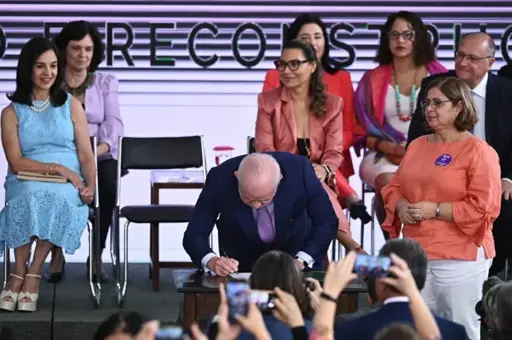
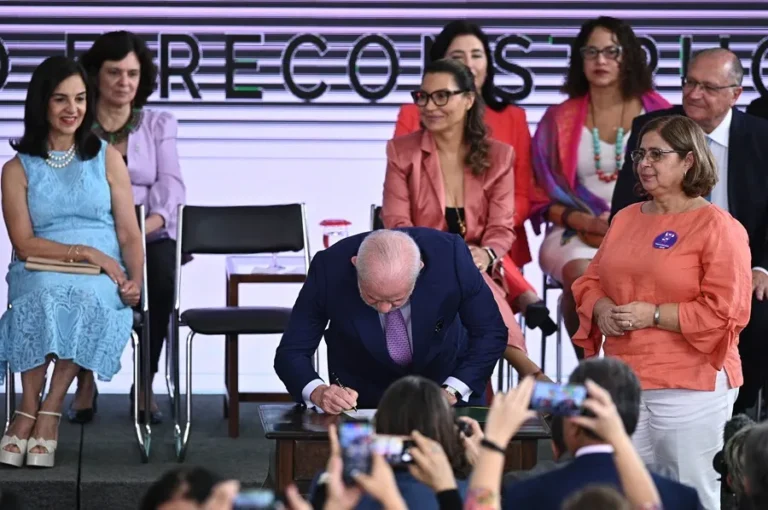
Women’s rights in Brazil advance under Lula through anti-violence measures, equal pay rules, menstrual health, and stronger care policies.
Related: Lula Calls for First-Round Victory Over Flavio Bolsonaro
Women’s rights in Brazil have become a central pillar of President Luiz Inácio Lula da Silva’s current term, with policies aimed at reducing inequality, expanding protection, and improving daily life for women across the country. Since returning to office in 2023, Lula has promoted legislative, economic, and social measures focused on gender-based violence, equal pay, economic autonomy, health, and care work.
Among the most significant advances is a new subsidy of up to six months for women victims of gender-based violence who are forced to leave their jobs. Access to the benefit requires only a judicial decision, eliminating the medical evaluation that previously delayed or blocked support for many victims.
Women’s rights in Brazil and anti-violence policy
https://www.gov.br/mulheres/pt-br
https://www.unwomen.org/
The push for women’s rights in Brazil has been closely tied to the fight against gender-based violence. The new subsidy is incorporated into the Maria da Penha Law and represents a major step forward by removing the medical assessment requirement that had made it harder for women to access economic support.
Under the new rule, women with formal employment will receive payment for their first 15 days away from work from their employer. From the 16th day onward, the National Social Security Institute, or INSS, will cover the benefit. For women without a formal job, the public institution will pay the full protection period, which can last up to six months.
The measure reflects priorities Lula has defended during his re-election campaign, where gender equality and the fight against domestic violence have been central themes. It also fits into a broader strategy to strengthen protection networks and reduce the barriers victims face when seeking help.
One of the most important initiatives in this area is the National Brazil Pact Against Femicide, signed in February 2026 by the executive, legislative, and judicial branches. The pact aims to coordinate efforts to prevent the murder of women because of their gender and to improve the response of public institutions.
The agreement sets priorities such as speeding up protective measures, strengthening victim support networks, expanding educational actions, and ensuring that aggressors are held accountable. It also establishes a permanent governance structure to coordinate policies across different branches of government.
In the technology field, the Brazilian government has launched tools to improve institutional response and directly protect women at risk. One of these is the Integrated Mulher Segura System, created to collect, organize, and systematize information on different forms of violence against women from public records.
The platform allows data to be consolidated at a national level and provides information that helps design prevention policies and improve the work of institutions that assist victims. Another initiative, the Alerta Mulher Segura Program, incorporates electronic monitoring of aggressors to reinforce compliance with judicial protection orders.
The system uses electronic ankle bracelets for perpetrators and portable tracking devices for victims. When an aggressor crosses the security perimeter set by the courts, an automatic alert is triggered, warning the woman and allowing police forces to intervene more quickly.
Lula da Silva: “No hay razón para que las mujeres sean tratadas como inferiores”. ¿Qué cambia en Brasil rumbo al Mundial 2027? Entra al enlace y conoce 👉 https://t.co/dI0Mz4dTBu#Brasil #FútbolFemenino #28Sep pic.twitter.com/yCo6KrzAt9
— teleSUR TV (@teleSURtv) September 28, 2026
Women’s rights in Brazil and equal pay
https://www.planalto.gov.br/ccivil/_03/ato2023-2026/2023/lei/l14611.htm
https://www.oecd.org/
The push for women’s rights in Brazil also includes economic measures aimed at reducing gender inequality in the workplace. One of the main advances was the enactment in July 2023 of the Equal Pay Law (14.611), which requires equal remuneration for men and women performing work of equal value or holding identical positions.
The law introduces pay transparency mechanisms, stricter inspections, and sanctions for companies that engage in discriminatory practices. It also requires companies with at least 100 employees to publish semiannual reports on remuneration, in order to identify disparities and demand corrective action plans.
The legislation also strengthens reporting channels and promotes training and inclusion programs to help women access employment, remain in the labor market, and advance professionally. In cases of wage discrimination, companies can face fines equivalent to ten times the new salary that should have been paid to the affected worker, a figure that doubles in cases of repeat offenses.
In the area of social protection, Lula’s government has maintained the priority of women as recipients of Bolsa Família payments, especially when they are responsible for supporting their households. This arrangement ensures that cash transfers reach mothers and female heads of household directly, strengthening their ability to make decisions about their families’ well-being.
The focus on women’s rights in Brazil also extends to areas that affect daily life, such as menstrual health, care work, and the balance between family and work responsibilities. These initiatives recognize that domestic and care tasks fall disproportionately on women and can limit their participation in employment and other social spaces.
One of the key programs in this area is Dignidade Menstrual, which guarantees the free and continuous distribution of sanitary pads to people who meet certain vulnerability criteria. The distribution is carried out through the Farmácia Popular program and targets low-income students, people registered in the Cadastro Único, and those experiencing homelessness.
In December 2024, Lula signed the National Care Policy, which recognizes care as a right and establishes shared responsibility among the state, families, the private sector, and society. The policy recognizes both the right of people to receive care and the rights of those who provide it, while also promoting personal well-being and autonomy.
The policy was later regulated to establish the National Care Plan as a tool for planning public action in this area. The goal is to coordinate measures across different agencies and levels of government, with targets and execution mechanisms aimed at expanding services and advancing toward greater shared responsibility in care work.
Women in science, culture, and sport
https://www.gov.br/mcti/pt-br
https://www.olympic.org/
The push for women’s rights in Brazil has also reached areas such as scientific research, cultural production, and high-performance sport. In these sectors, the federal administration has promoted economic support and measures to reduce barriers that can limit women’s professional development.
In science, the government has allocated specific resources for projects led by female researchers and for initiatives aimed at increasing women’s participation in fields where they have historically been underrepresented. These programs seek not only to fund research, but also to support training, retention, and career progression for women in science and technology.
One of the actions developed is the Feminismos, Mulheres e Meninas na Ciência program, promoted by the Ministry of Science, Technology, and Innovation. It includes support for scientific projects as well as outreach and training activities.
Support has also extended to the cultural sector, through calls and funding mechanisms that include women’s participation in areas such as film, literature, and other artistic expressions. These initiatives are part of broader policies to expand women’s presence in cultural production and facilitate access to public resources for developing projects.
In high-performance sport, a relevant measure was the extension of protection for athletes who receive public financial support. Brazilian legislation guarantees maternity leave for athletes benefiting from the Bolsa Atleta program, allowing them to temporarily pause their activities to have a child without automatically losing state support.
The measure aims to prevent motherhood from becoming a break in athletes’ careers and to allow them to return to competition later. It is part of a wider effort to ensure that women’s rights in Brazil are respected across all areas of public life.
Geopolitical context
The push for women’s rights in Brazil also has regional and global significance. In Latin America, where gender-based violence and economic inequality remain persistent challenges, Brazil’s approach is being watched as a possible model for other countries in the region.
The emphasis on equal pay, care work, and protection against femicide reflects a broader global debate on how states can reduce structural inequality. For international organizations, Brazil’s policies offer an example of how legal frameworks and social programs can be combined to advance gender equality.
At the same time, the women’s rights in Brazil agenda is unfolding in a political environment where far-right forces continue to challenge progressive policies. The outcome of these measures will depend not only on legislation, but also on budget allocation, institutional capacity, and sustained political commitment.
What comes next
The next steps will be closely watched. The implementation of the anti-violence subsidy, the equal pay law, and the national care plan will depend on effective coordination between federal, state, and municipal governments.
For now, the women’s rights in Brazil agenda represents one of the most ambitious policy efforts of Lula’s current term. Whether it delivers lasting change will depend on how these measures are enforced and expanded in the coming years.
From teleSUR English via This RSS Feed.