


Police killings — His final word was “fire”. On 7 January 2005, German police in Dessau locked the Sierra Leonean asylum seeker in cell number five, and tied him to a mattress by his hands and feet. Hours later, he burned to death. The police story was that Jalloh, bound at all four limbs, had somehow set himself alight with a lighter. More than twenty years on, his family and supporters are still fighting to have the case properly reopened.
This month, Jalloh’s family will be in London. So will the families of people killed by police in France, Belgium, Switzerland, Spain and the UK.
Police killings — A tribunal led by the families
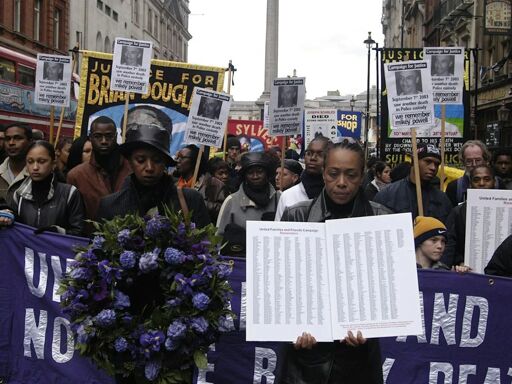
On 17 and 18 October, the People’s Tribunal on Police Killings will host what it calls an unprecedented European gathering. Families will give public testimony about the deaths of their loved ones, and about what came after. All the cover-ups, the collusion between police and judicial investigators, and the governments that stood behind them.
They will speak in front of an international panel. It includes Mireille Fanon Mendès-France of the Frantz Fanon Foundation, daughter of the legendary revolutionary and scholar Frantz Fanon. Alongside her sit US scholar Dr Joy James, Esther Mamadou-Blanco of the International Coalition for People of African Descent, and veteran British campaigner Professor Gus John. After the public day, the families will meet behind closed doors to plan a joint international strategy.
The tribunal describes itself as a “radical grassroots initiative” led by the families and friends of people killed by police, in prison and by other state agencies. It is supported by Migrant Media, 4WardEverUK and other groups.
Its aim is simple enough. These families have spent decades knocking on the doors of courts and inquiries that would not open. Now they’ve organised, united, and are knocking together.
The same story in six countries
One glance at the names on the list and you start to see the pattern. The victims are overwhelmingly Black, Arab, migrant or working class. The deaths happened in custody, in police vans and during arrests. And the system that was supposed to deliver justice failed to do so. Decades later, still no justice.
Take Lamine Dieng, for example. In June 2007, the 25-year-old French-Senegalese man died in a police van in Paris after officers pinned him face down. The first autopsy blamed an overdose. A second found he had suffocated, his head crushed against the floor of the van. French courts still threw the case out. To add insult to the family’s grief, they were ordered to pay €2,000 to the officers.
The family took France to the European Court of Human Rights. In 2020, the French state agreed to pay them €145,000 in a friendly settlement. No officer was ever tried. France just paid for Lamine’s death with taxpayers’ money, and the police were allowed to walk away.
Or take Brian Douglas, this time in London. In May 1995, police stopped the 33-year-old music promoter and father of one in Clapham. An officer struck him with one of the new American-style batons the Met had just introduced. He died five days later of a fractured skull. The inquest returned a verdict of misadventure. His family says the officers were never even disciplined.
Then there are Babacar Gueye and Adam B. in France, Lamine Bangoura in Belgium, Rooble Warsame in Germany, Roger Wilhelm in Switzerland, Haitam Mejri in Spain, and Olufemi Owoborode in the UK. Different countries and different decades, but the same story every time. Police killings and total impunity.
3,000 deaths, three convictions
The numbers in Britain alone should shame every home secretary of the last half-century. According to the tribunal, more than 3,000 people have been killed by police in the UK since 1970. In that time, only three cases have ended with officers convicted of manslaughter or murder.
Three.
That isn’t some sort of mistake. It’s a system working exactly as designed. The police investigate the police and the prosecutors decide the police are right in their investigation, then the coroners settle on “misadventure”. Politicians then swoop in to praise officers for their bravery.
Meanwhile the families are left to do the investigating themselves, often for decades, and often at their own expense. And these investigations bear fruit while the investigations of the state don’t — Dieng’s family pushed for a second autopsy, which found he’d suffocated rather than overdosed
The tribunal is now gathering data for a Europe-wide map of deaths at the hands of police. No government seems in any hurry to produce one itself.
Police killings — Why this matters now
Across Europe, governments are handing police more powers, not fewer. Here in Britain, people are being arrested for chanting on protests or pensioners holding placards, while murdering officers walk free. Accountability only seems to run in one direction.
That’s why a gathering like this matters. These families have been told for years that their cases were isolated tragedies. Putting them in one room tells a different story — this is how policing works for Black, Brown, migrant and working-class people across the continent.
The public testimonies are on Saturday 17 October at ArtsTwo in Mile End, East London. Tickets are free and can be reserved here.
Please come and listen. The least we owe these families is to hear what they have to say.
Featured image via Eventbright
By Jamal Awar
From Canary via This RSS Feed.