

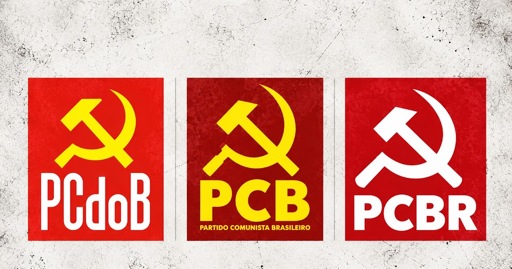

With Brazil heading to the polls in October, three communist parties are approaching the elections from sharply different positions. The Communist Party of Brazil (PCdoB) remains fully committed to the re-election of Luiz Inácio Lula da Silva and the PT-led coalition, while the Brazilian Communist Party (PCB) is presenting its own presidential ticket headed by Edmilson Costa, and the Revolutionary Communist Party (PCBR) is calling for an independent revolutionary left position outside both the Bolsonarist camp and the Lula-led broad front.
For the PCdoB, the immediate priority is defeating the far right and securing another Lula government. The party has officially endorsed the Lula-Alckmin ticket and is campaigning inside the Brasil da Esperança federation with the PT and PV, arguing that a new Lula term should deepen national development, reindustrialization and social policies. Its leaders present Bolsonarism as a neofascist, pro-US force and frame the election largely as a confrontation between the democratic-popular camp and the far right.
That strategy, however, also exposes the central contradiction of the PCdoB’s electoral line: for years it has subordinated its communist identity to alliances led by the PT and to the management of capitalism through broad coalitions. Its 2026 campaign again ties communist activity to Lula’s re-election rather than to an independent communist presidential project. From a class standpoint, this leaves unresolved the question of whether repeated support for social-democratic and social-liberal governments can produce a genuinely independent political pole for the working class.
The PCB has taken the opposite road. It is running Edmilson Costa for president and Cleusa Santos for vice-president on an explicitly anticapitalist and anti-imperialist platform centered on “popular power” and socialism. The party rejects the argument that every left-wing vote outside Lula automatically strengthens the far right, insisting that the working class cannot be permanently trapped by the logic of the “lesser evil.” In a recent intervention, Costa argued that fighting the extreme right and building an independent workers’ alternative are not contradictory tasks, but part of the same struggle.
The PCBR goes even further in its criticism of the established polarization. It describes the contest between Bolsonarism and the Lula-Alckmin bloc as a “false polarization” between two different forms of bourgeois politics: on one side, a reactionary far right associated with authoritarianism, attacks on workers’ rights and open class aggression; on the other, what it calls a social-liberal broad front that preserves austerity, privatization, precarious work and capitalist property relations. The PCBR therefore stresses proletarian political independence, socialist program and coordination among revolutionary forces, while some of its local organizations have backed candidacies from the PCB, PSTU and other forces of the revolutionary left.
The October elections will thus reveal not only the balance between Lula’s camp and the Bolsonarist right, but also the continuing strategic dispute within Brazil’s communist movement over whether communists should operate under a broader social-democratic banner or maintain an explicitly independent class line.
From In Defense of Communism via This RSS Feed.
It’s either Lula or the guy whose father tried to conduct a military coup just a few years ago. A guy who almost certainly was involved. This is not a hard choice. You will be put up against a wall. He will murder you.
