

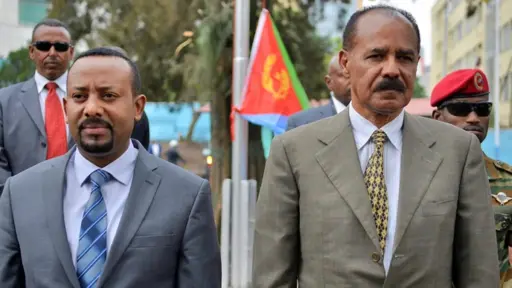
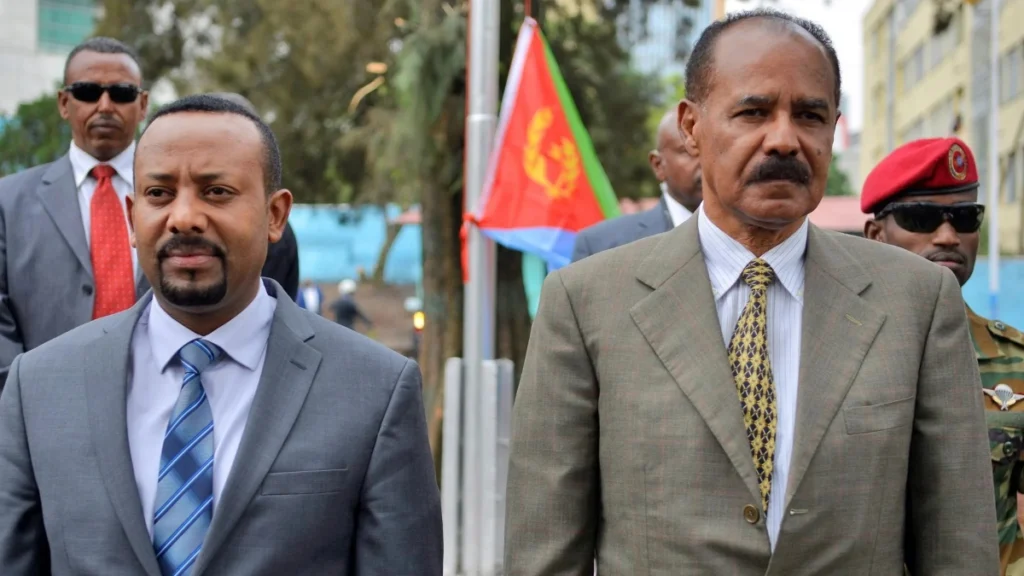
Ethiopia and Eritrea severed diplomatic relations Friday, one day after a drone attack struck Ethiopia’s Defense Ministry and National Defense Force headquarters in Addis Ababa, pushing a simmering dispute over Red Sea access into open rupture between the Horn of Africa neighbors.
Ethiopia expelled ten Eritrean diplomats and closed its embassy in Asmara in an immediate reprisal for Thursday’s explosion in the capital’s Tor Hayloch district, meanwhile rebel factions fighting the Ethiopian government in the northern Tigray region claimed responsibility for the drone strike.
Ethiopian officials nevertheless accused Eritrea of backing those insurgents, including the Tigray People’s Liberation Front. They cited what Addis Ababa described as “direct and indirect acts of hostility and belligerence” carried out against Ethiopian territory.
RELATED: UN Warns Ethiopia Risks Return To Full-Scale War
Asmara rejected the accusation and announced its own complete rupture of diplomatic ties. Eritrea blamed Ethiopia for arming, training and sheltering opposition groups to stoke internal conflict and engineer regime change, maneuvers the Eritrean Foreign Ministry cast as part of Addis Ababa’s expansionist plans.
The rupture reverses a rapprochement that began in 2018, when Eritrea reopened its embassy in Addis Ababa after years of estrangement between the two governments. That reconciliation had briefly raised hopes for lasting peace in the Horn of Africa.
Press Release: Ethiopia’s Deplorable Acts of Hostility
The Ethiopian Government issued a Press Statement today announcing the closure of the Eritrean Embassy to Ethiopia as well as declaring ten Eritrean Diplomats, including the Charge d ’Affairs and other Eritrean Diplomats… pic.twitter.com/YSTevbbcuj
— Ministry of Information, Eritrea (@shabait) October 1, 2026
Red Sea Access Dispute
Tensions in the Horn of Africa have escalated in recent months amid Ethiopia’s demands over portions of Eritrea’s Red Sea coastline. Landlocked Ethiopia lost its direct outlet to the sea in 1993, when Eritrea secured independence, and now relies on Djibouti for the overwhelming share of its international trade. Prime Minister Abiy Ahmed has made reversing that dependence a central strategic objective.
Eritrean Foreign Minister Osman Saleh asserted last month that Abiy Ahmed is pursuing a policy similar to Israel’s between the Nile River and the Red Sea. The territorial ambition carries explicit Israeli backing. Ambassador Avraham Neguise recently described support for Ethiopia’s maritime aspirations as clear state policy designed to secure a foothold in East Africa and counter Yemeni forces in the Bab al-Mandab strait, a vital chokepoint at the southern entrance to the Red Sea.
Ethiopia’s territorial ambitions have drawn explicit backing from Israel, whose ambassador, Avraham Neguise, recently said supporting Ethiopia’s maritime aspirations reflects clear state policy aimed at strengthening Israel’s foothold in East Africa and countering Yemeni forces’ influence over the Bab al-Mandab strait -a military relationship with roots dating back to the 1970s and 1980s.
Foreign Powers Drawn In
The United Arab Emirates has also been drawn into the alliance, having supplied drones and military equipment to Abiy Ahmed’s forces as a close regional partner. Eritrean Foreign Minister Saleh further warned of what he called Emirati “port imperialism” in Africa, pointing to conglomerates DP World and AD Ports, which he said control strategic enclaves across the continent’s eastern region.
Among the areas controlled by Abu Dhabi is Puntland, a semi-autonomous territory of Somalia whose independence is recognized solely by Israel. Eritrea has additionally accused the UAE of using its regional port network to deliver weapons to the Rapid Support Forces fighting in Sudan.
The dispute brings together longstanding sovereignty disputes, competing port interests, and the involvement of regional and international powers vying for geostrategic control over the Red Sea. The diplomatic rupture marks a significant escalation in what had already been a tense relationship between the two Horn of Africa neighbors, raising concerns about the potential for broader conflict in a region already strained by competing foreign interests and ongoing instability tied to Ethiopia’s internal conflicts, including the unresolved situation in Tigray.
From teleSUR English via This RSS Feed.