

France’s high school student unions distanced themselves Friday from episodes of urban violence that have accompanied weeks of nationwide protests, insisting they would continue pressing for better educational conditions while rejecting any association with the unrest.
Following a meeting with the Ministry of National Education, Nathanaël Combary, President of the Renouveau Lycéen Union, said those responsible for the disturbances have no connection to the movement’s actual demands.
Louis Letoublon, Vice-president of the Les Lycéens movement, echoed that position, arguing that continued dialogue with authorities is necessary without abandoning classroom mobilization, which he said is needed to maintain balance in the broader social conflict.
RELATED: French Students Put the Macron Administration in a Tight Spot
France’s magistrates’ union joined the pushback, demanding an end to police repression against students and accusing the government of responding with excessive force to what it described as legitimate anger over the deterioration of public education. The union criticized a security strategy it said was poorly suited to the vulnerability of minors, warning that the disproportionate use of force has disproportionately affected young people from working-class and minority neighborhoods and arguing that force alone would not restore calm.
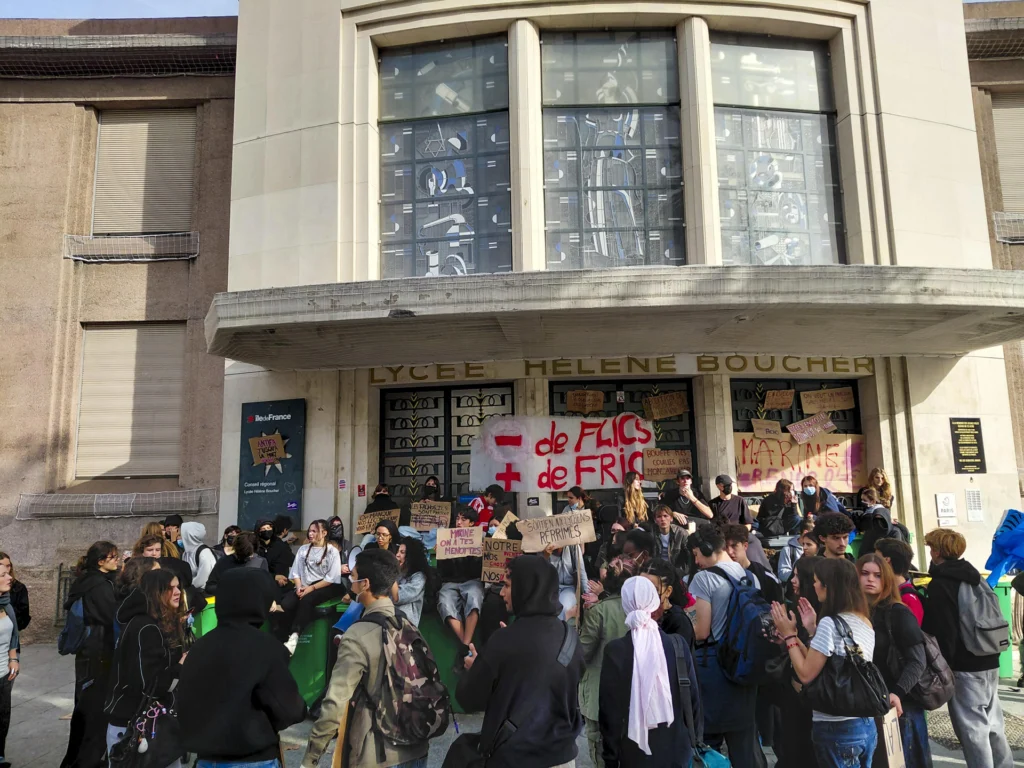
Protesting students at Hélène Boucher High School in Paris, considered one of the capital’s most prestigious institutions, pushed back against how they have been portrayed in media and government statements. Students said the aim of linking them to vandalism was to discredit their demands, stressing that those causing destruction were acting independently of organized student groups. The protest at Hélène Boucher began in solidarity with students at Paul Éluard school in Saint-Denis, who have denounced unsanitary conditions, teacher shortages and inadequate resources amid declining results in international PISA assessments, while also criticizing increased military spending alongside cuts to education funding.
🇫🇷 Mass riots are continuing in France
More than 400 schools are fully closed today over damage and threats to staff. Pupils have been moved to remote learning.
Despite bans on gatherings outside closed lycées, protests and clashes with police have been running since morning in… pic.twitter.com/rw6M3bS25m
— Visegrád 24 (@visegrad24) October 2, 2026
Crackdown Toll Rises
The protests, which began September 21, have been marked by vandalism and violent repression, that has led to the closure of 400 high schools and nearly 3,000 detentions nationwide within a 48-hour period. Justice Minister Gérald Darmanin has urged prosecutors to pursue civil liability against parents to cover repair costs, saying roughly 300 police officers and gendarmes and more than 60 teachers and school administrators were injured, while media reports point to dozens of additional injuries.
The unrest has fueled a broader political debate, with the government and figures including Franck Leroy blaming the left-wing La France Insoumise party (LFI) and its leader, Jean-Luc Mélenchon, for fostering the climate of violence -accusations the party has firmly denied, rejecting any suggestion that it incited confrontation.
Although the France’s government has announced the creation of a dialogue platform, student unions have called for blockades to continue, with local broadcasters reporting that no formal channel for resolving the conflict currently exists.
From teleSUR English via This RSS Feed.