

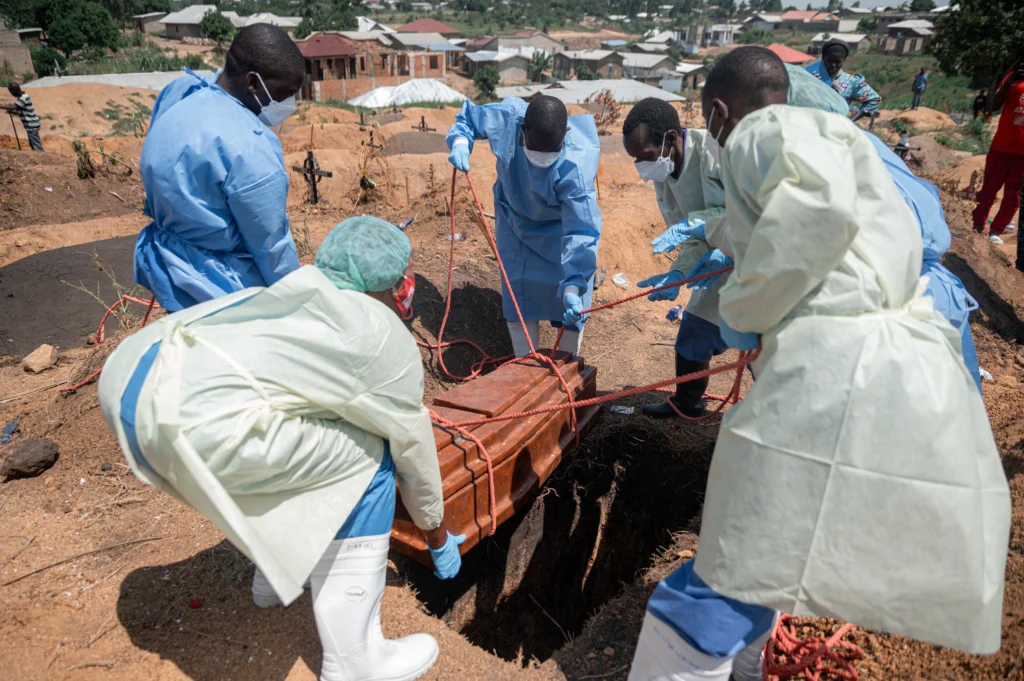
The Ebola outbreak sweeping eastern Democratic Republic of the Congo has killed 4,018 people out of 8,300 confirmed cases since May 15, making it the second deadliest in global history as unpaid frontline workers protest in Bunia.
The Ebola outbreak declared on May 15 in eastern Democratic Republic of the Congo has claimed 4,018 lives, according to the latest report from the country’s National Institute of Public Health.
Health authorities have recorded 8,300 confirmed cases, and the overall case fatality rate now stands at 48.4%.
RELATED: Seven Children Die from Ebola Each Day in DR Congo: Save the Children
The outbreak has spread across 63 health zones in 7 of the country’s 26 provinces, with Ituri remaining the epicenter while the virus has also affected Tshopo, Bas-Uélé, Haut-Uélé, North Kivu, South Kivu and South Ubangi. Despite the severity of the epidemiological situation, 2,162 patients have recovered so far, while another 842 remain hospitalized or in strict isolation.
The emergency now ranks as the second-deadliest Ebola outbreak in global history, trailing only the 2014-2016 West African epidemic that killed roughly 11,000 people. Transmission also crossed into neighboring Uganda, where 20 cases and two deaths were recorded before the World Health Organization (W.H.O.) declared that regional cluster over.
The Bundibugyo strain driving the current emergency has no specific medical treatment available. The W.H.O. is therefore developing two vaccines that have entered phase 1 trials in humans. In parallel, the Congolese government launched a mass immunization campaign using Ervebo, a vaccine that showed promising signs against this variant during animal testing.
The Ebola outbreak is not the only threat facing affected communities. Violence and insecurity are making it increasingly difficult to contain the virus, reach vulnerable populations and deliver life-saving medical assistance.
How can the outbreak be contained when violence… pic.twitter.com/7nLoiCPJZe— teleSUR English (@telesurenglish) October 2, 2026
Wages Threaten Response
Containment efforts are facing serious operational setbacks due to protests by frontline health workers in Bunia, the capital of Ituri province, who are demanding urgent payment of overdue wages. Contact tracers took to the streets with signs reading messages such as “No money, no data,” warning that repeated strikes are paralyzing the collection of information essential to slowing transmission of the virus.
Ebola spreads through direct contact with bodily fluids from infected humans or animals. The virus provokes severe hemorrhagic fever, vomiting, diarrhea and heavy internal bleeding in patients. The lack of funds to cover medical staff’s unpaid wages is deepening the humanitarian crisis in the most vulnerable communities, raising fears that the epidemic could spiral further out of control across Congolese territory if the labor disputes are not resolved.
Health officials have not indicated when the backlog in salary payments is expected to be resolved, even as international health bodies continue to warn that disruptions to contact tracing and data collection can significantly undermine outbreak containment efforts, allowing transmission chains to go undetected for longer periods. W.H.O. and international partners have previously provided support to the DRC’s Ebola response, though the current wage dispute highlights persistent funding and logistical challenges facing frontline health systems in conflict-affected regions of the country, where access to remote areas and chronic underfunding have historically complicated outbreak response efforts.
The outbreak’s continued spread, combined with the ongoing fatality rate nearing 50%, has placed added pressure on both Congolese authorities and the international community to accelerate vaccine deployment and resolve the labor disputes threatening to further hinder the response before the epidemic reaches additional provinces.
From teleSUR English via This RSS Feed.