

From the New York Times (9/23/26)…
It’s that time of year again: The Houthis are making the news—and so is the Western corporate media narrative that surrounds them.
The Houthis—formally Ansar Allah, “Supporters of God”—are from the Zaydi Shia minority in Yemen, and have governed the most populous sections of the country, including the capital Sanaa, since the start of Yemen’s civil war in 2014.
Like many a “civil” war, the conflict has plenty of outside participants—most notably Saudi Arabia, which led a coalition of Arab states (with the backing of the United States) in an effort to bomb and starve Yemen away from Houthi control.
In 2022, a tenuous truce took hold between the Houthis and the Saudi-backed Yemeni government, but the Saudi blockade of the country was never lifted.
This July, the Houthis declared their own naval blockade of Saudi Arabia, in response to the Saudi siege and resumed bombing of Yemen. In a rapid September offensive, the group completed its takeover of Yemen’s Red Sea Coast and the strategic Bab al-Mandeb strait, putting Saudi oil shipping operations in a decisive bind. The Houthis have also launched missiles at Saudi Arabia in response to Saudi attacks on the country.
‘Who are the Houthis?’
…to the BBC (9/24/26)…
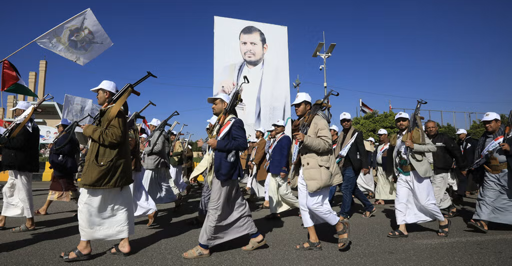
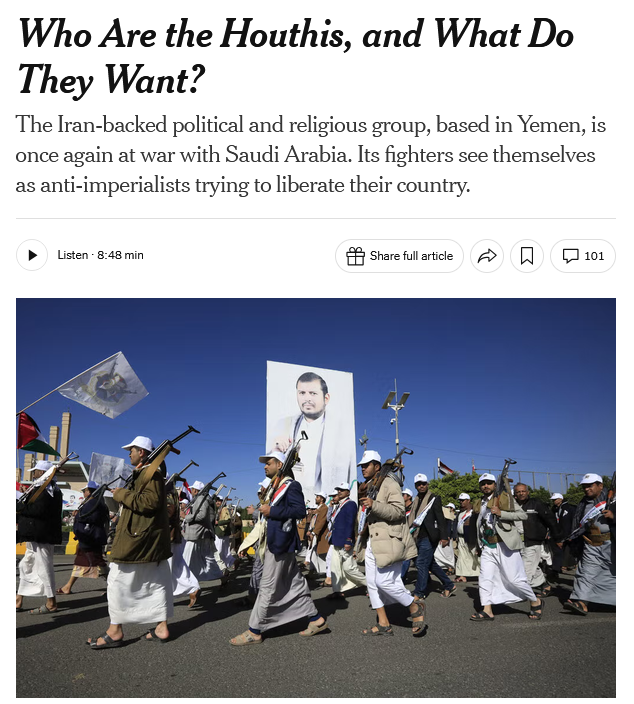
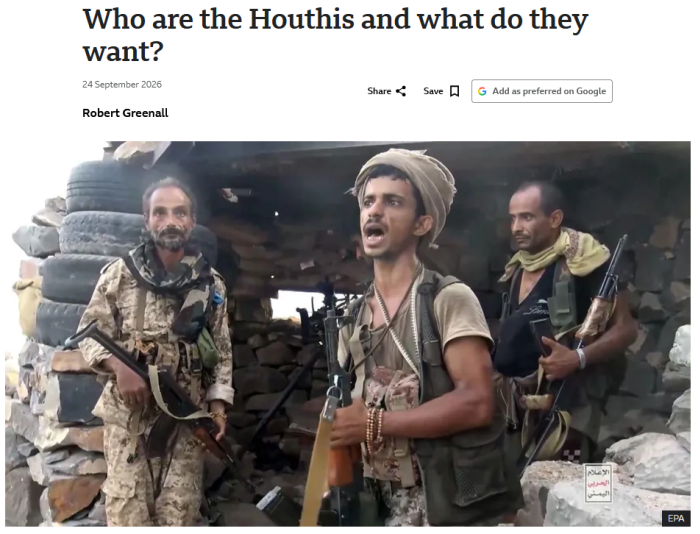
The offensive has prompted a slew of media interventions to ostensibly explain to everyone who the Houthis are. The New York Times (9/23/26), for instance, ran the headline “Who Are the Houthis, and What Do They Want?”; the BBC (9/24/26) ran the very same title, minus the comma.
The Washington Post (9/15/26) asked: “Who Are the Houthis, the Iran-Backed Rebels Threatening a Key Maritime Passage?” Its headline characterization revealed what corporate media see as the primary thing anyone needs to know about the Houthis: that they are simply proxies of Iran, the West’s current favorite enemy.
In a typical example, a recent CNN dispatch (9/21/26) identified the Houthis as “Iran-backed” in both the headline and the first sentence, with a reference to “Tehran’s proxies” appearing further down.
For its part, an Associated Press exclusive (9/23/26) on how “Iranian Advisers Helped Houthis Seize Yemen’s Red Sea Coast in Less Than 48 Hours” sounded the alarm that “Iranian Revolutionary Guard advisers were in the field helping direct the battle,” in a show of “how Iran has built the Houthis into a major regional partner able to open a new front in the wider war with the US.”
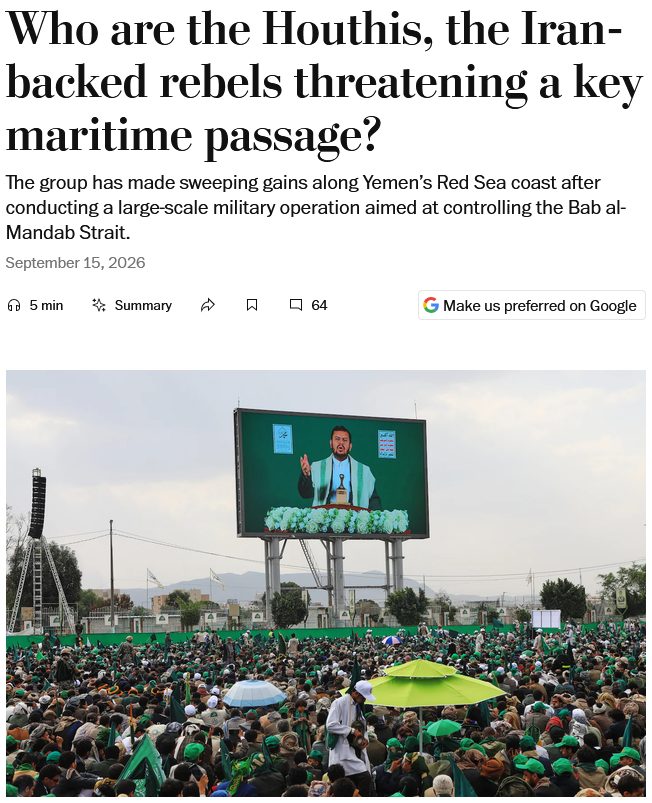
…to the Washington Post (9/15/26), establishment media are asking the same question, but not giving many answers.
Lost in the AP report, of course, is the fact that neither Iran nor the Houthis had anything to do with starting the “wider war.”
Following the launch earlier this year of the deranged US/Israeli war on Iran, the Houthis largely stayed on the sidelines. But now that they are acting up again, the media seem happy to oversimplify and demonize them as foot soldiers of Tehran.
The media’s reductionist approach erases the Houthis’ own domestic motives and aims, not to mention their own reasons for standing up to Saudi Arabia, the US, and Israel. That essentially eliminates the need for further investigation or thought about appropriate diplomatic responses, and justifies whatever aggression is meted out against Yemen by Saudi Arabia and friends. It also props up the idea that the US is fundamentally right to go after a proxy-happy Iran bent on overturning the proper regional order.
Granted, the Washington Post’s “Who Are the Houthis” explainer (9/15/26) does allow a bit of space for the view of a “pro-Houthi commentator,” Hussain al-Bukhaiti, who
said Houthi demands include free movement at Yemen’s ports and airports, the exchange of all prisoners of war and the use of Yemen’s oil revenue—much of which is under Saudi control—to pay the salaries of civil servants and services across the country.
But this idea that the Houthis have interests beyond those of Iran is immediately dismissed by an anonymous Yemeni official in the next paragraph, who the Post paraphrases saying that “the Houthi fighters were being closely directed by Iranians on the ground.” And who should Post readers believe—the Iran proxies or the US allies?
‘US-backed’ Saudi Arabia?
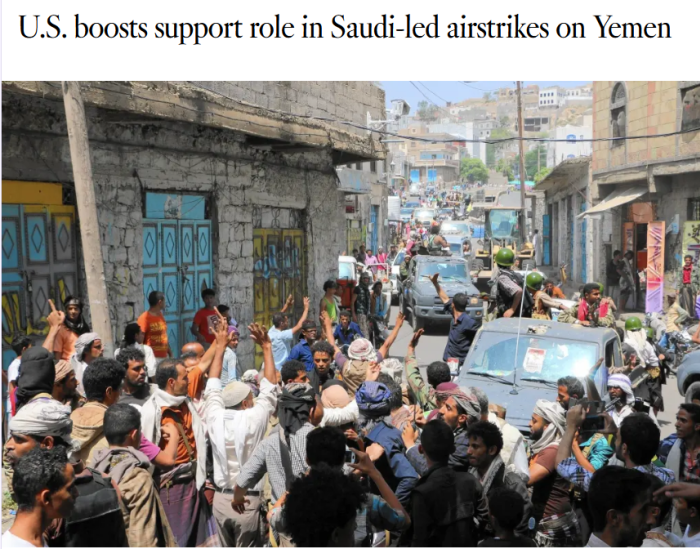
Without acknowledging this quite recent history (LA Times, 8/17/15), it’s impossible to explain why Yemenis would naturally sympathize with a country under attack from the US.
The media’s longstanding pathological refusal to discuss the Houthis as anything but “Iran-backed” raises the question of why, for the sake of symmetry at least, Saudi Arabia is never defined as “US-backed.” To be sure, it would be more difficult to cast the kingdom as a victim of Houthi antagonism were media outlets to provide regular reminders of the global superpower’s role in underwriting Saudi-led slaughter in Yemen.
Consider that, when the Saudi-led coalition staged its bloody entrance into the Yemeni civil war in 2015, the Barack Obama administration stood by with “intelligence, munitions and midair refueling to coalition aircraft” to assist in bombing the hell out of the impoverished nation.
American warships also helped to enforce a Saudi maritime blockade that would keep Yemen firmly on the brink of a famine that amounted to “torture in slow motion,” as determined by the World Organization Against Torture. Between April 2015 and October 2018, Save the Children estimated that some 85,000 children may have died of starvation in the country, due in large part to the blockade.
In August 2018, the Saudi-led coalition massacred 40 children and 11 adults on a school bus in northwestern Yemen, using a laser-guided bomb manufactured by Lockheed Martin, one of the beneficiaries of the previous year’s gargantuan US/Saudi “defense” deal. Neither this particular atrocity nor any other has made it into present media coverage as potentially useful context in understanding why the Houthis may have a beef with the (US-backed!) Saudis.
In the BBC’s “Who are the Houthis” explainer (9/24/26), Robert Greenall wrote that the group wants “an end to a Saudi blockade,” which inexplicably morphs later in the article into “what the Houthis say is a years-long Saudi blockade”—though it would have worked just fine to restate the blockade as fact.
Noting that “Saudi Arabia and Western powers say Iran smuggled weapons—including drones, and cruise and ballistic missiles—to the Houthis during Yemen’s civil war in violation of a UN arms embargo,” Greenall steered clear of referencing the effects of Western weapons on the Yemeni landscape.
‘Messaging is going to be tough’
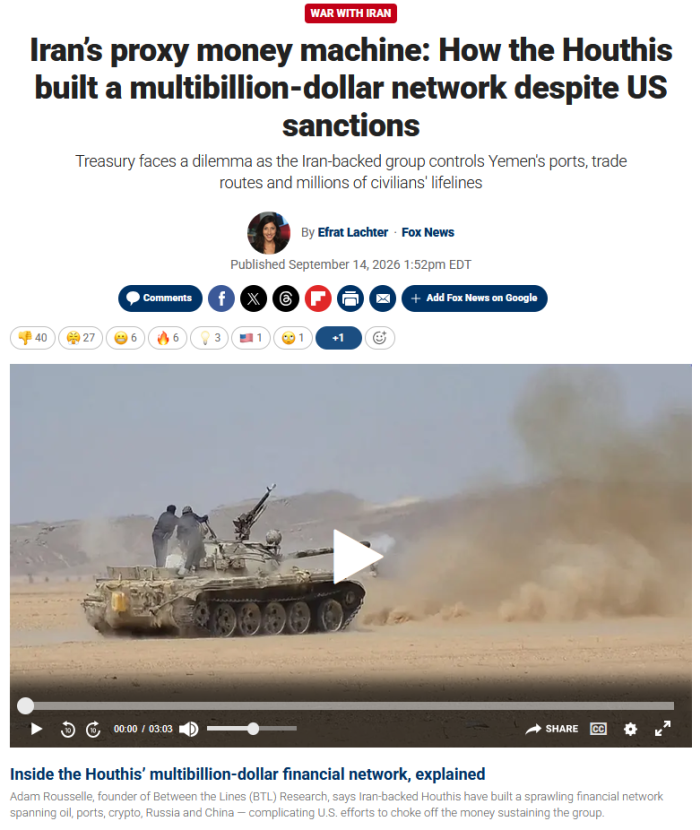
How dare Yemen continue to have an economy after the US said it couldn’t (Fox News, 9/14/26)?
In addition to helping sustain a panorama of utter humanitarian catastrophe in Yemen, the US has conducted its own periodic bouts of violence in the country since 2002, when “war on terror” chief George W. Bush kicked off a covert action program there—which allowed successive administrations to go about bombing Yemen without having to declare war or really say anything about it. By 2015, the London-based Bureau of Investigative Journalism calculated that such “covert action” had killed up to 1,580 people in Yemen.
Then, last year, Donald Trump undertook to pummel the country and kill a bunch of civilians in response to Houthi attacks on US ships in the Red Sea, and other actions carried out in solidarity with the victims of Israel’s US-backed genocide in the Gaza Strip.
In private correspondence that was leaked to the public as part of the debacle known as Signalgate, US Secretary of Defense Pete Hegseth cautioned that “messaging [on Yemen] is going to be tough” because “nobody knows who the Houthis are.” Of course, just because the taxpayers funding the bombing have no clue what is going on is no reason to call off the effort, and Hegseth cautioned that the US government needed to “stay focused” on conveying the idea that the Houthis are “Iran funded.”
Fast forward to now, and such messaging is still going strong, as in the September Fox News article (9/14/26) headlined “Iran’s Proxy Money Machine: How the Houthis Built a Multibillion-Dollar Network Despite US Sanctions.”
In the piece, complete with various menacing photographs of weapon-wielding Houthis, journalist Efrat Lachter warned ominously of “the sprawling financial network that has helped transform the Iran-backed group from a Yemeni insurgency into a heavily armed regional power capable of threatening global trade.”
And in case being a puppet of one US enemy isn’t enough, the Wall Street Journal (9/23/26) added that the Houthis are also “increasingly supplied by China.”
Trump, who apparently spoke too soon last year when he informed the Houthis that they would be “completely annihilated,” has thus far refrained from intervening in Yemen again on behalf of Saudi Arabia—although the United Kingdom has dutifully come to its fellow kingdom’s aid.
US ‘must rejoin Saudi war’
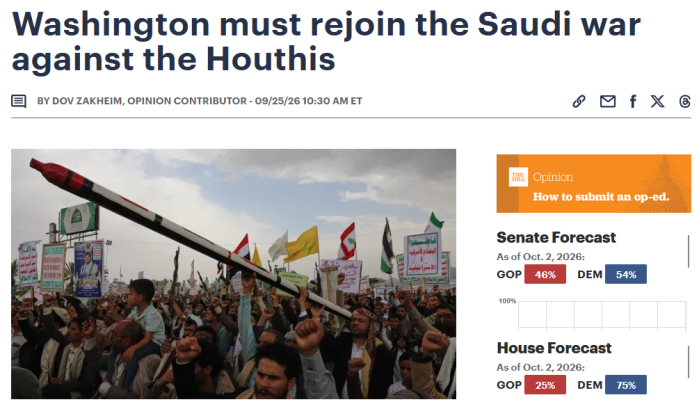
Dov Zakheim (The Hill, 9/25/26) warns that unless Saudi Arabia can continue to count on the US “rushing to its defense,” it and other Gulf states might find a way to get along peacefully with Iran.
Among observers concerned that the US is not engaged in nearly enough bellicose activity worldwide is Dov Zakheim, a former deputy undersecretary of Defense under Bush II and the author of an opinion piece at The Hill (9/25/26) headlined “Washington Must Rejoin the Saudi War Against the Houthis.”
In his entreaty, Zakheim urges the Trump administration to assist “its longstanding Middle Eastern ally” in spite of “an increasing munitions shortfall that would seriously worsen if it again joined the fight against the Houthis.”
And yet the shortfall somehow hasn’t managed to throw a wrench in plans for an estimated $24.3 billion fighter jet sale to Saudi Arabia—already the No. 1 client of US arms manufacturers—in a deal that was granted preliminary approval by the US State Department on September 17.
Ironically, Zakheim’s intervention contains more historical context than most corporate media coverage; at the outset, he explains that Houthi “resentment of Saudi Arabia stretches back nearly a century”:
In the 1920s, King Abdul Aziz of Saudi Arabia seized the Asir province that historically had been under Zaydi Muslim control. When the rulers of Yemen tried to reclaim the territory, they were defeated by the Saudis in 1934.
In other words, despite corporate media falling lock-step behind US officials on messaging, it’s not just all about Iran.
Now, as corporate media continue to ask who the Houthis are without wanting a real answer, one may recall Hegseth’s warning that messaging on Yemen was going to be “tough.” But for outlets committed to politically motivated and oversimplified sensationalism, it doesn’t seem very difficult at all.
From FAIR via This RSS Feed.