

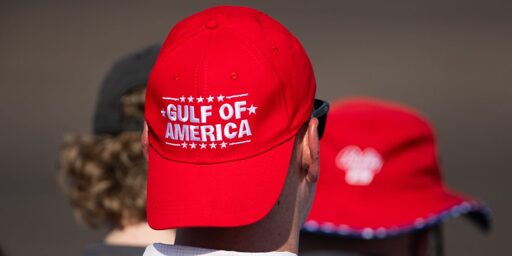
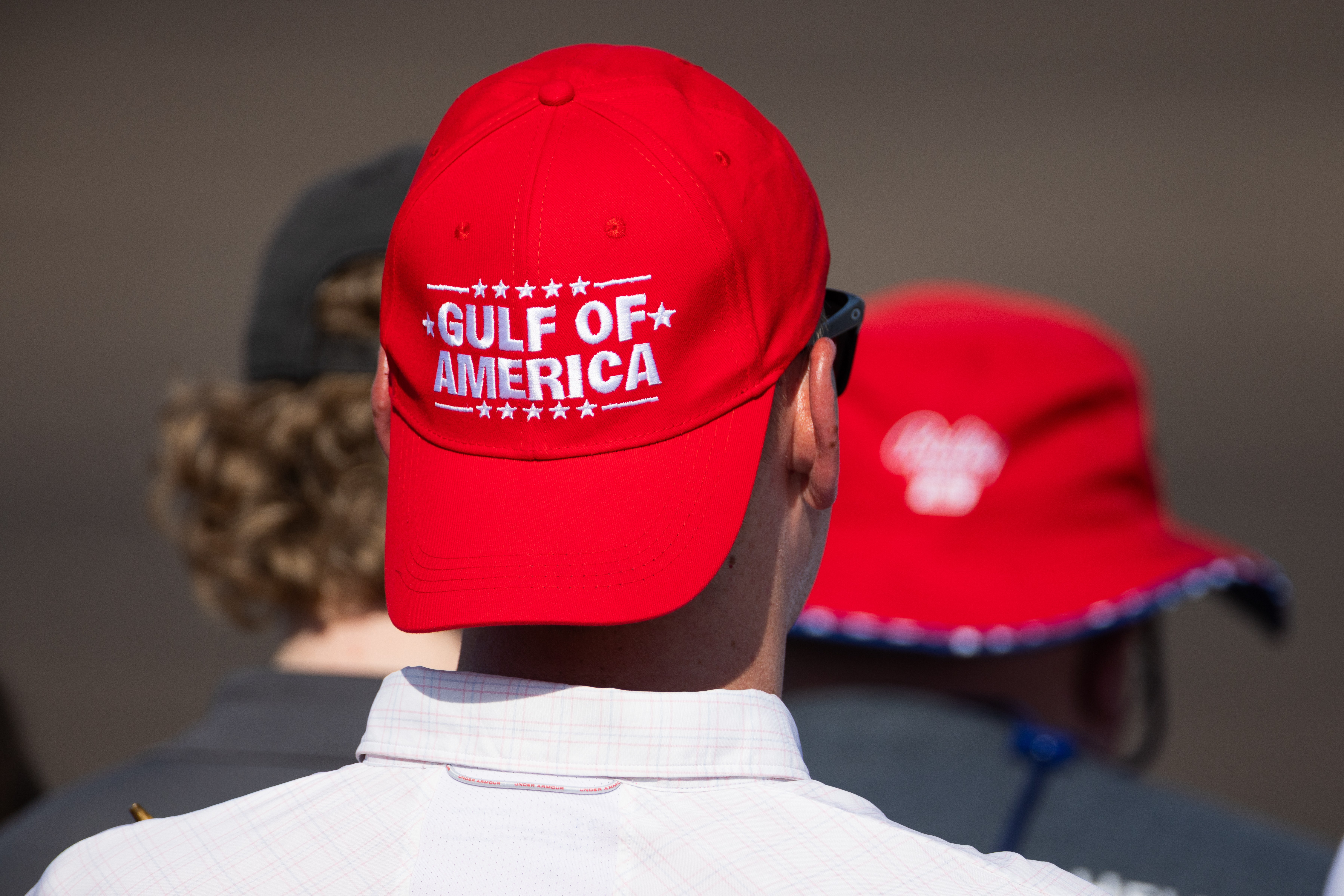
A man wears a red “Gulf of America” hat as Donald Trump arrives in Houston’s Ellington Airport, on Aug. 27, 2026, ahead of a Republican National Committee fundraiser. Photo: Reginald Mathalone/NurPhoto via Getty Images
Donald Trump received Chinese President Xi Jinping and the visiting Chinese press pool last week as reporters from news outlets he had banished stood outside the White House gates. At one point, Trump joked that China, the world’s leading jailer of journalists, “has the friendliest press corps.” Now, his acolytes in Alabama are taking up Trump’s cause, emulating the Chinese Communist Party’s mastery of information control at the local level by decreeing what supposedly independent public radio reporters are allowed to say.
The Alabama legislature passed a bill in late March requiring all state and local entities to refer to the Gulf of Mexico as the “Gulf of America,” in line with one of the many executive orders Trump signed on his first day in office. The legislation does not set forth penalties for noncompliance, but its sponsor, state Rep. David Standridge, called it “an opportunity to make a patriotic statement” on the House floor in January. Alabama Gov. Kay Ivey, a Trump ally, signed the bill into law.
Birmingham public radio station WBHM told its listeners in a letter from Will Dahlberg, the station’s executive director and general manager, that due to the law, which took effect October 1, the University of Alabama at Birmingham is forcing it to use the legislature’s preferred language in its reporting. The move puts it at odds with NPR, of which it is a member station; The Associated Press, which publishes the style guide used by newsrooms across the country; and other journalistic institutions. The station is licensed to the university, making its employees both state and UAB employees. Still, WBHM’s Journalism Code of Integrity emphasizes the newsroom’s independence and states that the university “should not — and cannot — expect to exert influence on WBHM’s journalists and its independent editorial process.”
Dahlberg wrote that not implementing the new language “may result in disciplinary action or termination of employees and affect WBHM’s relationship and support from UAB.” But nothing in the law requires the university to discipline or fire anyone. In other words, the university took a toothless stunt of a law, gave it teeth, and used them to take a bite out of press freedom.
Dahlberg also announced in the letter that he is stepping down from his position and leaving the station. His resignation was supposed to be effective October 16, but he posted an update that the university told him on Monday morning that he should pack his bags immediately. We cannot say for sure whether the university hastened Dahlberg’s departure due to his message to listeners and the criticism it generated, but the timing is certainly suspicious.
So why did the University of Alabama at Birmingham choose to embarrass itself rather than stand up for journalists and the First Amendment? As ridiculous as Alabama’s Gulf of America law is, its text did not tie the university’s hands. The university would not even have needed to bring a legal challenge to contest the law — it could have just let WBHM ignore it and supported its employees.
The university could have taken the position that the government choosing which words reporters must say is impracticable and burdensome.
The law only refers to “state and local entities” and makes no mention of media. It contains no penalties for noncompliance and limits its mandate to “when practicable,” giving a pass when complying would “impose an operational or financial burden.” Compelled speech is never practicable because it’s unconstitutional, but the operational and financial burdens of compliance are also significant. WBHM picks up national content from NPR and The Associated Press, for example. Are they expected to reject stories that say “Gulf of Mexico,” and fill that time with original reporting they haven’t budgeted or hired for? Or should they somehow intercept and edit those stories, likely in violation of their contractual obligations?
There is also ample Supreme Court precedent for the proposition that the government cannot put words in reporters’ mouths. In a landmark 1943 case on whether the state could force students to salute the flag or recite the Pledge of Allegiance, the court wrote that “if there is any fixed star in our constitutional constellation, it is that no official, high or petty, can prescribe what shall be orthodox in politics, nationalism, religion, or other matters of opinion or force citizens to confess by word or act their faith therein.” That means neither Standridge, Ivey, nor Trump is entitled to impose their definitions of patriotism on anyone —least of all the news media.
[
Related
Columbia Bent Over Backward to Appease Right-Wing, Pro-Israel Attacks — And Trump Still Cut Federal Funding](https://theintercept.com/2025/03/08/columbia-trump-funding-gaza-israel/)
More recently, some conservatives celebrated 2024’s NRA v. Vullo decision, which found that public officials could not “use the power of the State to punish or suppress disfavored expression.” There is no exception for radio stations that receive public funding. In 1984, the Supreme Court struck down a ban on editorializing by public broadcasters that received federal money, holding that funding a station doesn’t entitle the government to control its journalism — a principle affirmed in March when a federal judge rejected Trump’s executive order to defund NPR and PBS.
The university could have taken the position that, for one, public radio stations are not state entities, and two, the government choosing which words reporters must say is impracticable and burdensome. Last but not least, the university should have taken the stand that the First Amendment still exists to protect us all, despite Trump’s best efforts to cast it aside.
Just as law firms, news outlets, colleges, and others that have settled with Trump to stay in his good graces chose to cave when they could have easily fought back (as others successfully have), the University of Alabama at Birmingham made the cowardly choice to comply in advance.
[
Related
Mahmoud Khalil: “We Can’t Afford to Stay Silent”](https://theintercept.com/2026/10/02/mahmoud-khalil-ice-palestine/)
If anything, its capitulation is worse, because there’s no indication that the state intended to, or could, put up a fight. Is the Alabama legislature really so committed to Standridge’s silly law that it would waste taxpayer money litigating likely unwinnable constitutional battles? Maybe, but the university could have at least waited to see how, or if, the state would respond.
It is worth noting that Ivey is an ex officio member of the University of Alabama System Board of Trustees. That same board published an annual freedom of speech report in August. It consists of a single identical paragraph, copy-pasted each year with the only change being the date and the number of “events” held on its campuses that year, concluding that “the requirements of the [free speech] Policies have been repeatedly satisfied without a single alleged violation, which further speaks to their effectiveness in appropriately achieving the Board’s objectives.”
One is left to wonder if, despite pressuring WBHM to echo Trump talking points, the university will once again copy-paste that conclusion next year.
The post Public Radio Station Forced to Call Gulf of Mexico the “Gulf of America” appeared first on The Intercept.
From The Intercept via This RSS Feed.