

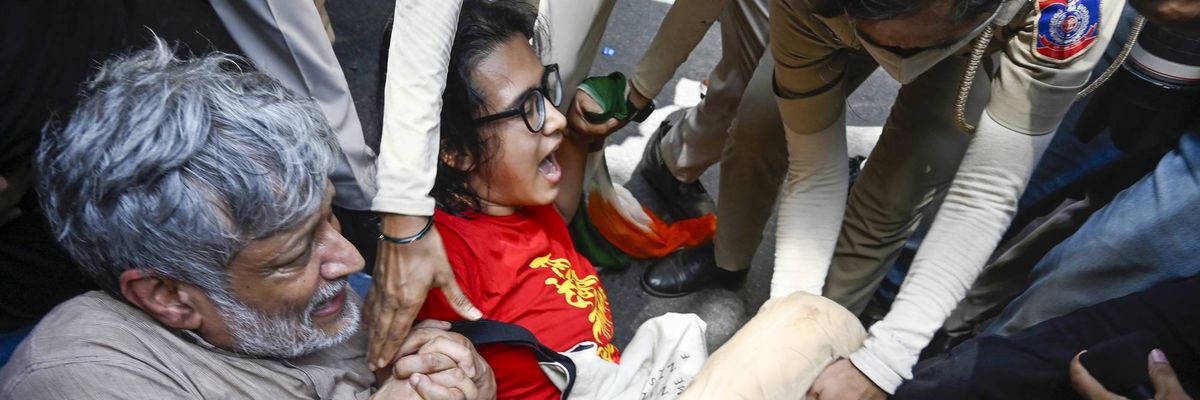
Police in New Delhi detained hundreds of people Friday amid a crackdown on demonstrations challenging India’s election authorities and their controversial revision of voter rolls, prompting Amnesty International to accuse the government of trampling fundamental rights in the world’s largest democracy.
More than 700 protesters—including former Delhi Chief Minister Atishi Marlena; Aam Aadmi Party (AAP) leader Saurabh Bharadwaj; and Neha Bora, who is president of the leftist All India Students’ Association—were reportedly detained in the capital as demonstrators sought to protest outside Jantar Mantar against Chief Election Commissioner (CEC) Gyanesh Kumar and the Election Commission’s Special Intensive Revision (SIR) of electoral rolls.
Journalists covering the protests were also reportedly detained and blocked from doing their jobs.
The Cockroach Janta Party—which led last summer’s successful youth-led protests to oust embattled Education Minister Dharmendra Pradhan after devastating leaks of critical university entrance exams—is again playing a central role in the demonstrations.
Police cited Section 163 of India’s criminal code—a provision intended to address immediate public order threats that critics say is misused to broadly restrict peaceful political assembly—to justify the mass detentions.
“The right to protest is not dependent on government approval. It is protected by the Indian Constitution and international human rights law," Amnesty International India board chair Aakar Patel said. “Prohibitory orders like Section 163 of India’s criminal procedure law, which grant temporary emergency powers to restrict gatherings in the name of public order, have become a convenient way for authorities to routinely prevent peaceful protests."
“Detaining people simply because they intend to protest is a blatant attack on the rights to liberty and freedom of peaceful assembly," Patel added. “Detentions must have a lawful basis and cannot be arbitrary or discriminatory. Those arbitrarily detained for solely exercising their right to freedom of expression and peaceful assembly must be released at once, and authorities must guarantee their right to protest.”
The sweeping overhaul of India’s electoral rolls has resulted in more than 133 million names being removed from draft voter lists across 30 states and union territories since the process began last year. That’s about 14.1% of the pre-SIR rolls. Delhi recorded the largest reduction, with 32.8% of registered electors removed from its draft list.
While the Election Commission says SIR intended to verify voter eligibility and clean up electoral rolls, critics warn that mass deletions could disenfranchise legitimate voters, particularly people who have migrated, lack documentation, or belong to marginalized communities.
The controversy intensified last month after an Indian Express investigation revealed that Election Commissioners Sukhbir Singh Sandhu and Vivek Joshi had formally objected at least 14 times over 10 months to decisions involving voter additions, deletions, and other SIR-related procedures. The two commissioners reportedly raised concerns, including over what they characterized as “unauthorized” or “illegal” actions.
"This is a disenfranchisement of millions of voters.”
Protesters are demanding Kumar’s resignation amid doubts about the transparency and impartiality of the SIR and those behind it.
“The protest is against Gyanesh Kumar and the Election Commission," protester Pawan, a 36-year-old IT professional, told The Indian Express Friday at Jantar Mantar. "But there’s a larger context, I feel. Demanding the resignation of the CEC isn’t the only thing. People are upset with the SIR. This is a disenfranchisement of millions of voters.”
AAP spokesperson Anurag Dhanda, who was among those detained, told Indo-Asian News Service that “we are simply demanding that democracy should not be destroyed. We were saying that people should have the right to vote. Gyanesh Kumar took away the right to vote and committed vote theft, yet the vote thief is not being put in jail. Instead, they brought us here and made us sit at the police station.”
“This is a complete dictatorship of the Modi government,” he added, referring to Indian Prime Minister Narendra Modi and his right-wing Bharatiya Janata Party.
Marlena, better known mononymously as Atishi, said that “when the British ruled India, Gandhiji fought for people’s right to vote. Today, when we have that right, Gyanesh Kumar is trying to take it away.”
Atishi said that when demonstrators tried to reach Jantar Mantar—an officially designated protest site—police hauled them away in buses and detained them at a local police station.
“We are not afraid of Modiji’s police,” she said, referring to Modi. “We will continue to fight to protect the right to vote. The fight against vote theft will continue. The EC’s system will have to be corrected, and Gyanesh Kumar will have to resign.”
At one point, Bora and other detained demonstrators were sprung from a police bus by fellow protesters in the streets.
After escaping detention, Bora defiantly called for a fresh wave of protests for Saturday.
“Get rest after today’s detention,” she said. “Because if you don’t, how will you reach Jantar Mantar at 1 pm tomorrow?”
“Thousands of police officers are working to save one man—Gyanesh Kumar—whom we have to ensure gets removed from office,” Bora continued.
“Jantar Mantar 2.0 is not done!” she added, implicitly referring to the earlier Cockroach Janta Party protests. “It has just begun!”
From Common Dreams via This RSS Feed.