

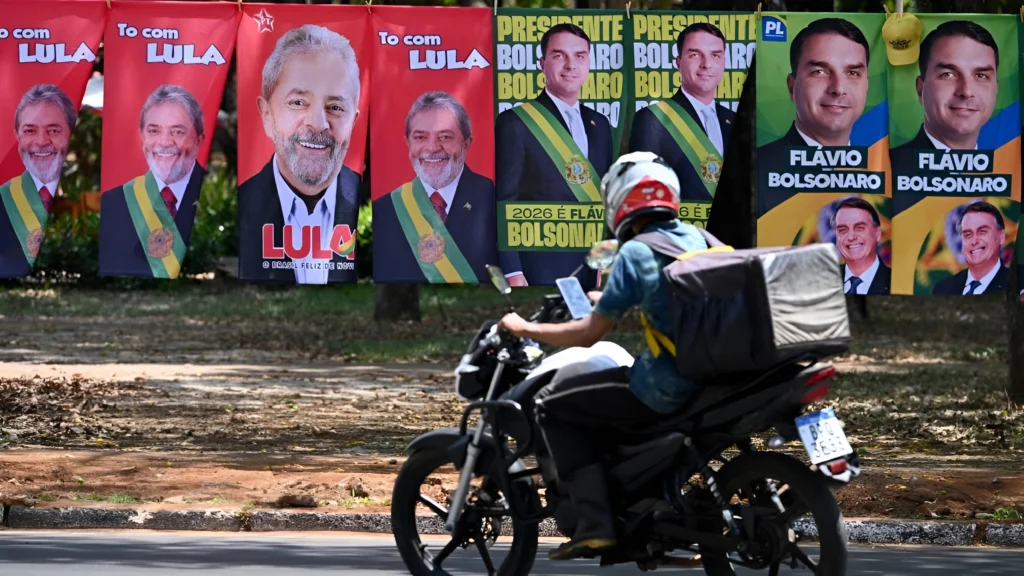
As Lula da Silva defends minimum wage increases and public investment, Flavio Bolsonaro promises deregulation.
As Brazil approaches its general election, the country stands at a crossroads that will shape its economic future, social policies, and international standing.
RELATED:
Brazil Seeks Investigation Into U.S. Interference in Elections
President Luiz Inácio Lula da Silva and Senator Flávio Bolsonaro embody two sharply contrasting visions for the nation, one anchored in state-led social development, labor protections, and multipolar diplomacy, and the other driven by deregulation, market privatization, and alignment with conservative foreign interests.
This article breaks down the key dimensions of the 2026 presidential race, examining both candidates’ political trajectories, legislative records, core economic proposals, and foreign policy doctrines.
Class Struggle and Political Trajectories in the 2026 Brazil Election
The 2026 presidential election in Brazil presents a clear choice between two different socioeconomic models. The current President Lula da Silva of the Workers’ Party is running for a fourth term, facing Senator Flávio Bolsonaro of the Liberal Party.
The election reflects an ongoing struggle over state revenue allocation, workers’ rights, environmental governance, and international trade alignment.
While Lula’s coalition emphasizes public investment, social protection, and re-industrialization, Flávio Bolsonaro leads a conservative platform focused on economic deregulation, tax cuts for upper-income brackets, and privatization.
Lula da Silva built his political career through metalworkers’ unions during the late 1970s and 1980s, co-founding the Workers’ Party.
During Lula’s previous terms as president from 2003 to 2010, his administration expanded income-transfer initiatives such as Bolsa Família and raised the real minimum wage, which contributed to removing tens of millions of Brazilians from extreme poverty.
Lula’s foreign policy emphasized South-South cooperation, expanding the BRICS block, and restoring regional integration through the Community of Latin American and Caribbean States.
After returning to the presidency in January 2023 following a defeat of former President Jair Bolsonaro in 2022, Lula’s economic policy centered on restoring state-backed infrastructure spending and passing a progressive tax restructuring plan.
On the other hand, Flávio Bolsonaro entered public office in 2003 as a state deputy in Rio de Janeiro before securing a seat in the Federal Senate in 2018.
Flávio political rise was driven by his family’s established conservative base, particularly among military figures, business groups, and evangelical voters.
Senator Flávio Bolsonaro acts as the political standard-bearer for the right-wing Liberal Party because of the ineligibility imposed on Jair Bolsonaro by the Superior Electoral Court. Flávio’s political platform centers on fiscal conservatism, strong market orientation, and opposition to state intervention in key economic sectors.
Hey @SecRubio:
It’s important for you to know:
This man wearing green is a congressman who is a close friend of Flavio Bolsonaro and his family, and he is currently imprisoned for links to drug trafficking and militia groups. https://t.co/drBntLxonq— 🅱🅴🅻🅲🅷🅸🅼ó🆁 🚩 (@mello1400) May 29, 2026
Scandals, Legislative Record, and Sectoral Support of Flávio Bolsonaro
Flávio Bolsonaro’s tenure in public office has been marked by legal investigations and political controversies. While serving as a state deputy in Rio de Janeiro, state prosecutors investigated Flávio’s office for an alleged public-fund embezzlement scheme known as “rachadinha.”
The investigation alleged that public employees assigned to Flávio’s office returned portions of their state-funded salaries to intermediate officials, including former parliamentary aide Fabrício Queiroz.
Prosecutors mapped millions of reais in unrecorded cash transactions linked to these salaries, which were traced to real estate purchases and a chocolate shop franchise owned by the senator.
Although technical procedural appeals dissolved early stages of the case on judicial jurisdiction grounds, official banking reports from the Council for Financial Activities Control remain part of the public record.
Investigations by state law enforcement and reporting from Brazilian news outlets detailed connections between members of the Bolsonaro political team and militia groups operating in Rio de Janeiro. Specifically, former police officer Adriano Magalhães da Nóbrega, who led the paramilitary group Crime Bureau (Escritório do Crime), had his mother and ex-wife employed in Flávio Bolsonaro’s legislative office for several years.
These paramilitary networks exert control over illegal real estate, public transport, and utility distribution in working-class neighborhoods across Rio de Janeiro’s West Zone.
In the Federal Senate, Flávio Bolsonaro’s legislative record shows consistent votes against social safety expansions and labor protection measures.
Official voting records show Flávio’s opposition to bills increasing corporate tax rates, as well as votes supporting the deregulation of environmental licensing processes.
Senatorial attendance records show frequent official absences during key committee reviews regarding public health and labor rights.
Flávio’s political platform maintains strong financial and political backing from agribusiness coalitions represented by the Parliamentary Front for Agriculture, which advocates expanding agricultural frontiers into preserved Amazonian lands, reducing demarcated Indigenous territories, and loosening federal regulations on pesticide use.
Flávio Bolsonaro’s legislative record and financial dealings also faced further scrutiny following a Federal Police investigation into his connections with the liquidated financial institution Banco Master.
According to official reports by the Council for Financial Activities Control, investigators examined financial transfers requested by the senator from the bank’s head, Daniel Vorcaro, to sponsor Dark Horse, a biographical film project about former President Jair Bolsonaro.
Federal authorities unsealed inquiries into potential money laundering, illegal capital flight, and political influence peddling, investigating allegations that public and private funds managed by the bank were funneled into media productions and foreign accounts linked to political allies.
While Flávio Bolsonaro denied all criminal wrongdoing, maintaining that discussions with Vorcaro involved a strictly private commercial arrangement, the case became a central point of political debate regarding regulatory oversight, executive influence, and corporate campaign financing in the run-up to the 2026 presidential vote.
BRASIL is in DANGER.
As I warned back in March 2026, Latin American countries like Brazil must prepare against potential US aggression as Washington hardens its grip on the hemisphere.Current pressure is intense: senior US officials were blocked from entering Brazil after plans… pic.twitter.com/WAocspUSuY
— Angelo Giuliano 🇨🇭🇮🇹 (@angeloinchina) August 21, 2026
Electoral Forecasts and Campaign Dynamics
Opinion polls conducted in late September 2026 indicate a competitive presidential contest. A Datafolha survey conducted September 22 to 23 showed Lula leading in first-round voting intentions with 45 percent, while Flávio Bolsonaro recorded 42 percent.
Polling data from AtlasIntel/Bloomberg published on September 29 showed Lula at 45.3 percent of first-round preferences, with Flávio Bolsonaro at 42.2 percent.
Taking valid votes into account, excluding blank and null ballots, the AtlasIntel survey placed Lula at 46.2 percent against Flávio Bolsonaro’s 43.1 percent.
On the other hand, allegations have been made regarding an attempt by Washington to effectively intervene in the elections. Such interventions have already been reported in Bolivia and Colombia, raising alarms regarding the elections in Brazil.
Foreign Policy Alignment and Geopolitical Stakes
The two candidates outline sharply divergent frameworks for Brazil’s stance in global governance, international trade, and regional diplomacy.
Lula da Silva prioritizes a multilateral approach centered on South-South cooperation, regional integration, and active participation in international forums.
Lula’s foreign policy framework focuses on strengthening regional mechanisms such as the Community of Latin American and Caribbean States and the Union of South American Nations.
Lula’s administration maintains expanded ties within the BRICS grouping to foster alternative financing arrangements for developing economies and reduce reliance on single-currency international reserves.
On trade and environmental governance, Lula advocates for sovereign development models that secure national industrial processing capacity rather than relying exclusively on raw material exports.
Lula’s platform opposes foreign military interventions and supports diplomatic negotiations in international conflicts, maintaining trade relationships with global powers in Asia, Europe, and North America without entering into binding geopolitical military alliances.
Flávio Bolsonaro advocates an international framework closely aligned with Western capital markets and conservative political administrations.
Flávio’s platform seeks to establish bilateral trade concessions directly with the United States and selected European economies, aiming to attract private foreign capital into Brazilian natural resources, energy infrastructure, and agricultural commodities.
In diplomatic relations, Flávio Bolsonaro favors reducing Brazil’s commitments to multilateral regional bodies, advocating for a streamlined focus on bilateral commercial agreements over regional political integration.
Flávio’s foreign policy doctrine aligns closely with conservative economic doctrines, advocating for private foreign participation in state asset management and reduced state intervention in cross-border capital flows. Flávio also indicated that, if he wins, he will have Brazil join the Shield of the Americas Agreement promoted by the Trump administration.
Lula feat. Bad Bunny. pic.twitter.com/5nMdM2EAyM
— Paulo Floro (@paulofloro) September 24, 2026
Electoral Forecasts, Statistical Trends, and Strategic Outlook
Recent survey data from major research institutes indicate a highly competitive electoral environment ahead of the vote.
First-round projections show President Lula da Silva leading in voter preference over Senator Flávio Bolsonaro, supported by strong voting bases in low-income brackets and the Northeast region.
With nearly 80 percent of voters reporting a fixed preference, the outcome still depends on turnout levels, regional mobilization efforts, and how uncommitted voters ultimately align in major urban centers.
Sources: TeleSUR – Al Jazeera – Al Mayadeen – Press Tv – Brasil de Fato – Agência Brasil – Portal.gov.br – EBC – TV Brasil – BBC – CNN – Folha de S. Paulo
From teleSUR English via This RSS Feed.