

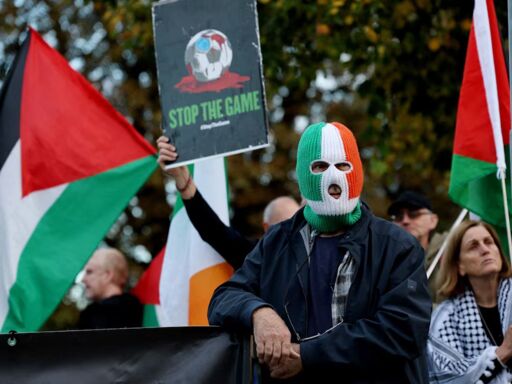

Ireland had barely closed the chapter on its controversial match against Israel when Palestinian solidarity again took center stage at Aviva Stadium in Dublin. The Irish national team’s match against Austria was halted twice due to pro-Palestine protests, highlighting the ongoing pressure on the squad and the Football Association of Ireland (FAI) just hours before their second fixture against Israel.
During the match on Thursday, October 1, several tennis balls were thrown onto the pitch around the 20th minute. Some bore stickers featuring the Palestinian flag and the hashtag #StopTheGame, directly referencing the campaign urging the Irish team to boycott its upcoming match against Israel. The referee temporarily suspended play until the balls were cleared from the field.
A second interruption occurred around the 35th minute when a pitch-invader ran onto the field carrying a Palestinian flag before security personnel quickly intercepted and escorted him off. Both incidents took place amid heightened security, following a demonstration organized by pro-Palestine groups outside Aviva Stadium before kickoff.
Solidarity with Palestine
The “Stop the Game” campaign claimed responsibility for the initial demonstration, calling it a targeted action using tennis balls. The group stated that the goal was to express solidarity with Palestinians and support Irish goalkeeper Gavin Bazunu, who withdrew from the national squad ahead of the Israel match in protest of playing the fixture.
This was not the first time tennis balls were used as a protest symbol at Aviva Stadium; a similar incident took place during Ireland’s friendly against Qatar last May, when balls were thrown onto the pitch to oppose holding the two matches against Israel.
The Dublin protests came just days after Ireland played Israel in the UEFA Nations League — a match moved to Debrecen, Hungary, instead of Israel, which ended in a decisive 3–0 win for Ireland.
Facing Israel sparked controversy
Leading up to the first match, public pressure mounted on the FAI and the national team to boycott the fixtures against Israel. In November 2025, FAI members voted to submit a formal request to UEFA’s Executive Committee seeking the suspension of the Israel Football Association from European competitions.
However, the FAI ultimately decided to proceed with both matches, and a majority of players voted to play the first fixture following internal discussions. The association announced on September 26 that the games would move forward while acknowledging the diverse opinions within the squad.
Ahead of the match, goalkeeper Gavin Bazunu withdrew from the team, citing personal principles regarding the fixture. Meanwhile, the team’s training session and pre-match press conference were delayed for hours as internal debates continued over participation.
When the Irish team took the field in Debrecen, the match included clear gestures of protest: players wore black armbands, declined the traditional pre-match handshakes, and turned or bowed their heads during the Israeli national anthem. On the pitch, Ireland secured the win with three first-half goals from Troy Parrott, Adam Idah, and Jack Moylan.
Protest shifts to Austria match
The pressure did not subside in the days following the Israel game; instead, it carried over to Ireland’s home match against Austria. Prior to kickoff, the “Stop the Game” campaign explicitly called for a boycott of the upcoming second fixture against Israel, urging the government and football association to take responsibility for the decision rather than placing the burden on the players.
This comes as the date approaches for the second match between Ireland and Israel, scheduled for Sunday, October 4, in Bačka Topola, Serbia. The FAI moved the fixture from Dublin due to what it cited as “operational challenges,” with the match set to be played behind closed doors without spectators
Featured image via the Canary
By Alaa Shamali
From Canary via This RSS Feed.