

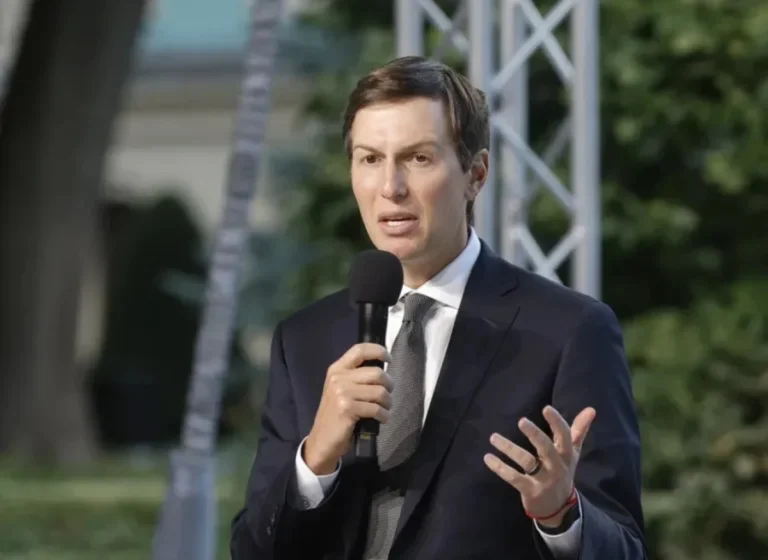
Kushner’s investment firm is Phoenix Financial’s largest shareholder, while the Israeli group has invested at least $456 million in nine defense-linked companies.
Jared Kushner, U.S. President Donald Trump’s peace envoy, has financial ties to Israeli defense companies through his investment firm, Affinity Partners, which is the largest shareholder in Phoenix Financial, according to an international media investigation based on Israeli financial transparency laws. Phoenix has invested at least $456 million in nine companies linked to Israel’s defense sector.
RELATED: Trump Escalates His Trade War by Banning Certain Canadian Products
Affinity Partners first invested $128.5 million in Phoenix in 2024 and doubled its stake in January 2025, five days before Trump returned to the presidency, according to the investigation.
Phoenix, one of Israel’s largest financial groups, has interests in insurance, pensions and asset management. Its investments include at least $265.1 million in Elbit Systems, Israel’s largest arms manufacturer.
Over the past year, Elbit has secured millions of dollars in contracts from Israel’s Defense Ministry, including about $200 million for advanced airborne munitions and $48 million for thousands of 155mm artillery shells. International media have reported that Elbit weapons systems have been used in the killing of Palestinians in Gaza.
US envoy Jared Kushner’s investment firm, Affinity Partners, has the largest stake in an Israeli company invested in more than half a dozen defence companies that have supplied munitions and armaments for the genocide in Gazahttps://t.co/kPh8e69Aa2
— Middle East Eye (@MiddleEastEye) October 1, 2026
Phoenix also holds stakes in Next Vision, which manufactures cameras for military drones; Bet Shemesh, which produces engines for Israeli warplanes; and Reshef Technologies, which makes electronic fuzes for artillery shells. The companies have reported military-related orders, including $165 million in orders from the Israeli military since the start of the war in Gaza.
Phoenix also has holdings in larger companies that have been linked to Israel’s expanding occupation of the West Bank and the destruction of civilian infrastructure in Gaza, including U.S.-listed Caterpillar. Other companies linked to the Israeli military in Phoenix’s portfolio include Israeli Shipyards and Boeing.
Kushner’s investment in Phoenix
Affinity Partners sold a third of its Phoenix holding in January but remained the company’s largest shareholder, with a 7.4 percent stake valued at more than $1 billion. Kushner has described Phoenix as Affinity’s “best investment.”
Affinity’s lawyers told the media that Kushner has no direct involvement in Phoenix’s decisions about which companies it supports. Kushner has nevertheless described in interviews his close interest in the work of the companies backed by his firm.
Phoenix, Caterpillar and other companies in Phoenix’s portfolio did not respond to media inquiries.
The financial ties have emerged as Kushner participates in diplomatic efforts over the war in Gaza. He met Hamas official Khalil al-Hayya in Cairo and held a four-hour meeting with Israeli Prime Minister Benjamin Netanyahu in August. He later reversed an earlier position that Israel was obstructing the plan and expressed support for what he called Israel’s “right to finish the job.”
The investigation also found that Gulf states, including Saudi Arabia, the United Arab Emirates and Qatar, invest through Affinity Partners in companies that Israel uses in its war against Gaza and in other conflicts involving Arab states. Because Kushner does not hold an official position in the U.S. government, he is not required to disclose his finances, according to the report.
Kushner was involved in the Abraham Accords, under which Bahrain, Morocco and the United Arab Emirates established official relations with Israel in 2020 during Trump’s first administration. He has also spoken about using investment to “incentivize” Muslim and Arab countries to normalize relations with Israel.
By April 2026, Affinity Partners had invested more than $6.1 billion in assets, with 99 percent of those assets coming from non-U.S. investors, including investors from Arab Gulf countries, according to sources cited in the investigation.
From teleSUR English via This RSS Feed.