

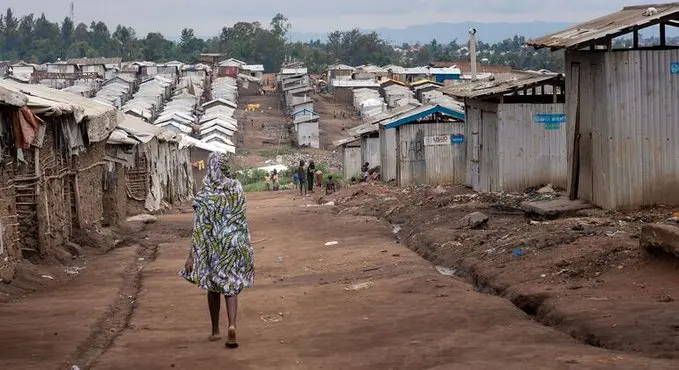
UN officials warn the loss of a treatment facility in Ituri is disrupting care as violence hampers efforts to track Ebola contacts.
A fire has destroyed an Ebola treatment center in a displacement camp in eastern Democratic Republic of Congo, leaving residents without direct access to medical care as insecurity disrupts efforts to contain the outbreak, the United Nations said Thursday.
RELATED: Seven Children Die from Ebola Each Day in DR Congo: Save the Children
The facility was located in the Kigonze settlement in Ituri province, where about 19,000 people had been sheltering. The camp was abandoned on Tuesday after residents fled amid military incursions, armed clashes and reports of gunfire following the arrival of Congolese soldiers and rebel groups.
Julien Harneis, the UN’s lead coordinator for the Ebola response, said the destruction of the center had eliminated critical medical capacity in one of the areas hardest hit by the disease and meant that operations would have to be rebuilt from scratch.
The enormous challenge of halting the spread of Ebola in DR Congo just became even harder after a key transit centre for patients requiring treatment burned down in Ituri province.
Here’s the reaction from the UN’s senior Ebola response official in DRC, @julienmh⤵️ pic.twitter.com/n5WaMVJr0H
— UN News (@UN_News_Centre) October 1, 2026
Losing a center means losing capacity, losing investment and having to start again. Above all, it means that people do not have access to the care they really need, Harneis said.
He said establishing Ebola transit and treatment centers across eastern Congo had required funding and the deployment of personnel, describing the effort as a major challenge throughout the region.
The destruction of the Kigonze facility has also complicated efforts to monitor people who may have been exposed to the virus. About 1,000 direct contacts of Ebola patients were living in the camp, but authorities have been able to trace only about one-fifth of them since residents fled to areas outside government control, according to the UN.
The security situation has deteriorated elsewhere in the region. The UN Office for the Coordination of Humanitarian Affairs (OCHA) reported that two health workers were killed in Lubero, in North Kivu province. It also reported attacks and mass displacement at the Rhoe camp in Ituri.
The outbreak, caused by the Bundibugyo strain of Ebola, was declared on May 15. According to the latest figures from Congolese authorities, updated through Sept. 29, the outbreak has recorded 8,224 confirmed cases and 3,982 deaths. Another 2,212 patients have recovered, while 851 remain hospitalized or in isolation.
The epidemic has affected 63 health zones across seven of the country’s 26 provinces: Ituri, Tshopo, Bas-Uélé, Haut-Uélé, North Kivu, South Kivu and South Ubangi.
The current outbreak is the second-deadliest Ebola epidemic recorded globally. It remains below the 2014-2016 outbreak in West Africa, which caused about 11,000 deaths and 28,000 infections.
The destruction of the Kigonze center adds the loss of critical treatment capacity to an already deteriorating security environment, while the displacement of residents is making it harder to locate people who may have been exposed to the virus.
From teleSUR English via This RSS Feed.