

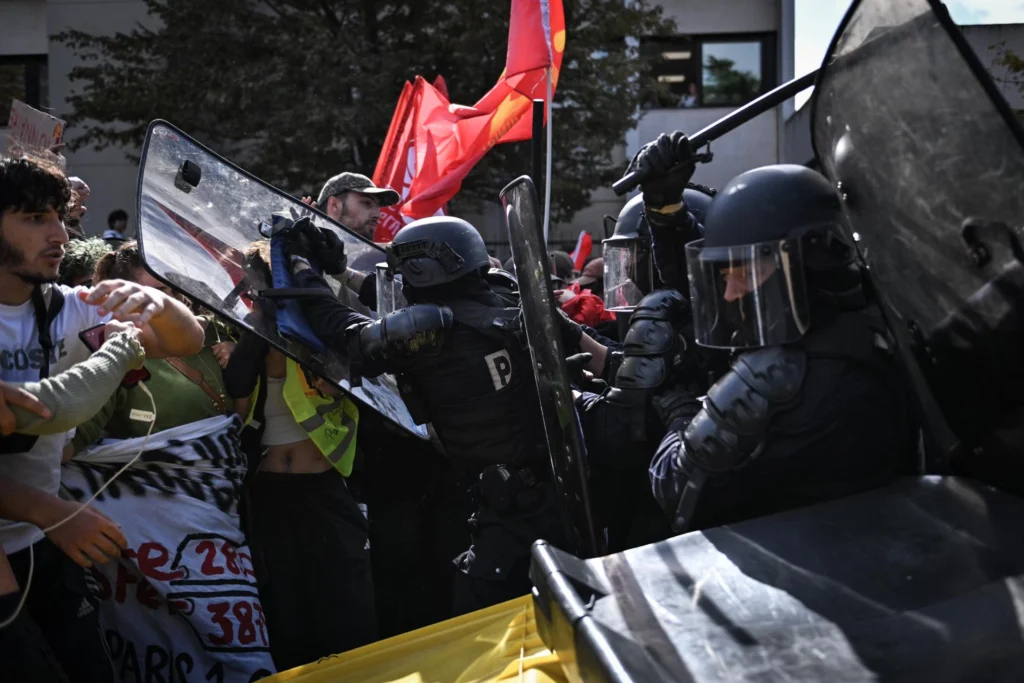
Student protests escalated across France on Thursday, spreading to universities and triggering a heavy police repression that led to the detention of 1,949 people, the majority of them minors, according to France’s Interior Ministry.
The student protests in France escalated dramatically this Thursday, suffering police repression with blows, tear gas, rubber bullets, and dispersal grenades.
According to the Ministry of the Interior, 1,027 educational centers were affected by the incidents, with 222 access blockades and 284 police officers and gendarmes injured. 1,949 people were detained, the 90% of whom are minors.
RELATED: 440 Arrested in France Amid Student Protests Over Education Funding
The escalation of the protests, which began a week ago to denounce the lack of teachers and demand better conditions in educational centers, resulted in repression in cities like Lyon, Lille, Marseille, and Pantin (on the outskirts of Paris).
In France, protests launched by high school students a week ago demanding improved educational conditions have spread across the country.
The police are using excessive force against high school students and making arrests. In response, the students retaliate against the police… pic.twitter.com/OEBBqXuIkm
— Antifa_Ultras (@ultras_antifaa) October 1, 2026
In response to the intensifying protests, French Prime Minister Sébastien Lecornu convened an emergency cabinet meeting this afternoon and requested that his ministers refrain from travel in the coming days. This measure ensures that government delegates are available to manage the situation in each locality. Additionally, Justice Minister Gérald Darmanin held a video conference with the 36 chief prosecutors of the country to address the blockades and the escalating violence of the protests.
For Friday, October 2, the French government has ordered the preventive closure of around 400 educational centers nationwide, forcing students to receive classes remotely. Meanwhile, Education Minister Édouard Geffray will meet with representatives from student unions, parents, teachers, and other members of the educational community to try to reach concrete agreements and calm the situation.
The government has accused the left-wing bloc La France Insoumise, led by Jean-Luc Mélenchon, and other affiliated groups of being behind the mobilization. This stance was refuted by both Mélenchon’s party, which is running for the 2027 presidential elections, and the main student union, the Union Syndicale Lycéenne (USL). “It makes me a little laugh,” said the federal responsible of USL, Philémon Jouglet Marcus, who assured that the government infantilizes the students when it claims that they are not responsible for their own mobilizations.
Je suis très inquiet des violences policières contre les jeunes gens. Un jeune a déjà été éborgné. La plupart d’entre nous sommes parents. Et si c’était le nôtre ?
Je l’ai dit, je le dis et redis : nous sommes pour les méthodes de lutte non-violentes.
Nous n’en revenons pas de… pic.twitter.com/RJDDuPjl9H
— Jean-Luc Mélenchon (@JLMelenchon) October 1, 2026
Text reads: “I am very concerned about police violence against young people. A young person has already lost an eye. Most of us are parents. (…) I have said, I say and I repeat: we are in favor of non-violent methods of fighting.We can’t help but be amazed by the state of dropout in high schools. A dropout of this magnitude is embarrassing! It’s been going on for years! ¡Mobilization has spread to universities! The Macron power has made a terrible mistake. By blaming us for all the evils, he believes it solves the problem. This is the result.”
The protests have highlighted the broader issues facing French society, including economic inequality and the need for better social services. The students’ demands for better educational conditions and the reversal of austerity measures have galvanized public support, with many calling for the government to address these issues and provide better conditions for students.
The government’s response to the protests has been met with criticism from various sectors, including human rights organizations and opposition parties. They argue that the use of excessive force and the detention of minors are disproportionate and violate the rights of the protesters.
As the protests persist, the government’s handling of the situation will be closely scrutinized. The students’ demands for better educational conditions and the reversal of austerity measures have struck a chord with many in French society, and the government will need to navigate these challenges carefully to maintain public support and ensure the safety of all involved.
From teleSUR English via This RSS Feed.