

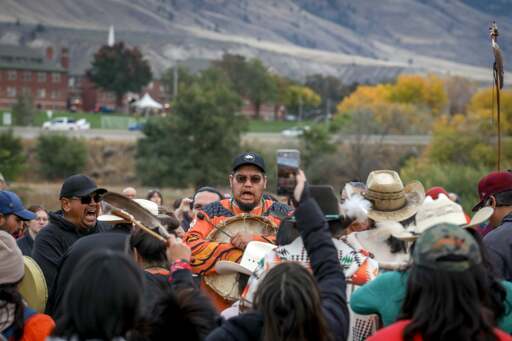

At the same site where a white nationalist demonstration occurred in Tk̓emlúps te Secwépemc on Sunday, more than 100 Secwépemc people and their allies returned to the area two days later to reclaim the space. They drummed, sang and prayed to cleanse the spot, which is located a few hundred metres away from the former Kamloops Indian Residential School. Photo by Aaron Hemens
Content warning: This article contains details about residential “schools.” Please read with care for your spirit.
On the eve of Orange Shirt Day, more than 100 people gathered in Tk̓emlúps te Secwépemc to cleanse and reclaim a site where a white nationalist demonstration occurred earlier this week.
For nearly three hours on Tuesday night, Secwépemc people and their allies drummed, sang and prayed — for the land and the people, and for all the families impacted by residential “schools.”

Secwépemc people and their allies drum, sing and pray on Tuesday, near the site where a white nationalist demonstration took place in Tk̓emlúps te Secwépemc two days prior. Photo by Aaron Hemens
Ashley Michel from Tk̓emlúps te Secwépemc organized Tuesday’s gathering with four other Secwépemc (Shuswap) mothers.
After seeing images of a group of masked white nationalists circulating on social media early this week, she told IndigiNews that they felt they had to come together to create a safer place for their children, and to help ground the community ahead of the National Day for Truth and Reconciliation — also known as Orange Shirt Day — on Sept. 30.
“We’re all mothers. We don’t want our children growing up in a world like this. We brainstormed, and we just wanted to come together and cleanse the area,” said Michel, who is the owner of Four Generations Creations.

The organizers of Tuesday’s gathering in Tk̓emlúps te Secwépemc. From left to right: Ashley Michel, Cam Gottfriedson, Morning-Star Peters, Stephanie Lindley and Willow Peters. Photo by Aaron Hemens
“We wanted to start things off in a good way and reclaim our space – take back our area and make it safe again. Especially for our children and our survivors.”
The group of about two dozen white nationalists were seen at Tk̓emlúps te Secwépemc reserve lands early Sunday morning. They hid their faces behind white masks and held a flag with the message “got bones?” — with images that quickly gathered outrage online.
The space where the group had gathered is a few hundred metres away from the former Kamloops Indian Residential School (KIRS) site and is located on the institution’s former grounds, which originally spanned 360 acres.

At the same site where a white nationalist demonstration occurred in Tk̓emlúps te Secwépemc on Sunday, more than 100 Secwépemc people and their allies returned to the area two days later to reclaim the space. Photo by Aaron Hemens
In 2021, leadership at Tk̓emlúps te Secwépemc revealed that they had identified evidence of 215 unmarked graves on the site, which unleashed a national reckoning about children’s deaths at the institutions.
“Sunday was just an example of what we at Tk’emlúps te Secwépemc are facing on a daily basis; on a weekly basis; on a monthly basis,” said Jeanette Jules, a Secwépemc knowledge keeper who helps manage the First Nation’s Le Estcwicwéy̓ (the missing children from KIRS) case.
“Since 2021, we’ve kept emails, texts, phone messages. Some of them are really disturbing and disgusting.”

Secwépemc people and their allies drum, sing and pray on Tuesday, near the site where a white nationalist demonstration took place in Tk̓emlúps te Secwépemc two days prior. Photo by Aaron Hemens
Tk̓emlúps te Secwépemc Kúkwpi7 (Chief) Rosanne Casimir said on Sunday that the group have ties to a group called Second Sons Canada, who are “linked to white supremacist and white nationalist ideology.”
“That blackness that they brought — that heaviness that they brought — is being lifted,” said Jules.
On Monday, Tk̓emlúps RCMP said in a press release that they are investigating the incident. They described the masked men and their activities as “a cowardly attempt to avoid accountability for their actions and messages that are clearly intended to intimidate, provoke fear and division.”

Secwépemc people and their allies drum, sing and pray on Tuesday, near the site where a white nationalist demonstration took place in Tk̓emlúps te Secwépemc two days prior. Photo by Aaron Hemens
A ceremony was also held by chief and council Monday evening in response to the incident, Kúkwpi7 Casimir said.
During the community’s gathering on Tuesday evening, survivors of KIRS also shared stories about their experiences at the institution. People then walked to the exact site where the white nationalists were seen and cleansed the area with their songs and prayers.

Community members march on Tuesday to the same site where a white nationalist demonstration occurred in Tk̓emlúps te Secwépemc two days prior. Photo by Aaron Hemens
Michel urged the white nationalists to educate themselves, and actually take the time to sit and listen to the stories of a residential “school” survivor.
She also described the group from Second Sons Canada as “cowards” hiding behind masks.
“If you’re so proud of what you’re doing, show your face. Say it with your chest. If that’s what you believe in, say it with your chest. What are you scared of?” she said.
“We came out here tonight. We showed our faces. We came in numbers. We did things in a good way.”

Community members march on Tuesday to the same site where a white nationalist demonstration occurred in Tk̓emlúps te Secwépemc two days prior. Photo by Aaron Hemens
Fellow organizer Stephanie Lindley from the Upper Nicola Band said that the white supremacists and their intimidation tactics only “lit a fire under everybody.”
“We’re strong. I know a lot of people’s reaction was fear. That’s valid. But I think the message is just showing the unity, and how quickly we can come together as a people,” said Lindley, who works as an nsyilxcən language teacher.
“They don’t win, and they’re not going to. Their hatred message – look at what it’s done for us today. It’s brought so many people together. Our babies get to watch this and see it. They’re going to remember this.”

Secwépemc people and their allies drum, sing and pray on Tuesday, near the site where a white nationalist demonstration took place in Tk̓emlúps te Secwépemc two days prior. Photo by Aaron Hemens
Michel encouraged allies to speak out against racism and residential “school” denialism, noting that discrimination is experienced by Indigenous peoples “every single day.”
“When you wear your orange shirt on Sept. 30, you might get to go home and take that off,” she said. “Indigenous people every single day have to deal with this. They don’t get to go home and take it off. We are dealing with this all the time.”

Secwépemc people and their allies drum, sing and pray on Tuesday, near the site where a white nationalist demonstration took place in Tk̓emlúps te Secwépemc two days prior. Photo by Aaron Hemens
While Michel said she felt more at peace after the gathering, she highlighted that she “doesn’t necessarily feel safe still,” and that “a little bit of an eerie energy” still lingers, due to the lack of accountability.
“Who are these men? Who do they work for? You don’t know. They could be out in our communities; they could be working healthcare; they could be working in politics. We don’t know,” said Michel.
“I still can’t believe it’s real. How can something like that happen? There’s no consequence for it at all.”

At the same site where a white nationalist demonstration occurred in Tk̓emlúps te Secwépemc on Sunday, more than 100 Secwépemc people and their allies returned to the area two days later to reclaim the space. Photo by Aaron Hemens
The next day, hundreds of people packed Tk̓emlúps te Secwépemc’s community arbour for the National Day for Truth and Reconciliation, to honour residential “school” survivors, intergenerational survivors, and the children who never made it home.
Despite the somber nature of the event, spirits were high as the sun beamed down on community members, who rejoiced in the comfort of one another’s presence.
Plenty of smiles, laughs and hugs were exchanged between families and friends from all ages and backgrounds. A sea of people wearing orange shirts sat close and held one another; children played in the sun; people enjoyed different food vendors; and they listened as dignitaries and survivors shared stories.

During the 2026 National Day for Truth and Reconciliation event in Tk̓emlúps te Secwépemc on Sept. 30, community members walked for the children by circling the community’s powwow arbour’s outer perimeter. Afterwards, the names of survivors of KIRS were read aloud, which was followed by a moment of silence. Photo by Aaron Hemens
They all walked for the children by circling the arbour’s outer perimeter on Wednesday. Afterwards, the names of survivors of KIRS were read aloud, which was followed by a moment of silence.
“B.C.” Premier David Eby was in attendance, where he met with survivors and community members after participating in the walk. He also spoke about the “intimidation” tactics of the white nationalist group earlier that week, and denounced residential “school” denialism in general.

A community member places an Orange Shirt pin on the jacket of B.C. Premier David Eby, during the 2026 National Day for Truth and Reconciliation event in Tk̓emlúps te Secwépemc on Sept. 30. Photo by Aaron Hemens
While he spoke, an eagle was observed flying in the sky above, circling the arbour and the former KIRS building.
“The people who survived residential school, the people who survived a government-driven attempt to wipe out their language and culture – they will never be intimidated,” said Eby.

B.C. Premier David Eby speaks at the 2026 National Day for Truth and Reconciliation event in Tk̓emlúps te Secwépemc on Sept. 30. To his right is Tk̓emlúps te Secwépemc Kúkwpi7 (Chief) Rosanne Casimir. Photo by Aaron Hemens
“We are standing up, shoulder-to-shoulder, against anybody who would come here and attempt to intimidate and attempt to provoke.”
Cindy Woodhouse Nepinak, the National Chief of the Assembly of First Nations, said at the event that the organization “stands with all of you today.”
“Against hatred, against bigotry – against anything that’s coming at you,” said Nepinak.
She said that the Assembly of First Nations is pushing the federal government to criminalize residential “school” denialism.
“If masked people come out anywhere, your identities will be identified. You’re not going to be covered up and hidden. Your identities are coming,” she said.

Cindy Woodhouse Nepinak, the National Chief of the Assembly of First Nations, speaks at the 2026 National Day for Truth and Reconciliation event in Tk̓emlúps te Secwépemc on Sept. 30. Photo by Aaron Hemens
“We call on Canada to make sure that they work with us. We call on the RCMP to work with us in a good way, to make sure that when people do that anywhere in this country, that they’re exposed.”
After Premier Eby and National Chief Nepinak spoke, they were each gifted eagle feathers.

Tk̓emlúps te Secwépemc Kúkwpi7 (Chief) Rosanne Casimir, left, gifts an eagle feather to B.C. Premier David Eby at the 2026 National Day for Truth and Reconciliation event in Tk̓emlúps te Secwépemc on Sept. 30. Photo by Aaron Hemens
Kúkwpi7 Casimir also acknowledged Sunday’s incident, but said that her focus is “on our residential school survivors, our intergenerational survivors, the children who never came home, and our shared responsibility to advance truth, to advance healing and reconciliation.”
She underscored that the survivors of residential “school” need to be honoured.

Tk̓emlúps te Secwépemc Kúkwpi7 (Chief) Rosanne Casimir at the 2026 National Day for Truth and Reconciliation event in Tk̓emlúps te Secwépemc on Sept. 30. Photo by Aaron Hemens
“We honour the survivors whose courage changed the country. For generations, they carried those truths that many were not prepared to hear,” she said.
“But because they chose to share their experiences, Canadians have begun to better understand the impacts – but also the responsibilities – that come with reconciliation.”

An Elder touches a commemorative eagle statue for residential school survivors at Tk̓emlúps te Secwépemc’s powwow arbour on Sept. 30, during the community’s 2026 National Day for Truth and Reconciliation event. Photo by Aaron Hemens
There is “zero tolerance” for the white nationalists and their denialism, she said.
“Our survivors have faced and overcame far greater challenges than this. They have lived through generations of discrimination, injustice and attempts to silence. Their courage is also what brought us here,” she said.
“Today, and everyday, we say to survivors and their families: we hear you. We see you. And we believe you.”

B.C. Premier David Eby and Tk̓emlúps te Secwépemc Kúkwpi7 (Chief) Rosanne Casimir sit with an Elder during the 2026 National Day for Truth and Reconciliation event in Tk̓emlúps te Secwépemc on Sept. 30. Photo by Aaron Hemens
The post In Tk̓emlúps, community gathers to ‘reclaim our space’ and denounce white nationalism appeared first on Indiginews.
From Indiginews via This RSS Feed.