

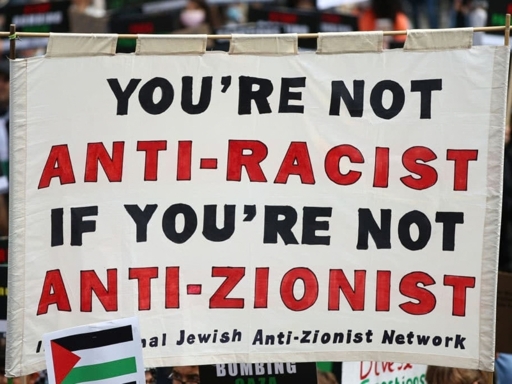

Green Party conference will debate, and then vote on, the much-discussed ‘Zionism is Racism’ motion. In the run-up, I have witnessed and joined many discussions around it. People have told me the motion is “divisive,” “problematic” and “toxic.” I have also seen several procedural objections raised.
This article answers those concerns and makes the best case for supporting Motion A105/E12. It follows genuine arguments I’ve seen against the motion, and the responses that I and others gave. Many arguments are made in extremely bad faith by elements of our political media class. However, what follows are worth sharing because, when they come from genuine concerns, they are — I hope — made in good faith.
(For a brief example of an argument/amendment not made in good faith, see the post below.)
The ‘Zionist synagogues’ amendment is authored by a liberal Zionist who opposes the actual Zionism is Racism motion
It is also based on a lie. This type of motion (E Motion) has no bearing on disciplinary structures
For example, no Muslim Green member has ever been… https://t.co/e6iihQMtHC
— Matt Kennard (@kennardmatt) September 30, 2026
Who do we mean by ‘Zionist’?
Zionists support the imperial project of a (mainly European) Jewish settler state in historic Palestinian land. Inevitably, that project displaces, forcibly expels and, increasingly, murders native Palestinians. This drives the ‘Israeli’ state, since its inception. Today it culminates in genocide against Palestinians, and Arabs and Persians more broadly. Like most imperial projects launched circa the 1910s, Zionism is racist to its core. Arguably, its racism has now outgrown even the worst of British imperial racism a century ago.
Some ask who, exactly, ‘the Zionists are.’ They complain that the motion and its amendments confuse and divide. The definition above is my answer, and I believe history objectively grounds it. All of these debates happen in a political context that has deliberately removed such a definition from “common sense.”
Critically, ‘Zionist’ is not shorthand for ‘the Jews.’ (Elements of the British political media class would have you believe otherwise, smearing Green Party members as such.) This motion makes that explicitly clear, as it should. Many Jews evidently do support Zionism, but a growing number oppose it wholeheartedly. Many Jewish people understandably resent such horrific crimes being committed “in their name.”
Zionism’s most vocal outriders are often Christian, especially Evangelicals in America and elsewhere. Add many Hindu nationalists, drawn by Zionism’s inherent anti-Muslim tendencies. Add a sadly large number of US-compliant Arab ruling classes, who act against their citizens’ strong general will. So non-Jewish Zionists outnumber Jewish Zionists by magnitudes. Zack Polanski himself has spoken of confronting the Zionist sympathies he absorbed in his youth through certain Jewish community institutions.
WATCH: Zionists heckle Polanski even though he’s gone soft on anti-Zionism
Is Zionism racism?
Some objections I’ve seen have come from even committed anti-Zionists. Some tell us the motion “makes no logistical sense.” Zionism may inevitably lead to racism and may have created a racist state, they concede. But settler colonialism is the real problem, and there is a difference. Settler colonialism may be racist; Zionism as a distinct ideology itself is not inherently so.
However, if we care about intellectual precision — we should — I challenge detractors to name a settler colonial project that was not intrinsically racist. If you can’t, calling Zionism settler colonialism already calls it racist. And, if Zionism inevitably leads to racism and has created a racist apartheid state, how does that differ from saying Zionism is racism? Zionism is as Zionism does.
One fallback is that the distinction matters to Jewish people who are pro-Palestine, but not ‘anti-Zionist’. We should work with them, the argument goes; win them over. This sits at the heart of Green critics who call the motion “divisive.” (Critics attacking the party from outside are largely not pro-Palestine at all.)
My response is principally one of bemusement. How can anyone claim to be meaningfully pro-Palestine whilst refusing to oppose the ideology behind decades of systematic murder and displacement? That essential opposition is what anti-Zionism is. The same applies to “progressives” like AOC, who fund arms shipments to Israel, but only for “defensive” purposes. (She possibly backtracked on this since seeing tides turn.)
If you will not confront the project that sustains the murder of Palestinians, those who pay attention will see a charlatan. The material and ideological realms link. Even Andy Burnham recognised this beside arch-Zionist Trump himself, warning that failing to act on our values makes people think “You’re all talk.”
What is the Green Party’s role if not to hold Burnham and others to account? Without a great electoral shove, they will not go far enough. The “talk” must walk. That is where the motion’s boldness lies.
Jewish anti-Zionists condemn Board of Deputies attempt to appropriate Cable Street
Can Zionism be a ‘bigger concept’?
Others say Zionism means more than the state project. Declaring “no it isn’t” in a leaflet, they argue, ignores a common Jewish understanding of our word. We don’t tar communism with everything done in its name, they point out. Equating Zionism with Israel, they say, is like equating communism with Soviet Russia.
One can attach extra ideas to Zionism, sure. Most often these run along the lines of “Jewish national self-determination.” But that doesn’t undo the fact that Zionism is an ethnic-supremacist territorial vision, grounded in historical and geographical reality. Zionists can addend whatever meanings they wish. While they remain Zionists, those meanings link to the actual Zionist project.
The communism analogy also collapses on inspection. (Rabid anti-communists, incidentally, blame a global ideology for every crime committed in its name while ignoring its spectacular achievements.) By most definitions, communism is a globally ubiquitous movement of the majoritarian class. Zionism is a historically specific state project for one particular ethnicity. Since its formal inception, it has been a project within Palestine. Unless critics propose re-running Zionist state-building in Patagonia once the project in Palestine collapses, the two cannot be separated.
The comparison cuts against critics, too. Nobody seriously suggests admitting well-meaning pro-capitalists into the communist party. Likewise, well-meaning Zionists can hardly play a part in a genuinely pro-Palestine movement. Zionism and broader imperialism cause the horrors visited on Palestinians, Arabs, Iranians and countless other peoples. We should acknowledge this supremacist ideology as what it is.
Israel lobby group CAA threatens Greens over ‘Zionism is racism’ motion
Who gets to define ‘which Zionism’?
Here critics tend to retreat to standing. I have heard that no one who isn’t Jewish, or who actually isn’t living under settler-state oppression, gets to define Zionism.
Respectfully, that doesn’t hold together. I can only say what I understand Zionism to be. I draw that from Herzl’s The Jewish State, and from extracts of European Zionist periodicals of the late nineteenth and early twentieth centuries, such as Palestyna. It was a movement encouraging select European Jews to colonise Arab lands in Palestine. Its leaders announced the plan as such, an explicit plan — headlined “WILL COLONIZE PALESTINE” in the New York Times — at the turn of the twentieth century.
If there is another Zionism, would it please stand up?
A subtler critic argues that Zionism means different things to different people. It can’t be defined in a sentence, they say. The motion should specify which Zionism it condemns, and which meanings it leaves alone. Without that, the matter feels obfuscated.
This has the same shape as a line from ‘liberal’ Zionist and Guardian columnist Jonathan Freedland. He infamously wrote that it is fine to criticise the state of Israel, the one that exists, murders whom it murders and displaces wherever it displaces. But a state of Israel, a hypothetical one that might act differently, is off limits. That begs the question: what could this different state be, besides one defined by ethnic privilege?
Tony Greenstein’s historic speech led to acquittal — and Zionist meltdown
Reality check on Zionism and Zionism is Racism
So let me put the challenge back: what kind of Zionism would not be racist? What, specifically, would it do? Any Zionism that doesn’t preserve “Jewish sovereignty” in Palestine at the expense of Palestinians quickly ceases to look like Zionism at all. It stops resembling any Zionism that has ever existed, and hence any that could exist in our real world.
Of course Zionism means different things to different people. That is exactly why we must clarify what it means to Greens. The Green Party can decide collectively that it is a racist project. Other parties will disagree, just as they mean wholly different things by trans rights, a liveable future, or even party democracy. We are talking about actually existing Zionism. It has given us decades of supremacism, displacement, unaccountable murder and now live-streamed genocide.
Consider Nazism, for a counter-example. If we condemned it as a racist, supremacist ideology — which we do, and should — nobody would demand that we first consider hypothetical, “alternative” Nazisms. We would rightly mean the one that gave us a colossal, murderous WWII and the evils of the Holocaust. (Relevantly, estimates place Holocaust victims at 11 million people exterminated. An unfathomable six million were Jews.)
Even where Zionists define the term their own way, the root stays the same: an ethnic nationalist movement concerned with the sovereignty of one specific ethnicity. People can add meanings, but they can’t remove that core. As one comrade noted by way of analogy: fascism is still fascism, even if people disagree about the precise role of corporatism within the fascist state. Same applies here.
EXCLUSIVE: Green ‘friends of genocide’ table anti-Canary motion for party conference
This ‘sneaks in’ a one-state policy
Procedural critics point out that official Green policy is a two-state solution. Whatever we personally think of that, they say, a one-state position shouldn’t enter “through the back door.” It should be proposed and debated openly. They accuse the motion of obfuscating a sneaky policy that contradicts existing policy. Others have stated or implied that the single-state clause is “hidden” inside the motion.
I would firstly say, though, this is among its most serious open commitments. Let’s be clear: “hidden” is simply wrong. The clause is in the wording of the motion. The motion is explicit about what it says and does, and, importantly for its many critics, what it doesn’t. So no “sneaky play” is going on.
None of this diminishes the importance of one-state and two-state debates. But we have run that debate for decades, and look where it has got us. One side has a superpower-backed, militarised state infrastructure. The other is stateless, dispossessed, bombed and starved. That is hardly a level playing field.
Zionists have taken every opportunity to diminish the prospects of Palestinian statehood. Israeli ministers openly admit as much — 80% do, in fact. If Palestinians will not gain statehood freely, regardless of UK “recognition,” we must help remove the barriers. It is the least that British politicians can do.
We should begin doing so by naming the dispossessors for what they are: racist supremacists.
Fascist Israeli minister Ben-Gvir demands Zionists massacre 30-40 Palestinians a day
It’s up to ‘people in the region’
Another line of critique says the party should pressure our own government. Impose more sanctions, end the occupation of Gaza, and end illegal settlements in the West Bank, following the pattern and precedent of South African apartheid. The future, they say, belongs to those who live there, not us. Zack Polanski raised this concern himself with Zeteo, even describing British party diktats as “imperial” sounding. (I will not get into the somewhat historically absurd use of this particular word choice…)
I agree with much of this, because it makes my exact case. In an ideal world, it would be up to those who live there. But that is the problem with confronting an apartheid state, which most scholars of apartheid agree is the correct term here. Those on the subjugated side get no say in how their state is run. They cannot decide anything until the structure oppressing them is dismantled.
The historic anti-apartheid campaign aimed to dismantle the racist, colonial state project that sustained the South African regime. Supporters of this motion propose doing exactly that. Yet now, for some reason, critics treat this version of opposition differently. Apartheid did not crumble without a mass campaign establishing it as a vile racist project. Why not do the same now?
We should help from afar, in any way we can. Our imperial Britain created this prolonged, murderous mess. We can now do our bit, however large or small, to end it.
Gaza holocaust continues during another weekend of Zionist atrocities
Is this ‘just semantics’?
An exasperated objection says anyone in the Green Party obviously opposes the genocide. But arguing over words does nothing for the victims, critics say. We should help Palestinians or fight racism directly. Some call this armchair activism, or “over-intellectualising”. Novara Media framed the motion more or less this way: a non-materialist venture into a murky culture war.
First, the motion is not only about words. The Party already rightly describes Israeli conduct as apartheid and genocide. It backs a full arms embargo, sanctions, and an end to occupation and illegal settlements. Most radically, it has even voted to recognise the IDF as a terrorist organisation. This motion goes further. Novara‘s own analysis says it commits the party to declaring itself anti-Zionist and supporting a single democratic Palestinian state. It demands freedom for Palestinian political prisoners, opposes the Palestine Action ban, affirms Palestinians’ right to resistance and equates Zionism with racism.
All this is true, and right. Most importantly, the closer such positions get to UK-wide policy, these can have material consequences for those on the ground. Resistance is not a war of words alone.
Furthermore, in a committed anti-racist party, being found racist carries serious consequences for members. Defining an ideology as racist therefore has real ramifications. It is not just “for show”. If passed, Zionists will hopefully not get a say in how future party debates are run — or indeed, not run.
Yet even if it were only semantics, semantics do matter.
Much of the British media and many politicians misrepresent Zionism, and so anti-Zionism. They justify genocide and normalise anti-Muslim racism. Refusing their framing is essential to ending the genocide, securing Palestinian self-determination and fighting true racism.
Any disciplined party line on why a project is racist strengthens us everywhere. Whether the target is Restore Britain’s fascists, Mahmood’s hostile immigration policies or Zionism, it equips us to counter bad-faith opponents. It also helps us talk honestly with the public and, with perseverance, raise consciousness.
Revealed: the insiders who filibustered the ‘Zionism is Racism’ motion at the Green Party conference
Is ‘Zionism is Racism’ rushed, ‘rigged’, or divisive?
Finally come the procedural complaints against Zionism is Racism. I have heard it said that this motion is “rushed.” However, after well over a year of debate, including stalling and filibustering, that’s clearly untrue. It also echoes the historic UN assembly vote in 1975 to equate Zionism with racism, so it’s hardly brand new.
Other people have told me the motion is “divisive,” “problematic” and “toxic.” Some feel an E-motion with so many items should have been split into several. (It is an A-motion, however, now voted top of conference prioritisation.) Others dislike that Greens4Palestine encouraged people to join and vote on it —Guardian reporters included. That “feels rigged,” they say, since single-motion members rarely stay or engage in internal democracy. (I’d note such objections were made in the Corbyn-Momentum member surge too.)
Sure, joining a party for one issue is probably unwise. (Green officials also deny it’s happening.) But most joiners undoubtedly come for a constellation of reasons: the climate emergency, wider anti-war sympathies, affordability. Even if some join for this motion, it shows how deeply people feel Palestinians’ suffering. Few issues have sustained a comparable mass movement this century. Any newcomers who then see this motion pass, with an openly ex-Zionist Jewish leader (more or less) on board, may regain faith in party politics.
I concede both supporters and opponents can behave badly, from unfair accusations of antisemitism to accusations of backing genocide. I won’t accuse just anyone who disagrees with me of backing genocide, certainly not within the Green Party. That is far-fetched. But hand-wringing, moral panic and leaks to right-wing press hacks about supposedly “problematic” policy are deeply misguided. That energy is much better spent on a united front against the racist ideology underpinning genocide.
Some people won’t state their positions on the Zionism is Racism motion, or opt out because the debate “gets heated.” But the heat is on — nowhere more than on Palestinian’s lives — and voting is here. I will happily defend a policy that detractors call divisive, problematic or toxic. I would apply those adjectives a thousand times over to Zionism itself.
Featured image via the Canary
From Canary via This RSS Feed.