

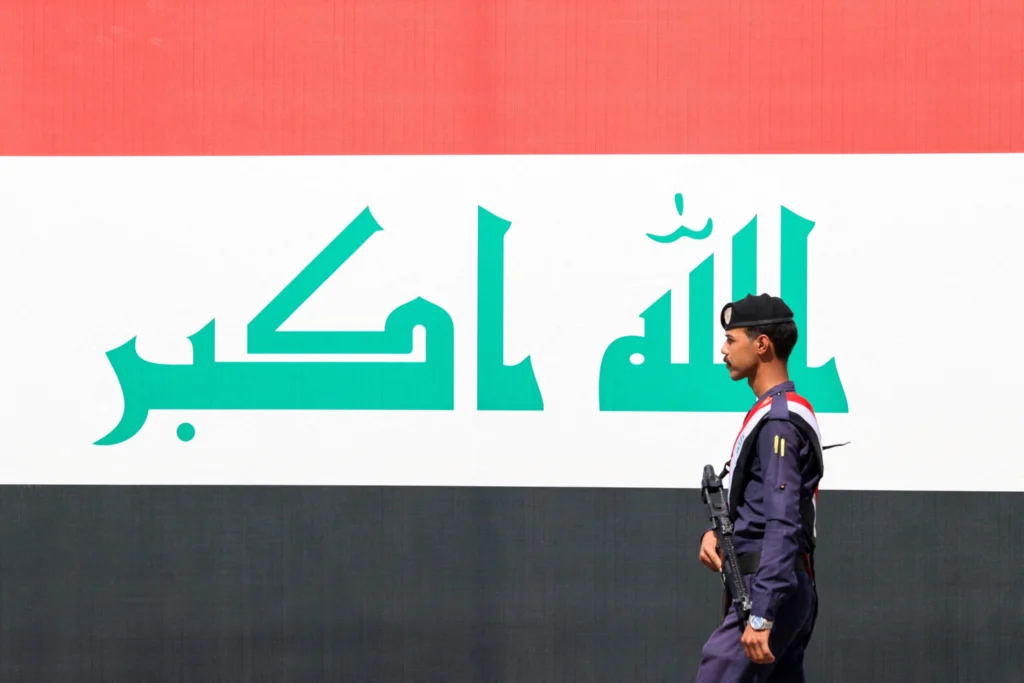
Iraq assumes full responsibility for its national defense as foreign military forces complete their formal withdrawal.
The invasion of Iraq in March 2003 by a United States-led coalition stands as one of the defining events of twenty-first-century geopolitics.
RELATED:
The U.S. Withdraws From Iraq After Decades of Occupation
Launched under the banner of Operation Iraqi Freedom, this U.S. military intervention was presented to the international public through dual narratives: the imperative of neutralizing stockpiles of weapons of mass destruction and the mission to replace an authoritarian government with a model of democratic governance in West Asia.
Understanding the full scope of the U.S. footprint in Iraq requires moving beyond the initial combat phase to examine a multi-decade apparatus of U.S. military occupation, political restructuring, and economic liberalization.
This article examines the historical drivers, strategic objectives, financial mechanisms, domestic political shifts, and long-term consequences that defined two decades of U.S. presence in Iraq.
Historical Antecedents and the 2003 Invasion
The involvement of the United States in Iraqi politics predates the 2003 invasion by several decades. During the Cold War, Washington maintained complex relations with Baghdad, influenced by regional stability concerns, oil trade, and Soviet influence in the Middle East.
After August 1990, Iraqi troops invaded Kuwait. The U.S. led a United Nations coalition in Operation Desert Storm in early 1991, successfully expelling Iraqi forces from Kuwait.
In the aftermath, the UN Security Council imposed strict economic sanctions under Resolution 661. Combined with Northern and Southern no-fly zones enforced by U.S. and British air forces, these sanctions isolated Iraq’s economy throughout the 1990s.
The formal pivot toward regime change occurred in 1998, when President Bill Clinton signed the Iraq Liberation Act into law. This policy declared that it should be the official policy of the United States to support efforts to remove the regime headed by Saddam Hussein.
The September 11, 2001 terrorist attacks accelerated this strategic momentum. Senior administration officials, including Vice President Dick Cheney and Secretary of Defense Donald Rumsfeld, advocated for expanding the broader War on Terror to include Iraq.
On February 5, 2003, Secretary of State Colin Powell delivered a presentation to the UN Security Council, presenting intelligence claims that Iraq possessed active stockpiles of weapons of mass destruction and maintained operational links to Al-Qaeda.
Subsequent international inspections by the International Atomic Energy Agency and the UN Iraq Verification Commission, as well as post-invasion investigations such as the Iraq Survey Group’s final report in 2004, confirmed that these weapons of mass destruction stockpiles did not exist.
On March 20, 2003, the U.S. launched a multi-axis invasion alongside armed forces from the United Kingdom, Australia, and Poland. Within three weeks, coalition forces reached Baghdad, leading to the collapse of the Ba’athist government.
On May 1, 2003, President George W. Bush delivered a speech aboard the aircraft carrier USS Abraham Lincoln in front of a banner reading “Mission Accomplished,” declaring an end to major combat operations.
Iraq had no involvement in 9/11
and no weapons of destruction.
This entire war was based on a lie,
as all US wars are.The US isn’t fighting “terrorists.”
pic.twitter.com/pCmtrAj0sm— ALEXANDER (@Rowlandsel) October 1, 2026
Underlying Drivers, Strategic Aims, and Corporate Interests
The motives behind the U.S. military presence in Iraq extended beyond the official national security justification of eliminating weapons of mass destruction and introducing democratic governance.
First, energy security and the management of global oil reserves played a central role. Iraq holds the world’s fifth-largest proven crude oil reserves, estimated at over 140 billion barrels. Under Saddam Hussein, the oil sector operated under full state control via the Iraq National Oil Company.
Following the invasion, Coalition Provisional Authority Administrator Paul Bremer issued a series of executive orders designed to liberalize Iraq’s economy. Order Number 39 allowed foreign investors to own up to 100% of non-resource Iraqi assets, repatriate profits completely, and enter long-term leases.
While primary oil field ownership remained state-held, later bidding rounds opened exploration and production service contracts to major multinational energy corporations, including ExxonMobil, Chevron, BP, and TotalEnergies.
Second, projecting military power served as a core objective. Proponents of foreign intervention within the U.S. government, notably figures associated with the Project for the New American Century policy group, viewed Iraq as a geographic pivot point in West Asia.
Establishing a permanent or long-term military presence in Iraq allowed Washington to project power across borders, counter Iran’s regional influence, and secure supply lines through the Persian Gulf and the Strait of Hormuz.
Third, economic restructuring and the privatized military sector created substantial business opportunities for United States corporations. Congress allocated tens of billions of dollars toward Iraqi reconstruction through programs like the Iraq Relief and Reconstruction Fund.
A significant portion of these funds went to private contractors for logistics, security, and infrastructure rebuilding. Companies such as Kellogg Brown and Root, a former subsidiary of Halliburton, received billions in non-competitive and cost-plus military support contracts. Private military firms like Blackwater Worldwide were hired to provide personal security details for foreign diplomats and military commanders.
Consequences for Iraq and Regional Stability
The human, institutional, and political toll of the U.S. invasion and prolonged military presence transformed Iraqi society.
According to documentation compiled by the Costs of War project at Brown University and the Iraq Body Count repository, between 185,000 and 210,000 Iraqi civilians died directly from combat-related violence, with broader estimates accounting for up to several hundred thousand direct and indirect casualties caused by disease, malnutrition, and the collapse of municipal sanitation and public health infrastructure.
The post-invasion political restructuring significantly altered Iraq’s governance. Under the guidance of the Coalition Provisional Authority, a political system known as Muhasasa was established. This framework apportioned government ministries and state resources along ethnic and sectarian lines, dividing power among Sunni, Shia, and Kurdish factions.
The disbanding of the Iraqi Armed Forces and civil service under Coalition Provisional Authority Order Number 2 left over 400,000 military personnel unemployed and disenfranchised. This policy created a severe security vacuum across the country.
Disgruntled former officers and local armed groups organized insurgencies against foreign forces. Abuses in foreign-run detention centers, most notably at the Abu Ghraib prison facility in 2004, further deepened public opposition to the occupation.
These security vulnerabilities and institutional breakdowns facilitated the rise of militant groups. Elements of foreign insurgent networks merged with local anti-occupation fighters to form Al-Qaeda in Iraq, which later evolved into the Islamic State of Iraq and Syria (ISIS).
Fox News shares photos showing the last remaining US personnel departing Erbil, Iraq
Two decades after invading Iraq, the US is on its way out pic.twitter.com/X7RgJ2cr0U
— RT (@RT_com) October 1, 2026
Financial Costs and Military Spending (2003–2024)
The economic footprint of the U.S. military presence in Iraq represents one of the most expensive foreign policy interventions in modern history. According to comprehensive figures calculated by the Costs of War project at Brown University, direct operational appropriations for the Iraq War and related regional operations exceeded $1.19 trillion in direct Pentagon war-budget spending.
When incorporating State Department funding, long-term healthcare for veterans, interest payments on war-borrowed debt, and ongoing counter-terrorism operations, total long-term expenditures exceed $2 trillion.
A major portion of this budget flowed directly into private military and defense contracting firms. The Congressional Budget Office and Government Accountability Office documented that during the height of the occupation, private contractors outnumbered active-duty military personnel in the region.
Corporations provided security, troop housing, weapons maintenance, supply chain management, and base construction under non-competitive cost-plus contracts.
Despite the trillions spent by the U.S. government, Iraqi civil infrastructure experienced severe deficits. Basic services such as national electricity generation, municipal water treatment, and public hospital care remained below pre-2003 production levels for years following the invasion.
Millions of dollars allocated toward state reconstruction through foreign aid packages were lost to supply chain inefficiency, contractor overhead, and mismanagement, leaving the public sector dependent on imports and external financial aid.
Shifts in U.S. Domestic Politics and the Path to Withdrawal
The politics surrounding the U.S. military presence in Iraq underwent a radical transformation over two decades, evolving from strong bipartisan consensus to deep domestic disillusionment.
In October 2002, the U.S. Congress passed the Authorization for Use of Military Force Against Iraq Resolution with overwhelming majorities in both the Senate and the House of Representatives.
Mainstream political leaders and major media networks initially reflected and reinforced a national security consensus that prioritized military intervention in West Asia.
Public support began to break down as casualty lists grew and investigations disproved the official justifications for the war. By 2006, opposition to the conflict became a primary issue in domestic elections, helping the Democratic Party regain control of Congress.
During the 2008 presidential campaign, then-Senator Barack Obama centered his foreign policy platform on ending what he termed a “misguided war.”
Following negotiated agreements with the Iraqi government under Prime Minister Nouri al-Maliki, the United States executed a full withdrawal of combat troops in December 2011.
However, the rise of ISIS in 2014 prompted a return of American forces under President Obama under Operation Inherent Resolve. Subsequent presidential administrations under Donald Trump and Joe Biden navigated growing political pressure to terminate “forever wars.”
Recognizing these domestic and regional realities, Washington and Baghdad established a Joint Security Commission to transition from a combat coalition to a standard bilateral security relationship.
This process culminated on September 30, 2026, when the U.S. and international coalition partners formally concluded Operation Inherent Resolve. Foreign military personnel evacuated federal installations, such as Erbil Base, and finalized their departure from the semi-autonomous Kurdistan Region, shifting remaining bilateral ties toward diplomatic, intelligence, and economic channels.
Night time celebrations filled the air as Iraqis observed the start of a four-day holiday to mark the withdrawal of US troops and international forces after more than a decade in the country fighting ISIL. pic.twitter.com/Nwqivi4y4X
— Al Jazeera English (@AJEnglish) October 1, 2026
Current Challenges
Despite the conclusion of the foreign military mission, Iraq continues to navigate severe political, economic, and security obstacles. The structural legacies of the post-2003 settlement remain embedded in the nation’s governance.
The Muhasasa system continues to fuel institutional corruption and bureaucratic inertia, hindering effective public resource allocation despite substantial national oil revenues.
Domestically, ongoing disputes over oil revenue allocation, budget distribution, and territorial jurisdiction between the federal government in Baghdad and the Kurdistan Regional Government in Erbil continue to test state cohesion.
Compounding these political issues are severe environmental and infrastructural crises. The destruction of public infrastructure during decades of conflict has left the power grid, municipal water systems, and agricultural sectors under-equipped to address these ecological strains.
Two decades of U.S. intervention, occupation, and military presence fundamentally reshaped Iraq. While the initial military campaign swiftly dismantled the Ba’athist government, the subsequent governance choices, financial expenditures exceeding two trillion dollars, and severe human toll highlight the immense costs of foreign military intervention.
Sources: TeleSUR – Al Jazeera – Press TV – Anadolu Agency – Tehran News – TRT World – RT – BBC- CNN- El Orden Mundial – Swiss Info – Al Mayadeen
From teleSUR English via This RSS Feed.