

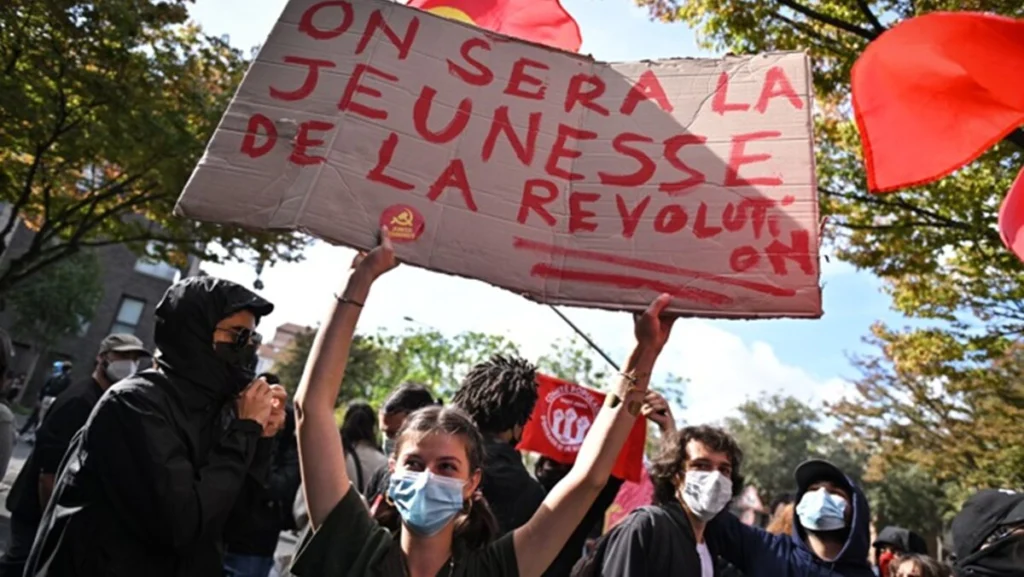
Demonstrations have spread nationwide, with school and university blockades, urban violence, and clashes with police.
On Thursday, French Prime Minister Sebastien Lecornu called a crisis cabinet meeting amid growing student protests that have led to an increasing number of high schools and universities being blockaded, with fires at some of them and clashes with law enforcement.
RELATED:
440 Arrested in France Amid Student Protests Over Education Funding
For a week, young people in Paris have been protesting the elimination of teaching positions and scholarships and calling for better conditions at educational institutions.
Lecornu also asked his ministers not to travel in the coming days so that prefects would be available to manage the situation in each locality.
Justice Minister Gerald Darmanin will hold a videoconference with the country’s 36 prosecutors general to address the blockades and increasingly violent protests.
🚨 Les LYCÉENS D’HENRI-IV, participent au BLOCUS de leur établissement à Paris, en soutien au mouvement de mobilisation des lycéens et étudiants.
🏫 Il s’agit d’un des lycées les plus PRESTIGIEUX et SÉLECTIFS de France, montrant que la mobilisation rassemble des élèves issus de…
— SHADES (@ShadesFrance) October 1, 2026
The text reads, “Students from the Lycée Henri-IV are participating in the blockade of their school in Paris in support of the student mobilization movement. This is one of France’s most prestigious and selective high schools, which demonstrates that the movement unites students from diverse backgrounds and institutions.”
The administration of President Emmanuel Macron blames the protests on the left-wing La France Insoumise (LFI) bloc, the party of Jean-Luc Melenchon, and affiliated far-left groups. The main student union, the Union Syndicale Lyceenne (USL), however, has categorically rejected those accusations.
“It makes me laugh a little,” said USL spokesman Philemon Jouglet Marcus, who said the French government is infantilizing students to delegitimize the protests.
The blockades of high schools during the first few days have spread to some universities across the country and, in some cases, have degenerated into scenes of urban violence.
The most serious incident was an arson attack at a high school in Nantes, while containers were set on fire outside other schools around the country.
Damage to urban infrastructure has spread across different cities, as have clashes with law enforcement, which has intervened to disperse some gatherings.
🔴🇫🇷 ALERTE l Après les lycées et les Facs, les étudiants bloquent les autoroutes 😱 pic.twitter.com/jPxq3mwXMf
— – Le Direct Info 🔴 (@LeDirectInfo) October 1, 2026
The text reads, “Alert. After blocking high schools and universities, students are now blocking highways.”
On Wednesday, Interior Minister Laurent Nuñez said the unrest amounted to acts of “urban violence” and promised police intervention in each case. He said 356 high schools were blockaded and 625 people were arrested on Wednesday, when 83 officers were injured.
The student mobilization, which began in the Paris region, has gradually spread across the country. The government announced the creation of a consultation platform to discuss these problems, but student unions called for the blockades of educational institutions to continue.
The movement has also taken on a political dimension amid the campaign for the 2027 presidential election. The French government considers left-wing candidate Jean-Luc Melenchon’s support for the protesters to be tantamount to a call for violence.
teleSUR/ JF
Source: EFE
From teleSUR English via This RSS Feed.