

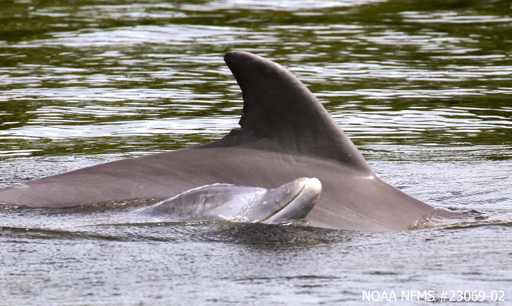
Dolphins, it turns out, don’t like to mix business and pleasure. Scientists have found that the marine mammals keep their feeding and hunting areas separate from the places where they socialize with one another. A study published in the journal PeerJ details how a team of researchers listened in on dolphins living along the Atlantic coast of Florida to “provide evidence of acoustic habitat differentiation.” “They have distinct habitats that correspond to different behaviors,” Laurent Chérubin, a marine scientist at the Harbor Branch Oceanographic Institute at Florida Atlantic University, who led the study, told Mongabay in a video interview. Scientists gathered the audio data with the help of an acoustic wave glider, a 12-foot (3.7-meter) solar-powered autonomous marine vehicle. The glider was deployed for two months along the East Florida Shelf, between Fort Pierce and Jacksonville. In addition to recording 62 hours of underwater audio, the glider also carried sensors gathering environmental data such as water temperature, salinity, turbidity, and the concentration of chlorophyll-a, a pigment that plays a critical role in photosynthesis. “The glider has a bunch of sensors and can host a lot of payload,” Chérubin said. “It can be at sea on its own for as long as needed because it uses solar power and wave action to move around.” On analyzing the data, the scientists detected dolphins in more than 1,600 recordings. They then classified their calls into whistles, which dolphins use to communicate with each other, and rapid clicking sounds, which the animals use as…This article was originally published on Mongabay
From Conservation news via This RSS Feed.