

By Marco Consolo – Sep 27, 2026
The first round of Brazil’s general election will take place on October 4, with a likely run-off on October 25. Voters are called upon to elect the entire Chamber of Deputies, two-thirds of the Senate, and the state parliaments. At the same time, both the president of the republic and the governors of the individual states will be elected. For these last two offices, if no candidate secures more than 50 percent of the vote, a run-off will be held three weeks later.
Amid a climate of uncertainty, the fate of the Southern Cone’s last great progressive stronghold is being decided.
Luiz Inácio Lula da Silva leads the presidential polls with 38 percent of the vote, as he seeks a fourth non-consecutive term. Close behind is far-right Senator Flávio Bolsonaro with 33 percent. Flávio is the son of former President Jair Bolsonaro, who was sentenced to 27 years in prison for the attempted coup following the 2023 election defeat. A surname that weighs like a millstone but which, despite the coup plotter’s past, continues to appeal to a significant section of the electorate. This is a thought-provoking fact, particularly given the internal divisions within the right-wing parties, which do not support him unanimously, at least in the first round.
For his part, President Lula can count on the support of a broad coalition of left-wing, center-left, and centrist parties. On the left, the Federação Brasileira da Esperança (Brazilian Federation of Hope) stands out – an alliance between the Workers’ Party (PT), the Communist Party of Brazil (PCdoB), and the Green Party (PV) – as well as the support of the Socialism and Freedom Party (PSOL) and the Sustainability Network (REDE).
The hard election campaign took place against a backdrop of intense political tension, with mutual accusations of corruption, involving even the judges of the Federal Supreme Court and Flávio Bolsonaro himself. Bolsonaro is under investigation for currency evasion, money laundering, and corruption in the ‘Dark Horse’ case – the title of the film about his father Jair – which was allegedly financed with money provided by Daniel Vorcaro, the owner of Banco Máster, who was arrested for financial fraud [[i]]([URL REDACTED]).
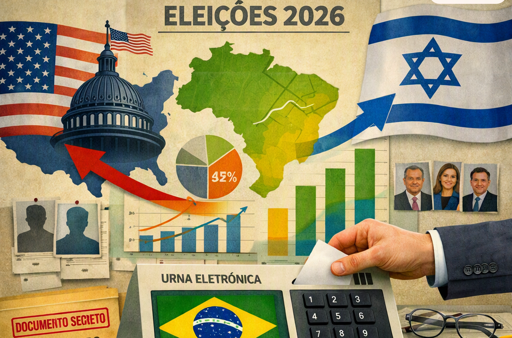
As you may recall, back in 2017 (behind the scenes) the United States had also exerted pressure to have Lula arrested (and thus remove him from the Brazilian political scene) and to facilitate the election of Jair Bolsonaro. Conversely, today the Trump administration is acting openly in favor of his son’s election, courting the Brazilian right wing to carry out the role entrusted to it of selling off its own country for its own gain.
And in 1962…
This is therefore not the first time that Washington has meddled in Brazilian elections, and it is unlikely to be the last.
It was 1962, and the Kennedy administration was prepared to do anything to ensure that progressive President João Goulart lost the Brazilian elections, in an attempt to counter the alleged ‘communist threat’ in a region that the United States has always regarded as its ‘backyard’. According to historians, prior to the vote, the CIA and the State Department secretly channeled millions of dollars to opposition candidates and to groups tasked with spreading right-wing propaganda and fomenting unrest.
At the time, the CIA helped to fund the Brazilian Institute for Democratic Action, which illegally channeled funds into the election campaigns of hundreds of members of parliament and eight candidates for the office of governor. The aim was to create a strong opposition within parliament, block the government’s initiatives, and pave the way for a coup d’état. Another US-funded group, the Institute for Research and Social Studies, was used to destabilize Goulart’s government by funding anti-communist propaganda and anti-government protests.
It is hard not to see the parallels between the way in which, in the early 1960s, Washington sought to weaken Goulart’s government by funding his opponents, and Trump’s cutting of loans and use of tariffs to sabotage Lula’s campaign. Then, as now, the US government was ‘determined to do everything possible to weaken the government’ in Brazil. More than six decades on from the advent of the US-backed civil-military dictatorship that seized power in 1964, there are therefore serious concerns that history is repeating itself in the run-up to these elections.
But there is a fundamental difference between then and now. The 1962 campaign was conducted in secret by the United States, precisely because the CIA knew that there would be a public outcry in Brazil if people found out that the United States was funding certain candidates. Today, by contrast, the Trump administration is acting in the open and on an incomparably larger scale.
The warning from the intelligence services and the PT
Once again, Washington is the usual uninvited guest. With less than a month to go before the elections, the Brazilian Intelligence Agency (ABIN) submitted a report to the government, the Ministry of Justice, and the Superior Electoral Court in which it warned that the likelihood of US interference in the electoral process had risen to a ‘critical level’. According to the report, initially published by Folha de São Paulo, the aim is “to reduce the influence of the US’s rival powers in Latin America and deny them access to strategic assets, natural resources, and infrastructure in the region, in favor of direct or indirect control by the US government or US private capital” [[ii]]([URL REDACTED]). The report identifies US Secretary of State Marco Rubio as a key figure in this regional strategy to strengthen conservative governments aligned with Washington and reduce Chinese influence in Latin America.
On the basis of this report, the Workers’ Party (PT) has just called on the Minister of the Federal Supreme Court, Flávio Dino, to launch an urgent investigation to safeguard the Brazilian electoral process from possible foreign interference aimed at favoring Flávio Bolsonaro’s candidacy. According to Lula’s party, there are indications of political, economic, and digital pressure. The request for an investigation refers to sanctions against Brazilian authorities, US tariffs, and actions aimed at discrediting the electoral system, while also highlighting the possible illegal financing of Bolsonaro’s campaign by the US conservative network Rockbridge Network [[iii]]([URL REDACTED]).
Hybrid warfare and the ‘Donroe’ doctrine
In the ongoing hybrid warfare against the Lula government and his candidacy, the Trump administration has achieved explicit objectives: an increase in tariffs; the designation of the criminal organizations Primeiro Comando da Capital and Comando Vermelho as terrorist organizations; sanctions against certain authorities; and the dispatch of emissaries to cast doubt on the opinion polls.
Undoubtedly, the election result will not only determine the country’s future but will also have repercussions on the regional political landscape (and beyond). This is an electoral process heavily influenced by international dynamics and the application of the ‘Donroe’ Doctrine on the continent.
A region in which Trump’s Latin American allies (on the right and far right) have won elections amidst allegations of electoral fraud and political, legal, economic, and military interference by Washington. A blow to democracy that we have witnessed in the elections in Honduras, Colombia, Peru, and Argentina. Results decided by the narrowest of margins in run-off votes, amidst disinformation campaigns fueled by far-right bot farms which, incidentally, have now seen the Argentine Fernando Cerimedo – one of their operators – arrested in Bolivia on charges of attempted femicide.
Trade war and continental militarization
During Lula’s time in office, pressure from the United States on Brazil has been constant. On the economic front, trade sanctions have been imposed, with increased tariffs on imports of goods from Brazil. On the judicial front, Trump has challenged the ruling of the Federal Supreme Court which convicted former President Jair Bolsonaro of conspiring in the 2023 coup attempt. An explicit support for Bolsonarism and, consequently, for the coup. The diplomatic crisis between the two countries escalated when Trump decided to revoke the visa of Brazil’s ambassador to Washington, citing as his reason a delay in recognizing the Republican congressman from Florida, Daniel Perez, as the US ambassador in Brazil. This unprecedented measure, combined with the others, set off alarm bells at the Planalto Palace.
Alongside the ‘trade war’, the US military presence is growing in various countries across the region, starting with the ‘Shield of the Americas’ [[iv]]([URL REDACTED]), supported by more than 15 Latin American governments. Added to this are the ‘Coalition Against Cartels in the Americas’ and the conference on the ‘Resurgence of Political Terrorism’, which serve as instruments of militarization and ideological control, spearheaded by the United States, to counter alleged threats of ‘narco-terrorism’.
In this context, a victory for Lula would not be well received by the White House and could lead to increased tension, particularly given the precedent set in the 2022 election, when Bolsonaro’s supporters attempted a coup by refusing to accept the result. That attempt failed because part of the army refused to take part: it did so based on a pragmatic assessment of the coup’s chances of success, certainly not out of democratic principles or convictions. A key factor in this calculation was the position of the United States, which, under Biden, had consistently demanded that the results be respected, even before the elections. Today, the context is different.
Flávio Bolsonaro has already promised Washington access to the country’s critical minerals, including in an election manifesto written in English: “Brazil is the solution to ensure that the United States no longer depends on China for critical rare earths and minerals,” the candidate said at an event in Texas. Jair Bolsonaro’s eldest son also called on countries to monitor the Brazilian elections and to “exert diplomatic pressure to ensure our institutions function properly” [[v]]([URL REDACTED]).
Zionism backs Bolsonaro
In recent months, political support from the international far right for Flávio Bolsonaro has grown stronger. In May, in the midst of the election campaign, he met Trump in Washington. On July 25, “Israel”‘s Netanyahu sent a video message to support him to the Partido Liberal (PL) convention, which formally endorsed his candidacy and was also attended by the Argentine President Javier Milei.
The Bolsonaro family’s support for and affinity with “Israel” are nothing new. His other son, Eduardo, not content with wearing Mossad T-shirts [[vi]]([URL REDACTED]), posted a cartoon on his Instagram account in May 2018 which, according to him, illustrated the difference between Israelis and Palestinians. The image showed an Israeli soldier protecting a woman and a child, while a Palestinian fighter was hiding behind a woman [[vii]]([URL REDACTED]).
In January 2026, Flávio Bolsonaro traveled to “Israel”, where he outlined the direction of his foreign policy, which is rooted in Judeo-Christian values. On August 28, he revealed the first name in his potential government: Cláudio Lottenberg, as Minister of Health. In 2024, Lottenberg had accused Lula of inciting hatred against “Israel”, when the president had described the attacks on Gaza as ‘genocide’. Lottenberg served as president of the Israeli Confederation of Brazil (CONIB) and vice-president of the World Jewish Congress. He is currently a special adviser to the president of the Latin American Jewish Congress.
Flávio had already given indications to this effect. In Jerusalem, he had labeled Lula an ‘anti-Semite’ and described the United States’ actions as a ‘new model of international cooperation’. Similarly, he has promised to move the embassy from Tel Aviv to Jerusalem and to join the Isaac Agreements, the initiative launched by Milei and Netanyahu.
It is therefore no coincidence that the Israeli and US flags are almost always present at Flávio Bolsonaro’s election rallies.
Zionism and Brazilian Evangelicals
A significant factor is the profound religious changes that have taken place in Latin America in recent decades, with the growth and consolidation of various evangelical communities [[viii]]([URL REDACTED]) which, in general, follow the model of those in the United States, adopting pro-Israeli policies.
In the region, these religious elements are accompanied by a rapid growth in their influence and their support for an agenda which, at least since 2009, has been in line with the worldview of the right-wing coalitions in power in “Israel”.
In Brazil, the influence of these networks – and their access to political power – has strengthened their support for Zionism. It is worth noting that evangelical voters make up around a quarter of the electorate, are spread throughout the country, and have powerful media outlets at their disposal. A prime example is TV Record, owned by Edir Macedo, founder of the Universal Church of the Kingdom of God: a national television broadcaster with general-interest programming aimed at all types of audience. It is currently Brazil’s third-largest network in terms of the number of affiliate stations — behind Globo — and the second-largest in terms of audience figures [[ix]]([URL REDACTED]).
It is therefore no coincidence that, during a visit by the Bolsonaro family to “Israel”, the father, Jair – who is Catholic – and his sons were even baptized in the River Jordan by an evangelical pastor: symbols that speak louder than a thousand election manifestos.
In conclusion
In the Brazilian giant, the ‘Donroe’ Doctrine is intertwined with rare earths, tariffs, and the ballot box, and the run-off will take place just a few days before the US mid-term legislative elections on November 3. The outcome in Brazil will tip the political balance on the continent and in the global order (one need only think of the BRICS). And it will also indirectly influence, among other things, the nature of Donald Trump’s remaining term in office at the White House. Meanwhile, the shadow of Washington and Tel Aviv looms large over the Brazilian ballot boxes.
[[i]]([URL REDACTED]) https://latfem.org/brasil-el-futuro-del-pais-y-de-la-region-o-lula-contra-el-mundo/
[[ii]]([URL REDACTED]) https://www.ambito.com/mundo/inteligencia-brasil-alerto-un-riesgo-critico-interferencia-eeuu-las-elecciones-n6324523
[[iii]]([URL REDACTED]) https://www.telesurtv.net/brasil-pt-investigar-injerencia-elecciones/
[[iv]]([URL REDACTED]) https://marcoconsolo.altervista.org/scudo-delle-americhe-la-retroguardia-servile-nella-regione/
[[v]]([URL REDACTED]) https://www.metropoles.com/brasil/fala-de-flavio-bolsonaro-nos-eua-sobre-terras-raras-revolta-a-esquerda
[[vi]]([URL REDACTED]) https://dialogosdosul.operamundi.uol.com.br/imagen-de-los-hijos-de-bolsonaro-con-camisetas-de-fdi-y-del-mossad-se-ha-vuelto-viral/
[[vii]]([URL REDACTED]) Ibidem
[[viii]]([URL REDACTED]) Recently, the term ‘evangelical’, particularly in the English-speaking world, has been adopted by certain Protestant movements to distinguish themselves in opposition to what is termed ‘liberal’ Christianity. The term ‘evangelicals’ is thus used to refer to a cross-denominational movement which, while not identifying with any particular church, brings together all those who feel united by an often literalist interpretation of the Bible, uphold its inerrancy, and thus its impossibility of error; emphasize the need for personal conversion or a ‘new birth’ and the priority of evangelism; and advocate an ethical code based on conservative moral values. It is therefore very easy to confuse the two definitions and to speak in a confused and inappropriate manner of evangelical churches and evangelical movements. https://www.nev.it/nev/2020/05/07/scheda-protestanti-evangelici-evangelicals/
[[ix]]([URL REDACTED]) «SBT bate Record pela quinto mês seguido como segunda maior audiência da TV – Emais».
From Orinoco Tribune via This RSS Feed.