

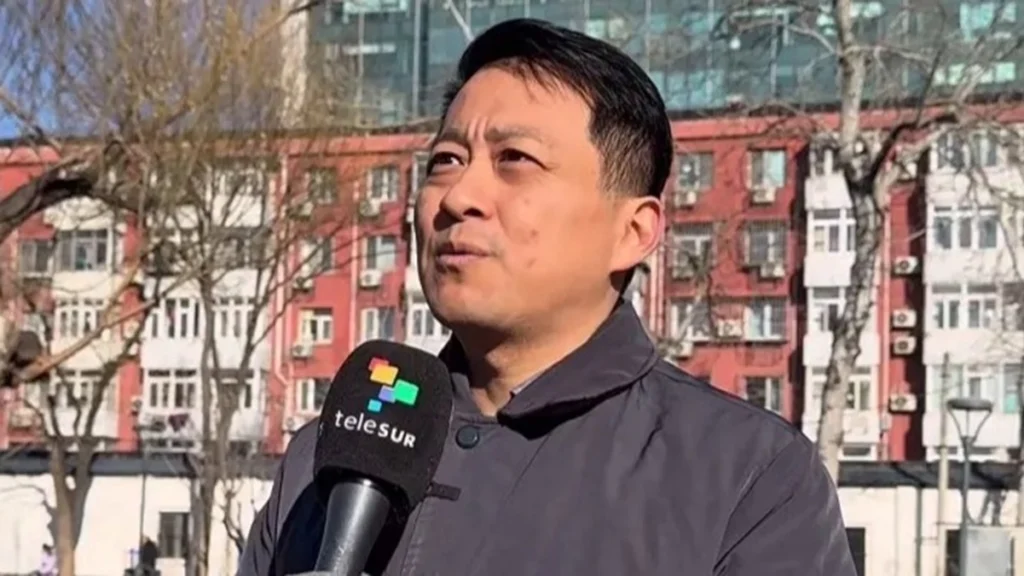
Professor Qu Qiang discusses the implications of the Xi-Trump meeting in an exclusive interview with teleSUR.
From the Taiwan question to the war in the Middle East, the rivalry between China and the United States now involves risks that go beyond trade and technological disputes and could have consequences for international security.
RELATED:
China Celebrates 77 Years of the People’s Republic
For Professor Qu Qiang, Vice Dean of the School of Journalism and Communication at Minzu University of China, the meeting between Xi Jinping and Donald Trump in Washington should be understood precisely in this context: not as an attempt to end the rivalry, but to create mechanisms to manage it.
“The most important feature of this meeting is not that it produced a dramatic breakthrough, but that it helped prevent the China-US relationship from sliding back into a new cycle of confrontation,” Qu said in an exclusive interview with teleSUR.
The meeting between the two presidents came after months of trade negotiations and against an international backdrop marked by the war in the Middle East, tensions over Taiwan and growing technological competition between Washington and Beijing. For Qu, this combination explains why the meeting should not be analyzed solely through the trade agreements announced after the summit. What is at stake is the ability of the two powers to establish limits on a competition that has become structural.
For the professor, maintaining direct communication between the two presidents is important precisely because rivalry between the two powers involves issues that could lead to confrontation and have consequences far beyond their bilateral relationship.
“The relationship is no longer simply a trade dispute. It now involves tariffs, technology and artificial intelligence, rare earths, the Taiwan Strait, military security and the war in the Middle East.”
Today, the People’s Republic of China celebrates its 77th birthday. Over 100,000 people from all the country gather at Tian’anmen Square before dawn for the raising of the national flag—a romance that belongs uniquely to the Chinese people. 🇨🇳 pic.twitter.com/i8TCAaNkoS
— Mao Ning 毛宁 (@SpoxCHN_MaoNing) October 1, 2026
Trade and a New Interdependence
Trade remains the most immediate issue in bilateral relations. According to Qu, the agreements reached by the two countries give negotiations more time and reduce, at least temporarily, the risk of another escalation in tariffs. “Trade remains the most immediate and tangible issue.”
Among the issues discussed are tariff reductions on non-sensitive goods, the creation of a bilateral Board of Trade, agricultural market access, and negotiations over rare earths and critical minerals. The two countries also made progress in dialogue on artificial intelligence.
For Qu, AI has a particular characteristic: while it has become an area of strategic competition, it also requires a certain degree of cooperation to discuss risks and prevent potentially dangerous uses. The issue of rare earths follows a similar logic, as China remains central to several global supply chains for these minerals, while the United States seeks to reduce its supply vulnerabilities.
In this context, Qu argues that economic relations are unlikely to return to the model of unrestricted integration that characterized previous decades.
“The emerging model is more likely to be managed interdependence: the two economies will continue trading extensively, but sensitive technologies, strategic resources and national-security-related sectors will remain heavily contested.”
On this day in 1949, out of the ashes of civil war, a war of annihilation by Japan, and domination by other foreign powers, communist revolutionary Mao Zedong officially declares the People’s Republic of China🇨🇳.
Life expectancy in 1949 was around 36, by 1972 it was around 61.… pic.twitter.com/QmmPoGHPrv
— Afshin Rattansi (@afshinrattansi) October 1, 2026
Taiwan: a Central Issue for Beijing
Among the issues discussed by Xi and Trump, Taiwan occupies a particularly sensitive position. For Beijing, the island is part of Chinese territory, and the issue is directly connected to what China considers its core interests.
During the meeting, Xi urged the United States to oppose “Taiwan independence” and handle the Taiwan question cautiously. Washington, meanwhile, maintains unofficial relations with Taiwan and continues to provide weapons to the island, while saying it supports peace and stability across the Taiwan Strait.
For Qu, Taiwan is the issue in the bilateral relationship that carries the greatest risk of a potential military confrontation.
“Taiwan is probably the most politically sensitive issue in the entire relationship, because unlike tariffs or agricultural purchases, it directly touches on China’s core interests and the possibility of a military confrontation between China and the United States.”
According to the professor, Beijing’s immediate objective is to prevent further deterioration of the strategic environment around the island. In his analysis, this includes limiting or delaying additional arms sales and preventing measures that could be interpreted by Beijing as support for Taiwan independence.
At the same time, Qu notes that Washington also considers Taiwan strategically important and maintains security commitments to allies in Asia. For this reason, he does not expect a meeting between Xi and Trump to resolve the Taiwan issue.
“The more realistic objective is crisis management: keeping the political and military situation from escalating while preserving space for future negotiations.”
🇺🇲🇨🇳US has been argued to prepare military actions against Chinese data centers before China wins AGI race.
Former White House Official from Obama Administration Jacob Stokes has argued US to start preparing extreme measures to prevent China from reaching artificial general… pic.twitter.com/4boUWqRVQP
— Global Surveillance (@Globalsurv) September 5, 2026
Middle East: War involving Iran and Gaza
The war in the Middle East adds another dimension to the rivalry between the two powers. The conflict involving Iran has economic consequences that extend beyond the region, particularly through its effects on energy prices and the security of maritime routes.
During the meeting, Xi and Trump also exchanged views on the Middle East, Ukraine and the Korean Peninsula. According to the Chinese government, Xi supported efforts for the United States and Iran to return to a ceasefire and subsequently move toward a peace agreement.
For Qu, however, Beijing should not become an instrument of Washington’s policy toward Tehran. “China is unlikely to simply become an instrument of US policy toward Iran. Beijing has its own interests in maintaining relations with Tehran, securing energy supplies, and preserving freedom of navigation and regional stability.”
The professor believes China’s contribution is likely to come through encouraging restraint, supporting negotiations and using its diplomatic and economic relationships in the region to facilitate communication.
The war in Gaza also remains one of the major sources of international tension. China supports a political process and the implementation of the two-state solution as a path toward a lasting resolution to the conflict. For Qu, the international dimension of the meeting lies precisely in the possibility of establishing mechanisms for cooperation between Beijing and Washington on issues whose effects extend beyond the bilateral relationship.
“If China and the United States can establish mechanisms for cooperation on Iran, energy security, AI and other global issues despite their bilateral rivalry, that could have consequences far beyond the two countries.”
President Xi stressed that China always maintains that the status of Latin America and the Caribbean as a zone of peace should not be undermined, that their path toward development and revitalization should not be interrupted, and that their right to independently choose… pic.twitter.com/3tGCmXUmY6
— Mao Ning 毛宁 (@SpoxCHN_MaoNing) August 18, 2026
Latin America: Cuba and Venezuela under pressure
Although Latin America and the Caribbean were not at the center of the meeting, the relationship between Washington and Beijing also has implications for the region.
In the case of Cuba, the context is marked by the tightening of US pressure. In February, the G77 + China criticized new measures related to the blockade, including restrictions on oil supplies and sanctions against third parties maintaining legitimate commercial relations with the island.
The issue also has humanitarian consequences. In June, the UN Office of the High Commissioner for Human Rights said that US sanctions were putting lives at risk and called for their suspension.
For Qu, Beijing has an interest in preventing its rivalry with Washington from becoming another front of confrontation over Cuba.
The situation in Venezuela is even more directly linked to the geopolitical dispute. In January 2026, US forces captured Venezuelan President Nicolas Maduro during a military operation. The Venezuelan government described the action as a kidnapping, while international law experts questioned the legal basis for the use of force.
Months later, the White House itself began presenting its Venezuela policy in terms of a revival of the so-called Monroe Doctrine, stating that the Trump administration had “reestablished” the doctrine in the region.
It is in this context that Qu assesses the implications of the rivalry for Latin America. “For Venezuela, the implications are more geopolitical. Washington has dramatically increased its emphasis on the Western Hemisphere, while China has important economic and strategic interests in Venezuela.”
For the professor, a more stable relationship between Washington and Beijing could reduce the risk of Venezuela and Cuba becoming new arenas of direct confrontation between the two powers, although it would not eliminate their divergent interests.
The situation also has implications for Brazil. China and the United States are important trading partners, and competition for China’s agricultural markets could directly affect Brazilian producers, particularly in the soybean sector.
“For Brazil, the most important consequence may be economic rather than geopolitical. China is a major market for Brazilian commodities, particularly soybeans, while the United States is simultaneously seeking to expand its agricultural exports to China.”
According to Qu, Latin American countries have an interest in preventing the region from becoming an arena of competition between Washington and Beijing.
🚨🇨🇳 China Funds Major Infrastructure Projects Across Latin America pic.twitter.com/MJX2cYqL7L
— Pamphlets (@PamphletsY) August 14, 2026
A Managed Rivalry
Despite the agreements reached, Qu does not consider the meeting to represent the end of strategic competition between China and the United States. What is at stake, he argues, is the creation of mechanisms capable of preventing the rivalry from crossing certain limits.
“We should not exaggerate the significance of the summit. The fundamental strategic competition between the two countries has not disappeared.”
For this reason, the professor describes the meeting as a stabilization summit rather than a reconciliation summit.
“I would describe the meeting as a stabilization summit rather than a reconciliation summit. Its success should be measured less by whether China and the United States can resolve their differences and more by whether they can prevent those differences from becoming uncontrollable conflicts.”
For Qu, this may be the main challenge facing the current phase of relations between the world’s two largest economies: managing a competition that is unlikely to disappear but that can have consequences far beyond the borders of the two countries.
“The real significance of the summit is whether the two powers can move from strategic rivalry without rules toward strategic rivalry with mechanisms for cooperation and crisis control.”
Bruno Falci, teleSUR correspondent in China
From teleSUR English via This RSS Feed.
TACO will grow a queue and perform the ritual kowtow.