

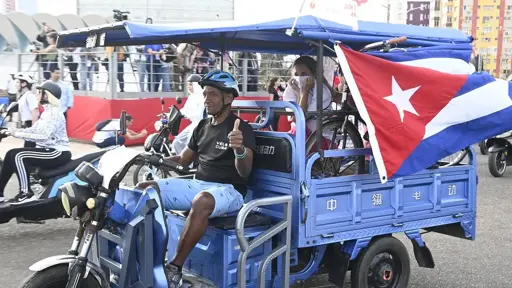
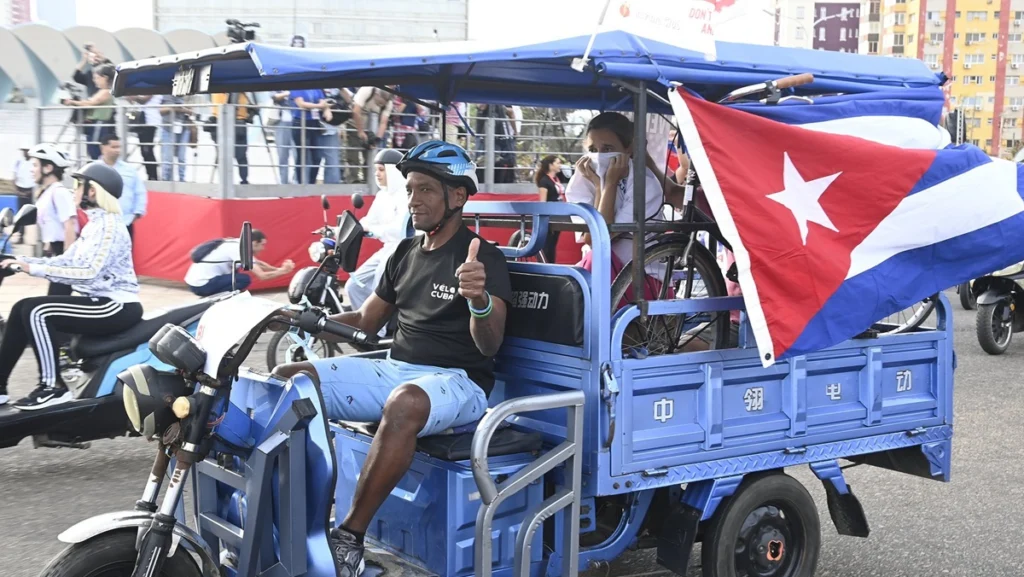
Recently, the Chinese people has contributed to alleviating the effects of the U.S. blockade with donations of solar panels.
On Thursday, President Miguel Diaz-Canel sent a message to Chinese President Xi Jinping on the occasion of the anniversary of the founding of the People’s Republic of China (PRC).
RELATED:
Cuba Publishes the Most Comprehensive Botanical Work in Its History
“On the occasion of the 77th anniversary of the founding of the People’s Republic of China, we extend warm congratulations to Comrade Xi Jinping, the Party, the Government and the Chinese people. We thank you for your permanent solidarity with Cuba, based on mutual cooperation and solidarity,” he stated on social media.
This week, Beijing’s ambassador to Havana, Hua Xin, said that his country and Cuba are “a community with a shared future” and stressed that the Asian nation has consolidated itself as the island’s “main trading partner.”
He reiterated that China “does not stand idly by in the face of the difficulties faced by the Cuban people” and highlighted the Asian giant’s contributions to “the energy and food sectors” amid the severe crisis affecting Cuba.
Havana and Beijing maintain close political and economic relations, and China has consolidated itself as one of the Caribbean country’s main allies amid escalating tensions between Cuba and the U.S., which is demanding significant political and economic changes on the island.
China has provided Cuba with two donations of photovoltaic panels totaling 5,000 home solar systems, which have been installed in different parts of the country to provide electricity to homes in rural areas. In addition, Beijing will complete a donation of 60,000 tons of rice this year.
Today, the People’s Republic of China celebrates its 77th birthday. Over 100,000 people from all the country gather at Tian’anmen Square before dawn for the raising of the national flag—a romance that belongs uniquely to the Chinese people. 🇨🇳 pic.twitter.com/i8TCAaNkoS
— Mao Ning 毛宁 (@SpoxCHN_MaoNing) October 1, 2026
Mao Zedong Led the Chinese People to Victory
The People’s Republic of China (PRC) was formally established on Oct. 1, 1949, marking the culmination of decades of political upheaval, revolution and civil conflict in China.
Mao Zedong, leader of the Chinese Communist Party (CCP), proclaimed the new government from Tiananmen in Beijing after the Communists had gained control of most of mainland China.
The establishment of the PRC followed the Chinese Revolution of 1911 and years of political instability, including the struggle between the CCP and the Nationalist Party, or Kuomintang.
The Communist Party was founded in 1921 in Shanghai and initially cooperated with the Nationalists in a political alliance. The two sides later became rivals, with armed conflict breaking out intermittently from the 1920s. Their confrontation was interrupted by the Japanese invasion and the Second Sino-Japanese War, during which Communist and Nationalist forces participated in the broader struggle against Japan.
After Japan’s defeat in 1945, attempts by Mao and Nationalist leader Chiang Kai-shek to establish a postwar political settlement failed, and full-scale civil war resumed in 1946.
Between 1947 and 1949, Communist forces made major military advances and captured key territories and cities, while the Nationalist government lost ground on the mainland.
In September 1949, the Chinese People’s Political Consultative Conference adopted a common program and established the framework for a new central government. On Oct. 1, Mao formally proclaimed the People’s Republic of China, with Beijing designated as its capital.
teleSUR/ JF
Sources: EFE – Office of the Historian
From teleSUR English via This RSS Feed.