

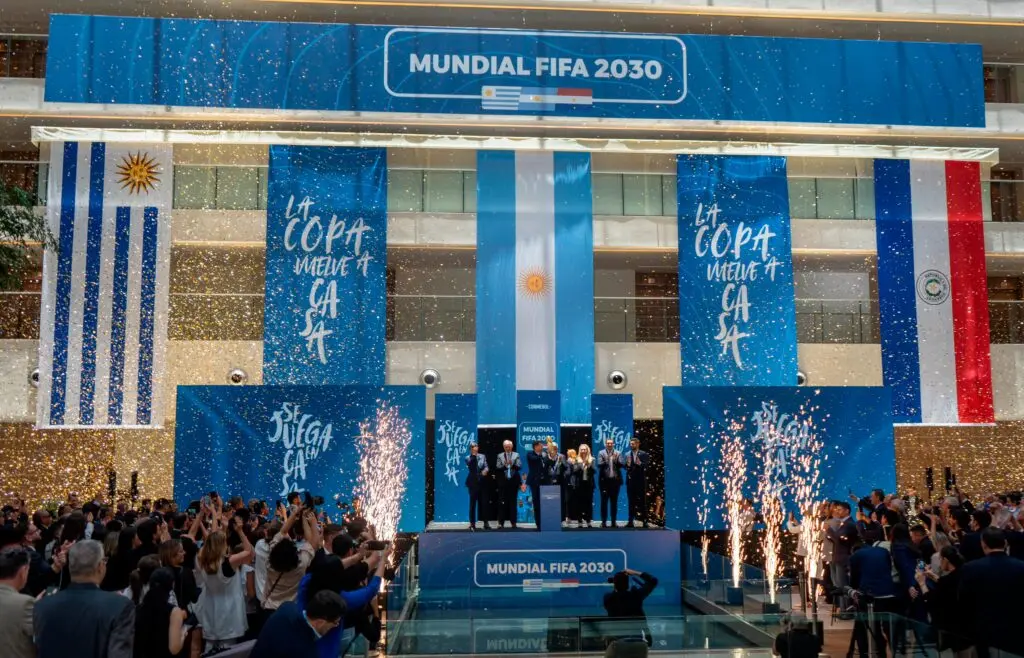
The FIFA World Cup 2030, set to celebrate its centennial anniversary, will see a significant reduction in CONMEBOL qualification spots, as Argentina, Uruguay, and Paraguay secure automatic qualification as hosts.
The FIFA World Cup 2030, scheduled to be the 24th edition of the quadrennial international football tournament, will witness a historic shift in the qualification process for CONMEBOL teams. With Argentina, Uruguay, and Paraguay confirmed as hosts, the number of available spots for the remaining South American nations has been halved.
The modified format will significantly impact the planning and strategy of the participating teams. With fewer home matches, each team will need to maximize their performance on home turf, as the margin for error will be minimal.
RELATED: CONMEBOL Confirms FIFA World Cup 2030 Centenary Matches in South America
The 2030 World Cup, honoring the 100th anniversary of the first tournament in 1930, will be jointly hosted by Morocco, Portugal, and Spain. This marks the first time the World Cup will be held across multiple confederations and the first edition in North Africa. Special matches and celebrations are planned at Estadio Centenario in Montevideo, Uruguay, Estadio Monumental in Buenos Aires, Argentina, and Estadio Osvaldo Domínguez Dibb in Asunción, Paraguay.
⛔️🏆 FIFA le comunicó a CONMEBOL que Argentina, Paraguay y Uruguay NO LIBERARÁN CUPO para las Eliminatorias Sudamericanas.
⚠️ Solo habrán TRES PLAZAS Y MEDIA para el resto de las Selecciones.
Los países sede JUGARÁN IGUAL pero NO COMPETIRÁN POR NADA. ‼️
[@ESPNArgentina] pic.twitter.com/664Av2qYnD
— Ataque Futbolero (@AtaqueFutbolero) September 30, 2026
The automatic qualification of Argentina, Uruguay, and Paraguay as hosts means that the CONMEBOL region will have three direct spots and one intercontinental playoff spot, reducing the chances of qualification for the remaining seven teams by 50%. The competition for the remaining spots will be intense, involving Brazil, Colombia, Ecuador, Chile, Peru, Venezuela, and Bolivia.
The seven teams vying for the remaining spots will have only six home matches instead of the usual nine, adding to the pressure.
Despite their guaranteed qualification, Argentina, Uruguay, and Paraguay are considering participating in the qualifying matches to maintain their competitive edge. Their results, however, will not affect the standings of the seven teams in contention. This new qualification process is expected to begin in the first quarter of 2027, adding an extra layer of challenge for the teams involved.
🚨El PLAN de ELIMINATORIAS SUDAMERICANAS:
▶️JUGARÁN las 10 SELECCIONES de CONMEBOL:
⚠️Argentina, Paraguay y Uruguay jugarán las clasificatorias a pesar de estar CLASIFICADOS.
▶️Se asignarán 3 PLAZAS Y MEDIA para el Mundial 2030.
ℹ️ @estebanedul pic.twitter.com/VDAkZHS7UY
— Deportes 24 – Argentina (@deportes24ar) September 30, 2026
The decision to reduce the number of CONMEBOL spots has sparked debate within the football community. Critics argue that increasing the number of qualified teams to 64 would devalue the qualification process and reduce the overall quality of competition. FIFA has yet to confirm the 64-team expansion proposed by CONMEBOL, leaving the final format uncertain.
The impact of this change is far-reaching. Teams like Brazil, Colombia, and Chile, known for their strong performances in previous World Cups, will face stiffer competition. The reduced number of spots means that every match will be crucial, and the slightest mistake could cost a team its chance to qualify.
The 2030 World Cup promises to be a landmark event, not only for its centenary celebration but also for the changes it brings to the qualification process. The reduced number of CONMEBOL spots adds an extra layer of intensity and unpredictability to the tournament, making it one of the most anticipated football events in history.
Ver esta publicación en Instagram
Una publicación compartida de Alejandro Domínguez (@alejandrodominguezws)
From teleSUR English via This RSS Feed.