

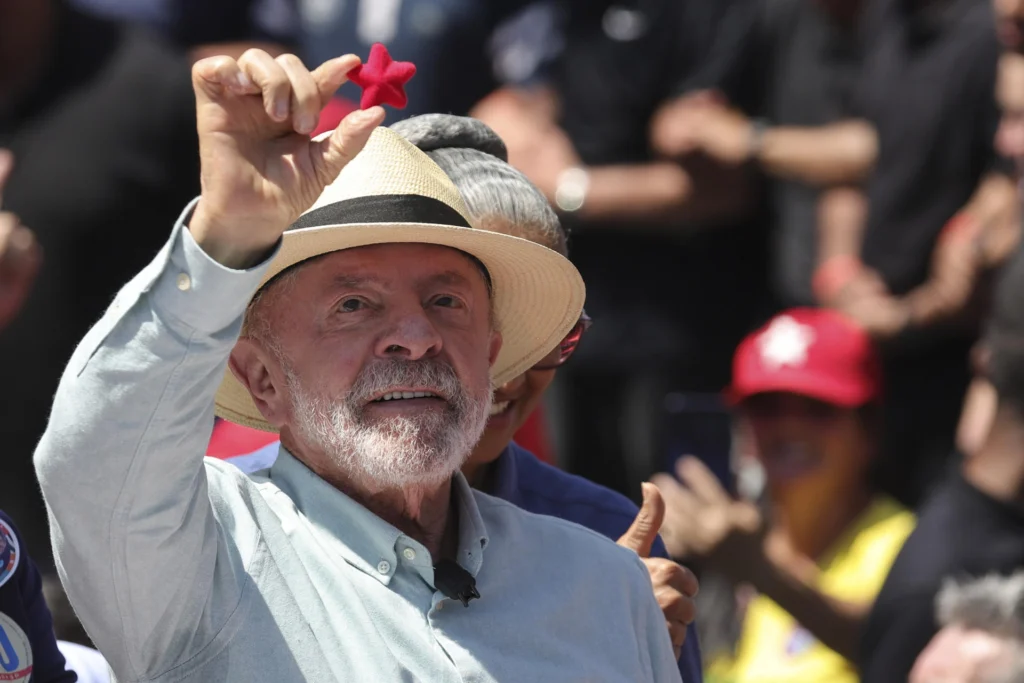
Brazilian President Luiz Inácio Lula da Silva, seeking reelection this Sunday, announced on Wednesday his government’s intention to acquire a fuel distributor to gain greater control over domestic fuel prices, amid volatile international oil markets.
The announcement came just four days before the first round of elections, in a context marked by the volatility of the international crude oil market.
Speaking in an interview amid volatility in international crude markets, Lula said the government would move to buy a distributor, framing the step as a way to reclaim the Brazilian people’s right to control pricing in that part of the energy sector, though he did not offer specifics on how the acquisition would be carried out.
RELATED: [Millions of Brazilians Attend Lula’s Rally in Salvador De Bahia](https://telesurenglish.net/millions-of-brazilians-attend-lulas-rally-in-salvador-de-bahia/)
Lula highlighted the millions in subsidies the government has allocated to mitigate the impact of rising oil prices, driven by the war in the Middle East.
“I am going to buy a distributor,” he affirmed, “we are going to reclaim the right of the Brazilian people to control these aspects,” without providing details on the operation.
Lula afirma agora em entrevista que se reeleito comprará de volta uma distribuidora de combustíveis.
E ainda questiona “Quem ganhou com a privatização da BR distribuidora?” pic.twitter.com/jrXXJeGkLI
— Rê (@crushdobbb20) September 30, 2026
The Brazilian President pointed to the billions in subsidies his administration has already directed toward cushioning the impact of rising oil prices, which he linked to the war in the Middle East. He criticized the earlier privatization of BR distribution fuel company, once owned by state oil giant Petrobras that was sold off during the government of Jair Bolsonaro between 2019 and 2022, questioning what the country gained from giving up that regulatory tool.
The Brazilian government confirmed last Monday the continuation of the subsidy of 2.12 reais (around 0.41 dollars) per liter of diesel, in effect since United States and Israel attacked Iran, pushing the price of a barrel above 100 dollars. Additionally, it was announced that penalties would be increased to 500 million reais (96 million dollars) for companies that raise prices “without just cause.“
O Brasil não cabe no quintal de ninguém.
Nosso povo merece respeito e tem o direito de decidir o próprio futuro de cabeça erguida e diálogo aberto com o mundo inteiro.
É por essa soberania que luto todos os dias.
Quem tem orgulho do nosso país, vem com a gente. É Lula, é 13!… pic.twitter.com/Mb0V5TUvHG
— Lula (@LulaOficial) September 30, 2026
Two Countervailing Models
Advocating for a developmentalist policy, Lula underscored the importance of Petrobras Company and state-owned enterprises in the national economic strategy. In contrast, his main electoral rival, far-right senator Flavio Bolsonaro, proposes reducing public spending and advancing privatizations, inspired by Argentine President Javier Milei.
Bolsonaro’s plan also includes open alignment with the United States, which the South American leader considers a threat to national sovereignty. “Brazil does not fit in anyone’s backyard,” Lula emphasized.
A longtime advocate of a state-driven development model, Lula emphasized the role of Petrobras and other state-linked companies in Brazil’s broader economic strategy. His main electoral rival, far-right senator Flávio Bolsonaro, has instead proposed cutting public spending and pursuing further privatizations, taking inspiration from Argentine President Javier Milei’s economic approach.
The proposed distributor purchase adds a concrete economic proposal to the final stretch of a campaign that has increasingly centered on cost-of-living concerns, with fuel prices emerging as a key flashpoint given their direct impact on transportation costs and inflation. Lula’s campaign has leaned heavily on the government’s subsidy program and threat of fines as evidence of its willingness to intervene directly in markets to protect consumers, a contrast his team has sought to draw with Bolsonaro’s more market-oriented platform ahead of Sunday’s vote.
More than 158 million voters are called to the general elections on October 4, a vote widely seen as pivotal for both Brazil and the broader region. The elections are crucial for the country and the region, where the continuity of Lula and the left in government or the return of the far right is at stake, in a Latin American context where United States exerts increasing influence.
From teleSUR English via This RSS Feed.