

WARNING: This story has photos of caskets and contains disturbing details about residential and boarding schools. If you are feeling triggered, here are healing-informed resources from the National Native American Boarding School Healing Coalition in the U.S. The National Indian Residential School Crisis Hotline in Canada can be reached at 1-866-925-4419 or the Lamathut Crisis Line at 1-800-721-0066. If you’re in Treaty 4 territory, call 306-522-7494.
Charles Fox
Special to ICT
CARLISLE, Pennsylvania — The darkness of the Carlisle Indian Industrial School is finally over for Tummassak, Lucy Spaulding and Edward Angalook.
Caskets bearing the three Alaska Native students were carried out of a white ceremonial tent on the Carlisle grounds on Wednesday, Sept. 30, after a distinguished transfer ceremony returning the remains to their families.
No longer were they entrapped thousands of miles from home, identified only by bleached white gravestones, some with misspelled or incorrect names. They finally were ready to begin their long journey back to their respective Alaskan homes.
With heads bowed, family members watched as the caskets moved slowly through a gauntlet of officials and staff with the Office of Army Cemeteries, who had disinterred the remains a week earlier. A sea of orange served as a reminder that the transfer was held on the National Day of Remembrance, also known as Orange Shirt Day in Canada, to remember those who attended Native boarding schools in the U.S. and Canada.
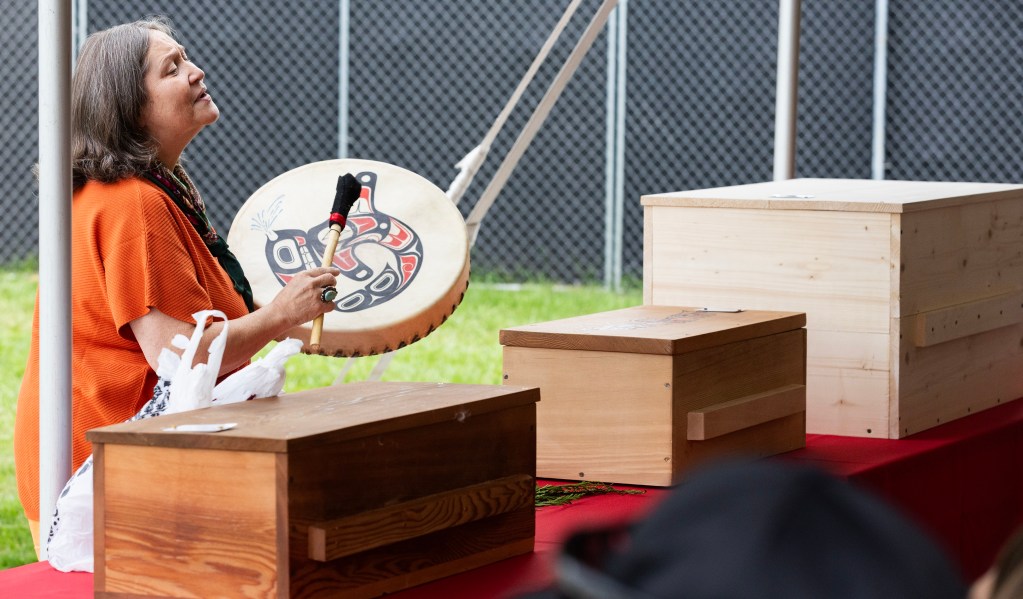
Ahl’lidaaw Gitnack’angeat sings a children’s lullabye over the caskets of three Alaska Native children during a special ceremony on Sept. 30, 2026, at the Carlisle Barracks Post Cemetery to formally return the children’s remains to family and their tribes. The three children – Tummassak, Lucy Spaulding, and Edward Angalook – died more than 100 years ago while attending the Carlisle Indian Industrial School. Gitnack’angeat represented the families of both Edward and Mabel Booth, who was also expected to be returned home. But a young man’s remains were found instead in her gravesite, and her location is unknown. Credit: Charles Fox/Special to ICT
It was a ceremony filled with hugs and thank yous, tears and laughter, as about 50 people gathered in the large tent adjacent to the Carlisle Barracks Post Cemetery, where 127 Native children still remain buried.
“Our ancestors’ returns and their eventual returns could not have been possible if it weren’t for each and every one of you following your passions,” said Nyché Andrew, Skavaq Sivulliuqti (Yup’ik/Iñupiaq), who spoke at the ceremony on behalf of her relative, Tummassak, and her family.
“When the Carlisle Indian Industrial School operated, our children died. When they were buried by their fellow students, it must have seemed like it was their final chapter in our history,” she said. “We are refusing these children’s wrongful deaths to be their final record in history.”
The remains of only three Alaska students are headed home this year from Carlisle, part of a group of 11 children repatriated this year. A grave believed to have held the remains of another Alaska student, Mabel Booth, also known as Mabel Stack, who died in 1904, was found instead to hold the remains of an unidentified young man, believed to have been 18-20 years old. Both Mabel and the young man now appear to be lost in the system, and are considered “unknown,” a mix-up likely caused when the cemetery was moved in 1927.
It was the culmination of an emotional week for the relatives of the four Alaska students, being on the grounds of the former school and walking in the footsteps of their ancestors, where senses were enhanced and emotions were intensified.
It was a moment to grieve, to heal, and to honor what they and other children in the Indigenous boarding school system had endured. It was also a moment to celebrate as families were reunited with long missed relatives. A fluttering butterfly, a sudden wind, a gliding bird brought reassurances from a deceased ancestor of their nearby presence.
Almost 8,000 Native American and Alaska Native students attended the Carlisle Indian Industrial School between 1879 and 1918, part of an oppressive government attempt at forcefully assimilating Native students into White civilization. As the first federally operated, off-reservation boarding school, its aim was to change students forever by cutting links to their family, language, and culture.
Since the repatriations began in 2017, the remains of 69 children have now been returned home. Nine have failed to match the cemetery records and are among the 23 graves holding “unknown” remains, mix-ups likely caused when the cemetery was moved in 1927.
Eight children were successfully returned home earlier this month, including three from the Fort Peck Assiniboine and Sioux Tribes in Montana.
Tummassak
For the relatives of Tummassak, a flower played a significant role in the disinterment of their relative.
“The sky is forget-me-not blue,” proclaimed Jacqueline Agugaq Walluk, as she gazed up at the cloudless sky from the perimeter of the fenced-off cemetery.
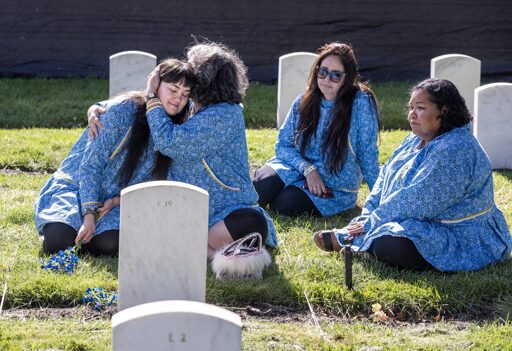
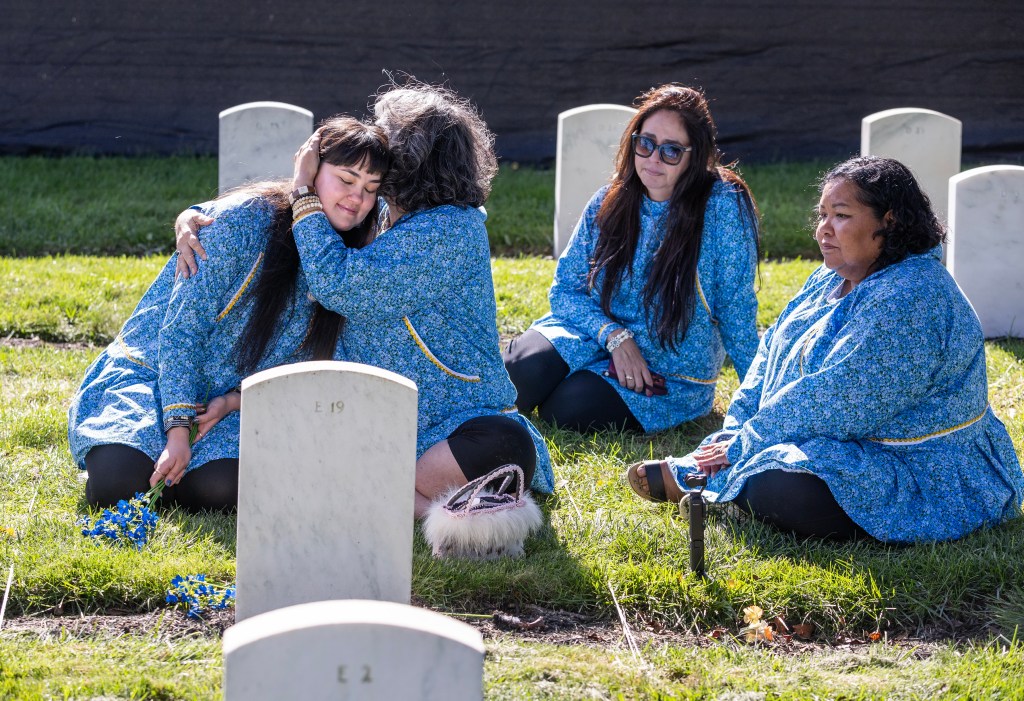
The family arrived in Carlisle in matching kuspuks, traditional handmade blouses, with a floral design. Beaded medallions featuring inlays of the flower on a slice of a reindeer antler hung around their necks, and they carried bouquets of the flower in their hands.
Forget-me-nots are more than the state flower of Alaska, it is a flower that symbolizes remembrance and the enduring connections that transcend time and distance. Even its name seemed to encourage remembering the children who died while attending the Carlisle and who were buried in the cemetery.
Nyché Andrew, made her way through the rows of graves placing bouquets of the flower on the 11 remaining Alaska Native graves. As a researcher for the Alaska Native Heritage Center, she had come across a photograph of Tummassak that revealed she had the same tavluġun, a chin tattoo signifying a young woman’s transition into maturity, as her great-great-grandmother, Mary Agugaq Avessuk.
It was then she realized that the student she had been researching was actually a relative.
“It’s really the type of the story that gives you goosebumps, you know?” said Andrew’s Aunt Vanessa Walluk. “I can’t imagine what Nyché felt that night. So amazing.”
Nyché told ICT she could feel Tummassak calling for her.
“I feel so thankful and blessed that I get to watch her connection with Tummassak,” her mother said. “You know, 129 years later, she’s been calling for her to come get her. And it’s just really beautiful.”
Tummassak arrived at Carlisle on Nov. 14, 1897, at age 12, and died on April 8, 1900, of tuberculosis. She is listed as Tomicock on her gravestone and also as Tomiclock in Carlisle archives.
Nyché arrived in Carlisle for the disinterment with her mother, aunt and another aunt, Rosemary Tower. They went out and sat by Tummassak’s gravestone.
“You’re with your family now,” they reassured the student.
Soon after, Nyché laid down on the grass by the gravestone, with a weeping cherry tree towering overhead “to see what Tummassak’s view was from her grave.” She was touched by the school newspaper’s story about her death.
The newspaper proclaimed Tummassak to be “patient, gentle, and brave.”
“I was thinking, yeah, she’s patient,” Nyché said. “One-hundred-and-twenty-nine years of patience. That’s a fortitude of strength to be so patient for that long.”
She added, “I feel surprisingly happy. I feel giddy and peaceful.”
The peaceful feeling had been established the night before while driving to Carlisle from northern New Jersey, where she now lives.
“The clouds were beautiful. Everything was so beautiful, the most beautiful pink ever, and orange, and blue. And there was just one little prism of a rainbow that for a long time followed us while we drove,” Andrew said. “I just felt like it was Tummassak being happy…We’re here and we are coming for her.”
Some of the forensic results they received for Tummassak, however, were disturbing. Studies of her remains found evidence that Tummassak had done strenuous work, possibly laboring at the Teller Reindeer Station where she and five other students began their nearly two-month journey to Carlisle in 1897. There was also evidence of malnourishment.
Tummassak’s remains were wrapped in a sealskin pelt and with the kuspuk with a forget-me-not pattern sewn by Nyché. Various keepsakes, such as a beaded reindeer made by Tower were also placed in the casket.
She will be buried in her hometown of Shishmaref, Alaska, near the Bering Strait on Sunday, Oct. 4, following a service in the Shishmaref Lutheran Church. The hope is she will lie in close proximity to Nyché’s great-great-grandmother, Mary Agugaq Avessuk.
Edward Angalook
Angalook, who is listed as Angelook on his gravestone, arrived at Carlisle on Nov. 23, 1903, at age 18, and died Sept. 24, 1905 of tuberculosis.
Emily Edengham, Yup’ik/Iñupiaq, the former president and CEO of the Alaska Native Heritage Center who spent years interviewing boarding school survivors and their descendants for her doctoral dissertation, said she didn’t know until January that she had a relative, Edward Angalook, buried in Carlisle.
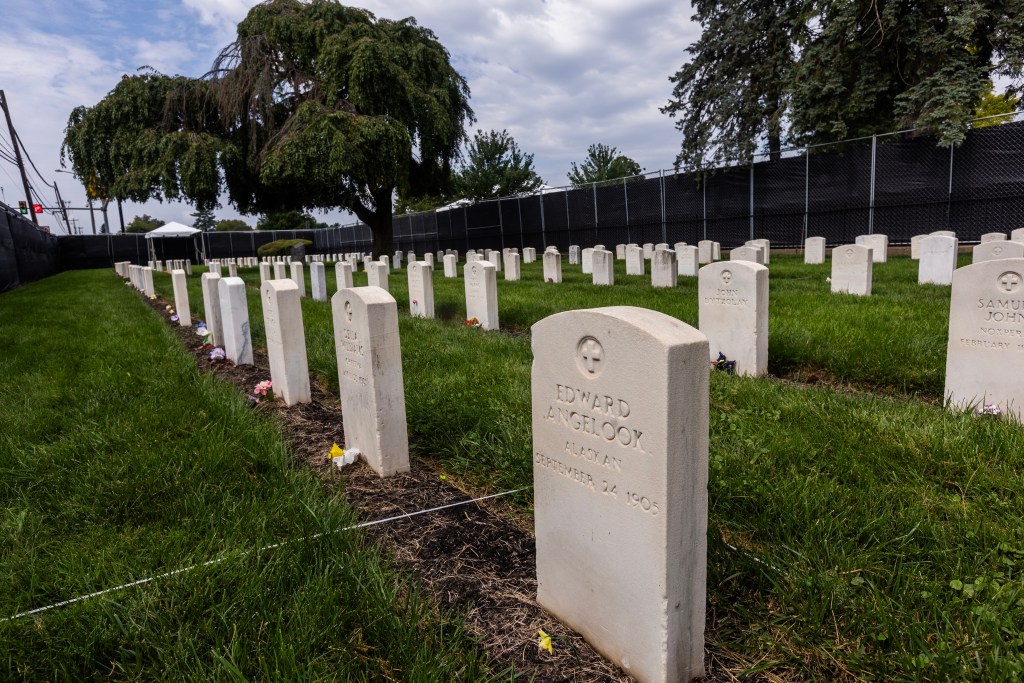
The remains of Edward Angalook, a student who died while attending the Carlisle Indian Industrial School, were formally transferred to family on Sept. 30, 2026, at a special ceremony at the Carlisle Barracks Post Cemetery so he can be returned to Alaska for reburial. Angelook, who is listed as Angelook on his gravestone, arrived at the Carlisle Indian Industrial School on Nov. 23, 1903, at age 18, and died Sept. 24, 1905, of tuberculosis. Credit: Charles Fox/Special to ICT
Edengham lives in Ketchikan, Alaska, but grew up in South Texas.
“I wasn’t raised in my community,” she said. “My mom was part of a forced adoption.”
She had a homecoming in 2016, and went to her home community for the first time. She was given a Native name, Changunak, by her aunt, only to discover later it was the name of Edward’s adopted mother.
“I was able to walk on the land of my ancestors and feel the wind knowing that this was a place where my roots start,” she said. “Now, 10 years later, I’m getting to help bring my uncle back home to where he’s from.”
Edengham arrived in Carlisle on Sept. 24. It was the same date Edward had died 121 years earlier. He was disinterred from his grave on Sept. 25.
Edengham spoke with members of the four Alaska families about the arduous two-month journey and the thousands of miles the students traveled to get to Carlisle.
“Could you imagine what the kids went through in 1903?” asked Edengham.
She said she was surprised to learn that the Carlisle school’s history was not widely known to those who lived there.
“How do you break the tradition of silence? How do you start bringing this to light so our people can heal, so we can start making sense of it?” she said. “It’s this part of our history that they are intentionally forgetting and not talking about, and to me, that silence is so loud.”
Edengham described her visit to Carlisle as “one of the most sacred journeys I’ve ever been on in my life.”
She is accompanying Edward’s remains to Unalakleet on Alaska’s Seward Peninsula, where he will be buried in early October next to his adopted mother Changunak Antisarlook Andrewuk, also known as Sinrock Mary. After the forensic results were confirmed on Sept. 29, a ceremonial fire was lit in Unalakleet to mark the start of the mourning period.
Lucy Spaulding
Lucy Spaulding, 14, and her younger sister, Lizzie,12, arrived together at Carlisle on Oct. 24, 1903, part of a large group of 33 Native students from southeastern Alaska. It was Carlisle Superintendent Richard Pratt’s last big recruitment during his tenure.
Nine of the students, including Lizzie, became ill during their time at Carlisle and were sent home. Lizzie left Carlisle on May 28, 1904. Though there does not appear to be a record of her type of illness, she died soon after returning home, according to her niece, Myranell Bergtold.
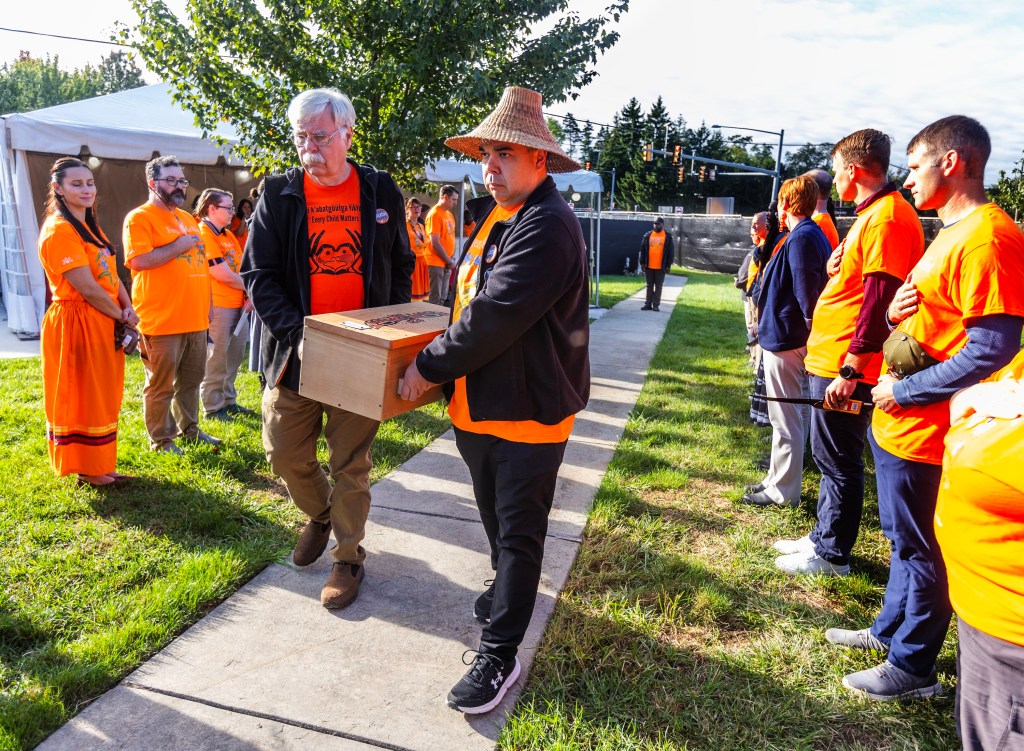
Glenn Bergtold, left, and Matthew Bergtold carry the casket of Lucy Spaulding after a distinguished transfer ceremony on Sept. 30, 2026, to return her remains to her family more than 100 years after she died while attending the Carlisle Indian Industrial School. The orange T-shirts serve as a reminder that the ceremony was held on National Day of Remembrance, also known as Orange Shirt Day, a day in the U.S. and Canada for remembering students who attended the boarding school system.
When Lucy became ill with tuberculosis, however, she was kept at the school.
“Why didn’t they send her home when she first started getting ill? Instead she was in that (school) hospital for four months,” Bergtold asked.
The question that constantly haunts Bergtold is why she was even at the school at all.
“Why was she there to begin with? Because all they learned was how to be a housewife,” she said. “The women were very limited on what they were there to learn. They’d be maids in a household or something, or nannies. … Why would they do this?”
Bergtold has anger towards Pratt and all the officials who fed the pipeline of students going from Alaska to Carlisle.
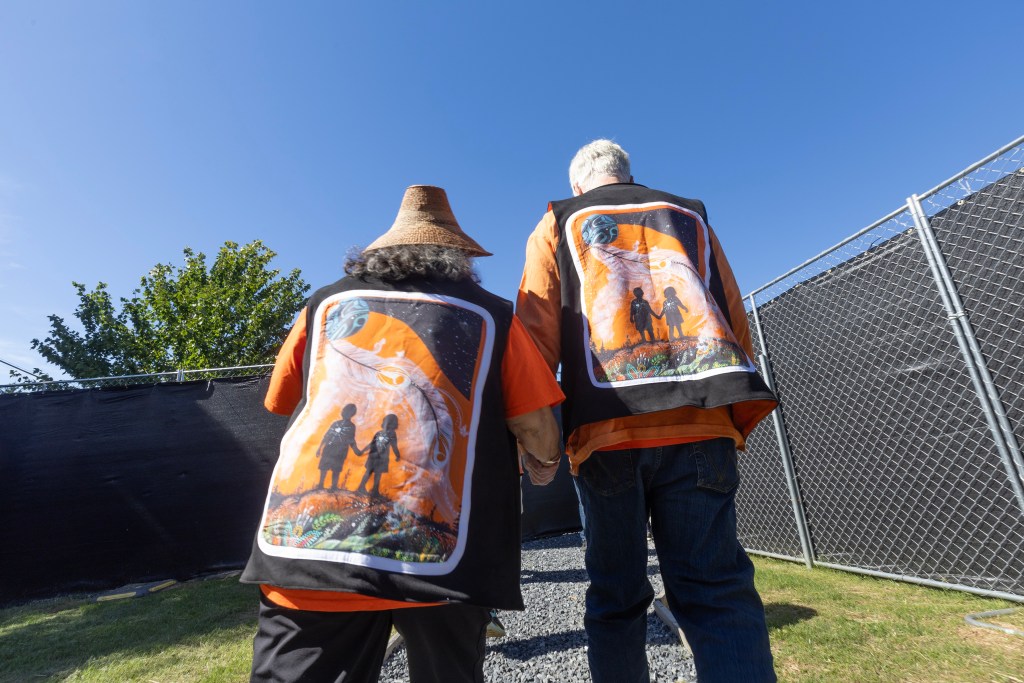
Myranell Bergtold, left, and Glenn Bergtold, relatives of Lucy Spaulding, leave the Carlisle Barracks Post Cemetery hand-in-hand. Lucy was among three Alaska Native students, including Tummassak and Edward Angalook, who died while attending the Carlisle Indian Industrial School more than 100 years ago. On Sept. 30, 2026, the children’s remains were formally returned to their families and they began their journey home to Alaska. Credit: Charles Fox/Special to ICT
In the recent visit to Carlisle, Lucy’s four relatives took time to walk in the footsteps of Lucy and Lizzie and toured the Carlisle Barracks. They stopped on the parade grounds, the quadrangle in the center of the school where the famous photographs of the student body were taken. They stopped to sing the song, “We Speak For Ourselves.”
“Not just to honor them, but all these children that didn’t have a voice of their own.,” Bergtold said. “I mean, even if they did speak up, nobody listened.”
Jennifer McCarty, another relative of Lucy’s, would later say, “What happened here is unforgivable.”
After the forensic examination, Lucy’s remains were wrapped in a quilt especially made by Myranell’s husband Glenn and placed in a cedar box that was donated by Ken Decker and the Ketchikan Indian Community. The lid featured a raven painted by Decker. Also included was a bouquet of cedar roses, and all the coins, marbles, and shells that had been placed on her grave over the years.
Lucy is scheduled to make her homecoming on Oct. 11. She will be given her last boat ride in the fishing boat of Clifton Guthrie traveling from Ketchikan to Metlakatla. Guthrie is also carving a wooden wall hanging in Lucy’s honor that will ultimately hang in the Jim Thorpe Center for the Futures of Native Peoples at Dickinson College in Carlisle
The following day a celebration of Lucy’s life will take place in the Metlakatla Town Hall. She will be reburied in Bayview Cemetery where her brother and sister, Lizzie, are buried. They will also bring the recently repatriated Ammolite of Sidney Campbell to his grave and sing a song to both of them.
Mabel Booth
Mabel Booth, also known as Stack or Stock, arrived on Oct. 24, 1903, at age 11, and died less than a year later, on Aug. 14, 1904, of tuberculosis. Her last name is listed as Stock on the gravestone and Stack in the Carlisle records, but Booth is believed to be her correct last name.
For Mabel’s relatives, their stay in Carlisle for disinterment started with Ahl’lidaaw Gitnack’angeat leading them, drum in hand, singing a spirit song in the cemetery. Three days later, that enthusiasm was spirited away.
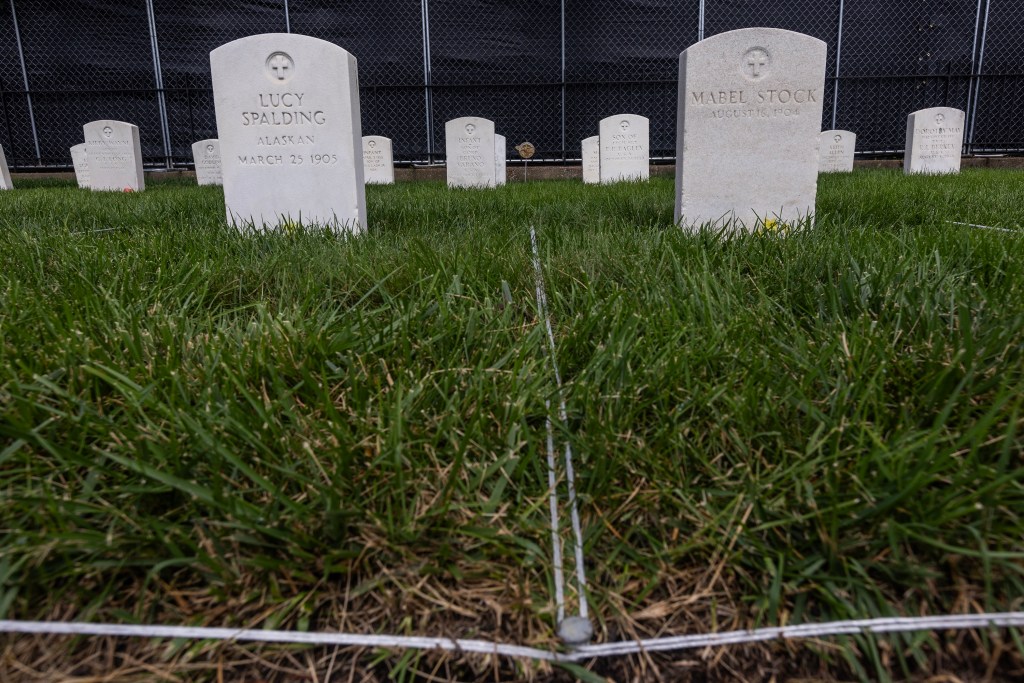
Alaska Native students Lucy Spaulding (shown as Spalding on the gravestone) and Mabel Booth (shown as Stock) died while attending the Carlisle Indian Industrial School in Pennsylvania more than 100 years ago. Their remains were set to be repatriated back to southeastern Alaska but the remains found in Mabel’s grave were found to be a young man. Credit: Photo by Charles Fox/Special to ICT
“Unfortunately we are not able to take Mabel home. The body they disinterred was male, they said, about 18-20 years old. We are all a mix of emotions,” Kathleen McKindles stated in an email to ICT. “It’s very disheartening because we don’t know where her remains are.”
“ It’s hard, you know,” McKindles said during a phone conversation. “We don’t know where she is…. It’s hard because now Mabel’s an unknown.”
Mabel’s relatives had some concerns from the beginning. Marilyn Stack, 80, the elder who along with McKindles, had spearheaded the effort to bring Mabel home, had been hesitant to make any homecoming or reburial plans before the forensic results were confirmed. Stack’s health had prevented her from making the trip to Carlisle.
“We know in the past there have been instances where the remains were not a match,” Ahl’lidaaw Gitnack’angeat said. “And so she [Marilyn] is kind of worried that it might happen to us. So she was afraid to go too much further until she got confirmation that it’s a match.”
Those concerns, unfortunately, proved all too true, as the Office of Army Cemeteries announced their findings to Mabel’s relatives on Monday, Sept. 28, bringing disappointment to the six relatives who had made the trip.
“I feel like I was probably the most disappointed, because I feel like I had invested into it all these years,” said McKindles, who started researching Mabel in the 1990s and organized the paperwork for her return.
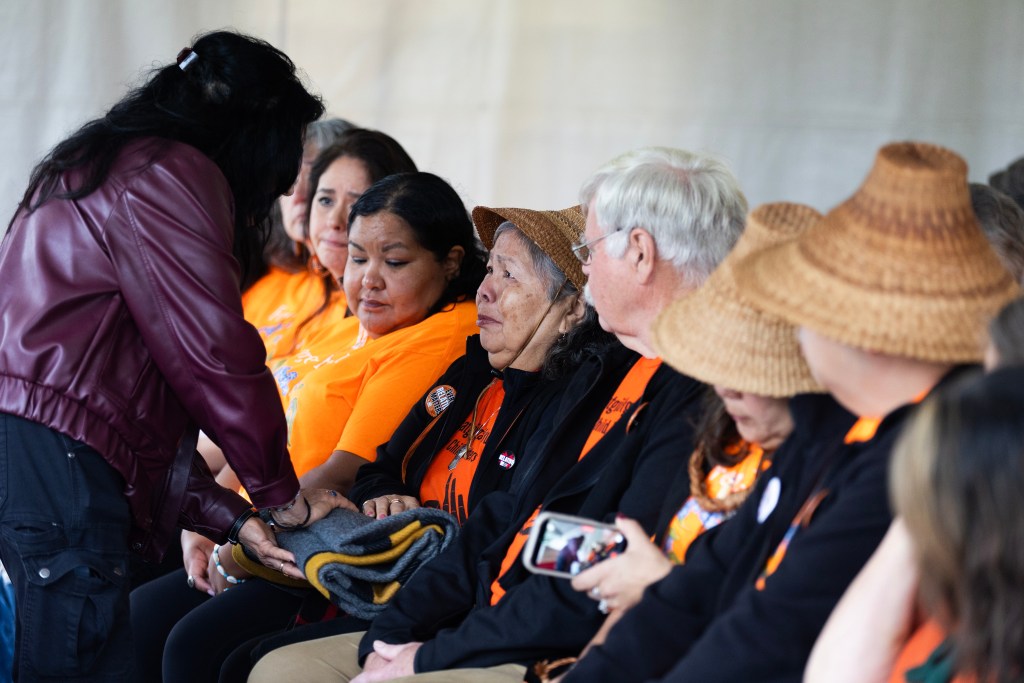
Karen Durham-Aguilera, left, executive director of the Office of Army Cemeteries, presents Myranell Bergtold, the niece of Lucy Spaulding, a blanket during a distinguished transfer ceremony for the remains on Sept. 30, 2026. Lucy was among three students who died more than 100 years ago while attending the Carlisle Indian Industrial School and who are now being repatriated back to their family and tribes. Credit: Charles Fox/Special to ICT
The family’s thoughts soon turned to why the Alaska Native students were ever sent to Carlisle.
“I can’t imagine my great-grandparents allowing her to go that far away,” McKindles told ICT. “I just can’t imagine, and I don’t understand that. She was going to school, and they all spoke English…They had all been converted to Christianity.”
She continued, “It’s a huge question mark. My grandma always told me that [Mabel] was taken…Mabel never came back and her mother never got over it.”
The relatives had discussed what to do if the forensic results didn’t produce a result. In the end, they knew that every child matters.
“Marilyn was sad, but at the same time she had the feeling that this unknown child was also somebody’s child, somebody’s baby, and that her feeling was that they have a sense of responsibility to this young man,” Gitnack’angeat said. “She felt like she’s gained a grandson.”
They decided when the young man was reburied at Carlisle, they would give him the very same ceremony as if it was Mabel’s reburial and treat the unknown child as if their own, Gitnack’angeat said.
Gitnack’angeat instructed the forensic anthropologists to lay cedar boughs at the bottom of the casket and have the remains wrapped in a red cloth. Hemlock sprigs would be put in the four corners as a reminder of their tribe. Eagle down and feathers were placed on top of the bundle for protection and peace.
With Mabel’s burial location now being unknown, she will join Mary Kinninook and Henry Rose as Alaska Native students in undefined graves.
For Mabel and her relatives, there is not any homecoming in the works. Her gravestone doesn’t exist anymore, and there is not a designated place for a visiting relative to pause and mourn Mabel’s life ending as a teenager thousands of miles from home.
There is not a place to lay flowers, There isn’t even a known photograph. At risk of being forgotten, she now exists as “unknown,” a purgatory that for the time being all but prevents a return home. For Mabel, all that was left to do on Remembrance Day was to remember her.
“Mabel will eventually come home,” McCarty announced as the transfer ceremony came to a close on Sept. 30. “It just won’t be today.”
Going home
The remains of 11 students who died at the Carlisle Indian Industrial School in Pennsylvania were disinterred from the school cemetery and returned to their family members and tribes in September. The students include three Alaska Native students, three from the Fort Peck Assiniboine and Sioux Tribes, and one student each from five other tribes across the U.S. Here are the students from other tribes who have already been returned home.
Alaska Natives
*Edward Angalook, who is listed as Angelook on his gravestone, arrived Nov. 23, 1903, at age 18, and died Sept. 24, 1905 of tuberculosis.
*Lucy Spaulding arrived Oct. 24, 1903, at age 14, and died March 25, 1905, of tuberculosis. She is listed as Spalding on her gravestone.
*Tummassak arrived on Nov. 14, 1897, at age 12, and died on April 8, 1900, of tuberculosis. She is listed as Tomicock on her gravestone and also as Tomiclock in Carlisle archives.
Note: A fourth student from Alaska, Mabel Booth, who arrived at Carlisle on Oct. 24, 1903, at age 11 and died on Aug. 14, 1904, was also expected to also return home this year. But the remains found in the grave marked as hers was found to be an unidentified young man. She and the young man are now both listed as an “unknown.”
Fort Peck Assiniboine and Sioux Tribe***Peter Howe** arrived at the school on April 15, 1890, at age 16, and died six years later on June 5, 1896, of tuberculosis.
*Richard Morgan arrived April 15, 1890, at age 17, and died March 25, 1891, of tuberculosis.
*Christine Redstone arrived April 15, 1890, at age 15, and died July 19, 1899, of tuberculosis.
Comanche Nation*Frances Bones arrived on Nov. 8, 1894, at age 14, and died on May 7, 1895. Her cause of death was not listed in Carlisle records.
Absentee Shawnee Tribe***Fannie Gibson** arrived on Dec. 24, 1899, at age 17, and died on Dec. 6, 1900, of tuberculosis.
Shoshone Paiute Tribes***Della Atkins** arrived on Dec. 13, 1900, at age 17, and died 12 days
*Susie King arrived at the school on Oct. 25, 1890, at age 16, and died Oct. 21, 1891. Her cause of death was not listed.
Keweenaw Bay Indian Community***Margaret Davis** arrived at the school on Sept. 15, 1889, at age 14, and died Dec. 21, 1892, of tuberculosis.
The post A somber Remembrance Day begins the journey back to Alaska for three students who died while attending Carlisle appeared first on ICT.
From ICT via This RSS Feed.