

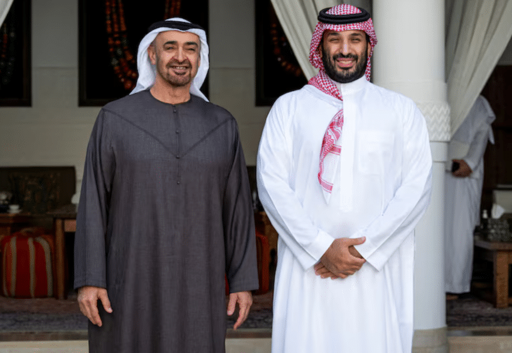

The genocidal US-Israeli rampage in the Middle East since 2023 has shown the world how billionaire power, colonialism and the far right work together. The pro-Western dictatorships in Saudi Arabia and the United Arab Emirates (UAE) also fit into this dystopian patchwork.
Both Gulf regimes have long fuelled devastating conflicts of their own. But increasing tensions between the two have threatened to make matters even more complex, so we absolutely need to pay close attention.
Love affair with Israel and Western far right
The UAE is a repressive dictatorship with a love for extreme capitalism.
It’s a major global player in the gold trade, alongside Switzerland and the UK. And a lot of that gold has reportedly come from conflict zones in Africa. One such place is Sudan, where the UAE has been turbocharging a catastrophic and genocidal civil war.
Although the UAE is religious, it is mostly pragmatic and has focused primarily on expanding its economic and political power in recent years. To that end, it normalised relations with Israel in 2020, massively boosting bilateral trade and setting the two up as key regional partners.
In the US, the dictatorship cultivated close links with far-right lobbyists and fundraisers. And it courted elitist Tom Barrack, a longtime billionaire friend of Donald Trump who has secured important diplomatic roles in the Middle East under Trump’s second presidency. The UAE has also invested heavily in the Trump family crypto brand.
The UAE has been cosying up to the European far right too. And extreme capitalists like Reform UK (which is also very close to Israel) have been more than happy to sing the regime’s praises.
A September report from research group FairSquare, for example, explained how senior Reform figures:
have strong and increasing ties to the UAE, [and] have enthusiastically advanced the Gulf state’s interests in the UK.
Noting UAE “torture of UK nationals” and “violations of UK sovereignty”, it highlighted:
…multiple instances where the UAE has behaved more like an adversary than an ally of the UK.
Evidence of “meddling” by this “deeply authoritarian actor”, FairSquare’s Alex Carlen argued, is “overwhelming”.
The group urged the British government to “counter the risk that the UAE poses to democracy in the UK”.
The UAE has historically reacted badly to Western scrutiny about its brutally repressive regime, seeking to smear or silence its opponents.
UAE falling out with fellow dictatorship Saudi Arabia
Saudi Arabia got UAE support for its decimation of Yemen (2015-2022). When Mohammed bin Salman became Saudi leader in 2017, he emulated the UAE in many ways — reducing religious power and increasing corporate power. Nonetheless, Saudi Arabia remains much more theocratic than the UAE.
The UAE can possibly be a bit quicker to change because only around 1.3 million of its more than 11 million inhabitants are actually Emiratis. In Saudi Arabia, meanwhile, the nation of 37 million people consists of about 21 million Saudis. And this population difference also makes it harder for the Saudi regime to ally fully with Israel.
Ordinary Saudis, for example, strongly oppose Israel’s crimes in Palestine, so any official move to normalise relations with Israel could potentially create serious problems for the Saudi regime.
Despite (and perhaps because of) its smaller size, the UAE has rapidly become a major regional challenger to Saudi Arabia’s power. This has seen the two regimes battling for influence in the Middle East and eastern Africa. But it’s their ongoing struggle in Yemen that has noticeably pushed them apart since 2025.
While Saudi Arabia backed the official Yemeni regime, the UAE opted to support the secessionist Southern Transitional Council (STC), which made big (but temporary) gains in late 2025 and early 2026. The Saudis responded by attacking and seriously weakening the STC. The UAE then announced it was stepping back.
The UAE soon challenged Saudi power openly, though, by leaving oil group OPEC. As one of the world’s largest oil exporters, Saudi Arabia essentially leads OPEC and exercises power over oil prices. Amid the oil squeeze during the US-Israeli war on Iran, the UAE’s willingness to offer oil at lower prices looked very much like a gift for the US.
The Saudi-UAE competition for US favour
Saudi Arabia has had military and intelligence ties with the US since around the 1940s, and has regularly funnelled its petrodollars into wars against allies of both Iran and the USSR. A major buyer of US weapons, it has continued to invest heavily in the US whilst also forging alliances with likeminded conservative capitalist states.
Because Israel is a key junior partner of US imperialism, however, the ongoing Saudi refusal to normalise relations with the apartheid state remains a sore point for Washington. Some analysts suspect that the US’ recent refusal to give direct support to Saudi Arabia’s efforts to defeat the Houthis in Yemen was part of Washington’s efforts to push the Saudis into recognising Israel.
The UAE, on the other hand, isn’t just investing (potentially more than the Saudis) in the US. It has also previously collaborated with Israel in Yemen. The UAE has also associated more strongly with the US and Israel during their war on Iran than any other regional power.
Traditionally, the UAE has hedged its bets by cannily dealing with everyone and anyone (including China and Russia). But with its own strikes on Iran, it has made its allegiance to US-Israeli interests clearer than ever.
The UAE has also fully embraced US artificial intelligence corporations, aiming to be a regional leader in the area. The Emirati embassy in the US has boasted about the dictatorship’s “role as the US’s largest trading partner in the Middle East”.
It also insisted it is “on track to becoming the leading source of foreign direct investment into the US”.
UAE taking over from Saudi as key driver of conflict?
For decades, it was Saudi Arabia fuelling regional conflicts, but it seems the UAE has increasingly taken on that task for itself in recent years.
The Horn of Africa — home to conflict and refugee crises that few regions in the world can match — has been a particular target for the UAE dictatorship.
Having fought to get its way in both Egypt and Libya after the Arab Spring (while repressing dissent to avoid unrest at home), it soon helped to undermine the possibility of a civilian revolution in Sudan too.
Sudanese activist Husam Mahjoub wrote that:
Sudan’s gold, its fertile agricultural land, its Red Sea coastline, and its sheer size make it a central testing ground [for the UAE’s regional sub-imperial project].
These are also reasons for Saudi Arabia’s development of close ties with Sudan’s military regime in recent years.
As Mahjoub added:
Sudan is also a critical node in the UAE’s continent-wide strategy of port and logistics dominance, part of an investment program now worth more than $110 billion across the continent, with dozens of port concessions, dry ports, and logistics hubs.
With this in mind, the UAE has cultivated close ties with the genocidal regime of Ethiopia (another friend of Israel) to help funnel resources to Sudan’s RSF paramilitaries in their fight against the Saudi-backed government.
As an apparent thank you for Ethiopia’s support, both the UAE and Israel have backed the African state’s controversial efforts to ensure access to the Red Sea via Eritrea (risking regional conflict in the process).
In Somalia, meanwhile, a UAE firm has invested around $450 million to develop an economically crucial port in the breakaway province of Somaliland. It has also helped to build up an airport (since late 2025) and a military base there. This base reportedly hosts not just UAE forces, but also Israeli and US forces.
Competing dictatorships but Western allies in the end
The US empire clearly values both Saudi Arabia and the UAE, whether that’s for their resources and money, their willingness to keep business running smoothly for the rich and powerful, or their opposition to Iran. This is perhaps why it has been careful not to take sides in the Saudi-UAE spat, preferring reconciliation.
The two regimes definitely care mostly about their own interests. Ultimately, their interests align with the interests of both the US and Israel, so they seem to be trying to de-escalate tensions. For example, 29 September saw the first official visit of a senior UAE figure to Saudi Arabia since 2025.
Whether reconciliation comes or not, the dictatorships’ economic competition and fuelling of conflict in the region is unlikely to end any time soon. The same goes for their role in supporting the international growth of a dystopian billionaire-colonial-fascist alliance. Therefore, the actions of both Saudi Arabia and the UAE must remain firmly on our radar.
Featured image via Reuters
By Ed Sykes
From Canary via This RSS Feed.