

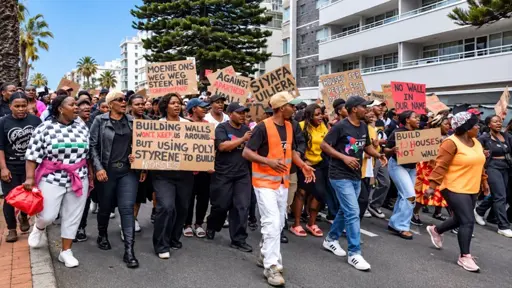

A proposed R114 million wall along Cape Town’s N2 has sparked protests, with residents and civil society groups accusing the city of investing in a barrier that could deepen the divide between poorer communities and surrounding suburbs.
Residents marched on September 25 to oppose the N2 Edge project, a planned 9-kilometer wall development that the city says is aimed at improving safety and security along the highway.
But protesters say that the wall risks reproducing the spatial divisions created under apartheid, saying public money should instead be spent on housing, public services and opportunities for communities that have been pushed to the margins.
Movement for CARE, which was among those involved in organizing the protests, had criticized the project, saying;
“Instead of investing in dignified housing, safe neighborhoods, quality public services, and opportunities for communities that have been pushed to the margins for generations, the city wants to invest millions in a barrier that deepens exclusion and reinforces the geography of apartheid.”
The organization said from the beginning when the news about the proposal was announced, that Cape Town does not need more walls but rather affordable housing close to work and economic opportunities, as well as greater investment in communities.
“We need investment in communities, not their isolation. We need a city that brings people together instead of driving them further apart,” it said.
The Movement for CARE described the proposed structure as an “Apartheid Wall,” arguing that the first step towards justice is refusing to normalize and hide existing inequalities.
City defends the R114 million project
The City of Cape Town has defended the project as a safety intervention. In January, Cape Town Mayor Geordin Hill-Lewis said the city’s adjustment budget had committed “R114m to the N2 Edge project.”
The investment “will make a positive difference to the safety of every motorist along that stretch, and reduce pedestrian fatalities,” Hill-Lewis said.
He said the project would repair safety barriers and introduce other safety improvements for communities along the N2.
Hill-Lewis also said that a small number of “criminal elements” were affecting the safety of hundreds of thousands of daily N2 users.
According to the mayor, the N2 Edge project would be accompanied by increased highway patrols, with more than 40 new Metro police officers deployed to the N2, supported by CCTV cameras, automatic number plate recognition and digital coordination for rapid response.
Despite the widespread backlash, the city maintains it will continue with the project.
Abahlali baseMjondolo backs the protest
Abahlali baseMjondolo also supported the protests, saying in a post that the project would deepen racial and economic divisions in the city.
“The City of Cape Town continues to entrench neo-apartheid laws in post-apartheid South Africa by building a wall that segregates and hides the poor from the rich along the N2,” the organization said.
Adding that the project shows that the Democratic Alliance-led City does not recognize the needs of poor communities, particularly Black communities.
Read more: “A declaration of war against the poor”: AbM leads resistance against South Africa’s anti-occupation bill
The organization said it supported the struggles of residents in Khayelitsha, Langa, Dunoon, Gugulethu and Mitchells Plain who continue to face what it described as segregation and racism.
The protests have raised questions over whether the R114 million allocated to the N2 Edge project represents the right priority for Cape Town. With the protesters arguing that public resources should instead be directed towards reducing inequality, improving services and providing better housing and opportunities for communities living along the N2, instead of separating communities and concealing poverty.
From BT News via This RSS Feed.