

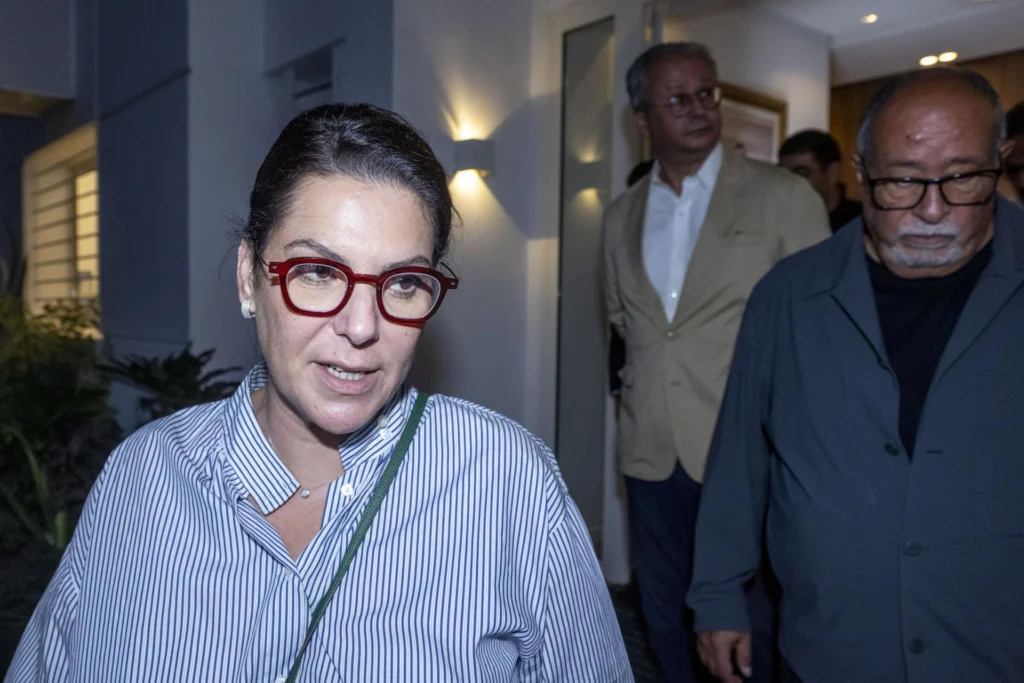
Morocco’s King Mohammed VI formally appointed lawyer Fatima Ezzahra El Mansouri as the country’s head of government on Tuesday, making her the first woman to hold the position in Moroccan history, following the victory of the Authenticity and Modernity Party in the September 23 legislative elections.
The announcement, issued by the Royal Cabinet from the Royal Palace in Rabat, came after El Mansouri’s liberal-centrist party secured the largest parliamentary minority, winning 97 of the 395 seats in the House of Representatives, equivalent to 24.5% of national representation.
The appointment took place during a formal audience at the royal seat, marking the official start of Morocco’s institutional transition process and the establishment of policy guidelines for the incoming constitutional term.
RELATED: Morocco Tightens Ceuta Border Security Amid Calls for New Mass Crossing
El Mansouri, 50, holds a degree in commercial law from Mohammed V University in Rabat and completed postgraduate studies in international law at academic institutions in France and the United States, backing an extensive career in public service and the strategic leadership of legal and political organizations. She brings more than 17 years of continuous experience in national politics. Her political career began at the municipal level in 2009, when she was elected mayor of Marrakech, a position to which she was later re-elected in the 2021 subnational elections.
El Mansouri subsequently served as Minister of Housing, Urban Planning and City Policy in the outgoing cabinet of Aziz Akhannouch, where she led territorial development programs, community infrastructure renewal initiatives and housing planning efforts, establishing a strong technical profile within her political party.
Morocco’s King Mohammed VI has appointed Marrakesh’s long-time mayor, Fatima Ezzahra El Mansouri, as the country’s first female prime minister after her party won last week’s parliamentary election. The 50-year-old becomes the second woman in the Arab world to lead a government. pic.twitter.com/kNVJMoO9L4
— Al Jazeera English (@AJEnglish) September 30, 2026
Priorities Ahead For 2030
Under Article 47 of Morocco’s constitution, which authorizes the appointment of the head of government from the party that receives the most votes, El Mansouri immediately began negotiations with parliamentary blocs, including the National Rally of Independents and the Istiqlal Party, to form a majority governing coalition.
El Mansouri takes on leadership of the government with priorities centered on containing inflation, reducing youth unemployment, and overseeing the technical planning of major public works and strategic infrastructure projects tied to Morocco’s joint hosting of the 2030 FIFA World Cup. She will also face the challenge of maintaining economic stability while responding to the demands of the country’s most vulnerable communities, as inflationary pressures and employment demands require immediate technical responses to preserve social cohesion.
🇲🇦 Pour la première fois de son histoire, le Maroc sera dirigé par une femme à la tête de son gouvernement. Fatima Ezzahra El Mansouri a été nommée Première ministre par le roi Mohammed VI.
🔍 Avocate de formation, à la tête des 20 femmes d’Afrique les plus influentes selon… pic.twitter.com/PiOoCiDxic
— FRANCE 24 Français (@France24_fr) September 30, 2026
El Mansouri’s appointment reinforces the implementation of the constitutional framework approved in 2011, which ties the selection of the head of government to the popular will expressed at the ballot box, a provision that strengthens the legitimacy of parliamentary institutions and deepens the political institutionalization process under the monarchy’s leadership.
Regionally, the transition also reflects the broader evolution of public administration legal frameworks across North Africa, continuing modernization processes that began with reforms to Morocco’s family code and expanding the participation of professionals in senior public office. Going forward, the new government’s agenda will need to balance attracting investment for infrastructure projects with allocating resources toward social protection, with the administration’s ability to build consensus among key parliamentary forces expected to shape its operational effectiveness on the international stage.
From teleSUR English via This RSS Feed.