

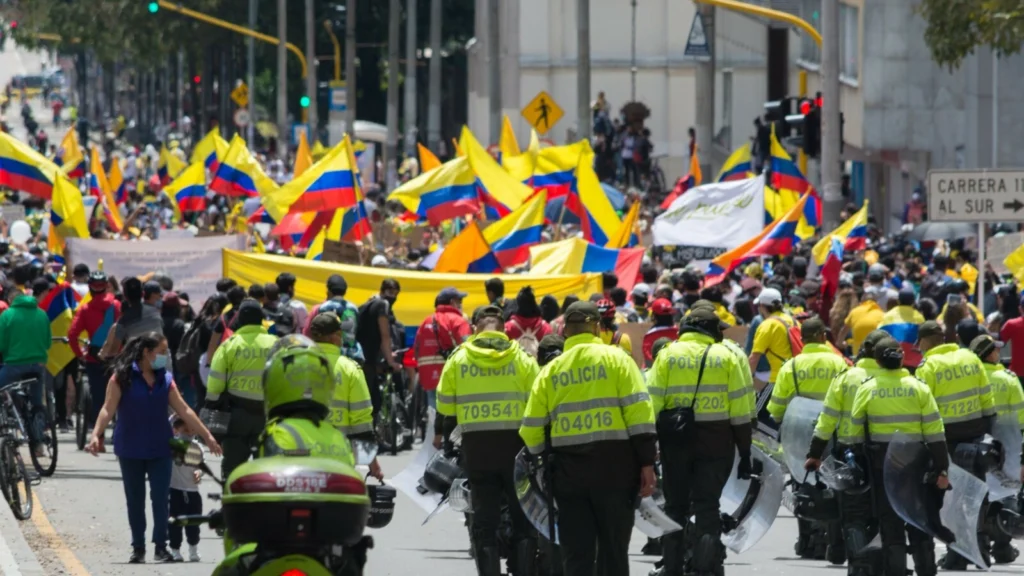
The administration of Colombian President Abelardo de la Espriella has proposed modifying the protocol governing the conduct of authorities during protests, via a draft decree published this Wednesday by the Ministry of the Interior. The text will remain open for public comment until October 4.
RELATED:
Colombia Deploys Military to Santa Marta After Violence
The initiative amends Decree 003 of 2021, the regulation establishing the protocol for protecting the right to peaceful protest and governing the State’s legitimate use of force. The draft maintains the presumption that demonstrations are peaceful and stipulates that protective actions must target only those engaging in violent behavior, without affecting the mobilization as a whole.
The main modification addresses scenarios where—from the outset of a gathering—the carrying or use of firearms, bladed weapons, explosives, or incendiary devices is identified. It also covers the detention of individuals, assaults on third parties, public officials, police officers, medical personnel, or journalists, as well as the destruction of infrastructure.
In such cases, the police may intervene against those committing these acts while simultaneously maintaining dialogue with peaceful demonstrators. Thus, the proposal eliminates the requirement to first exhaust dialogue, mediation, and facilitation phases with individuals accused of participating in violent acts.
#Bogotá | Graves problemas de movilidad se registran a esta hora en Bogotá por manifestaciones en diversos puntos. A esta hora, avanzan movilizaciones por la Carrera 7ma con calle 38 y se desplazan hasta la calle 26 por donde se movilizan hacia el occidente de la capital. pic.twitter.com/CU05muTi47
— La FM (@lafm) September 28, 2026
The text reads, “Serious mobility problems are being reported at this hour in Bogotá due to demonstrations at various points. At this hour, mobilizations are advancing along Carrera 7ma with Calle 38 and are moving toward Calle 26, where they are heading westward through the capital.”
The draft also outlines guidelines regarding the organization of marches and sit-ins. Announced measures include a requirement for more detailed advance notification to local authorities, providing information on routes, schedules, and the estimated number of participants.
Additionally, the proposal suggests designating zones where demonstrations take priority and others subject to potential restrictions, particularly near commercial areas or critical infrastructure.
The draft anticipates an increased police presence during protests and establishes criteria of proportionality and gradualism regarding the use of force. The regulation ostensibly seeks to distinguish between the peaceful expression of public discontent and violent acts, establishing specific protocols for each situation.
The proposal has emerged amidst a backdrop of mobilization by social and trade union sectors against the new government. The Central Unitaria de Trabajadores (CUT)—along with the Colombian Federation of Educators (Fecode) and other organizations—has called for a national day of action on October 14 to protest De la Espriella’s policies.
Gabriel Rondón, who served as Deputy Minister for Social Dialogue and Human Rights under the Gustavo Petro administration, challenged the draft measure, stating that it contradicts rulings by the Supreme Court of Justice and recommendations issued by the Inter-American Commission on Human Rights (IACHR) in 2021.
Rondón also criticized the timeframe allotted for public input. “Furthermore, allowing only five days for comments on such a significant decree clearly demonstrates that the government… has no interest in citizen participation, let alone democratic debate,” he wrote on his X account.
#Colombia | Santa Marta was militarized following an escalation of terrorist activity and an armed strike.#AbelardoDeLaEspriella #SantaMarta #Terrorism #teleSUREnglish pic.twitter.com/7Ssvo0mprk
— teleSUR English (@telesurenglish) September 24, 2026
From teleSUR English via This RSS Feed.