

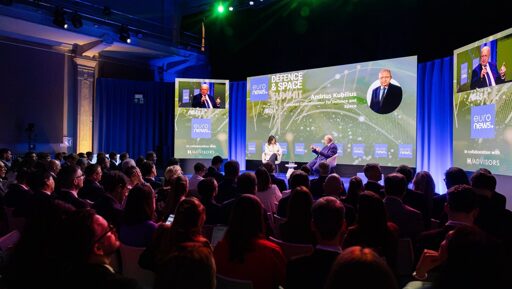

More rearmament talks are underway in Brussels as European politicians continue building an increasingly tense anti-Russian discourse. On Wednesday, September 30, defense ministers and industry representatives joined the Euronews Defense and Space Summit, focusing on the bloc’s growing defense expenditure and member cooperation.
The summit took place after weeks of allegations of hybrid attacks on EU members, which pushed the already tense rearmament narrative permeating the European political establishment up a couple more notches. It also followed, by only a couple of days, the Council of the EU’s announcement of the next phase of five European Defense Projects of Common Interest (EDPCIs) – projects that “allow EU countries to work together on major defense initiatives that are too large or too complex for individual countries to develop on their own.”
Read more: “Militarization of rules and minds” in Europe threatens workers and welfare
While separate, the two events shared several points in common, starting with a focus on increasing coordination between EU countries to arm more efficiently – and spend the billions of euros planned for defense over the coming years. They also emphasized sections of the military sector to receive the most attention – including drones and military capacities in Eastern Europe.
This geographical focus goes beyond EU members, expanding to – at least – Ukraine and Moldova. Most EDPCIs – like the Drone and Counter-Drone European Resolve (DECODER) and the Eastern Flank Watch – list Ukraine as a partner. Ukrainian arms entrepreneurs were also present at the summit in Brussels, including leading figures from Fire Point, one of the country’s most prominent arms companies.
Very imminent investments into arms
While NATO Secretary General Mark Rutte stated in his summit intervention that there is “no imminent danger” to the alliance members’ territories, he and others did not hold back in offering anticipations of an unstable period.
Belgian Minister of Defense Theo Francken, for one, anticipated “more hybrid threat actions” and an overall “dark winter for Europe” – a scenario he seems to want to address by spending more on arms and cutting social services, as he has explicitly stated on numerous occasions.
“Europe has been very good in investing in soft power, in social security,” Francken said. “And it’s beautiful to have a pension system, to have social welfare systems when someone gets sick, when somebody loses his job – we have everything. But when there’s a war or there’s hybrid threats, we don’t have anything.”
Considering the significant amount of money European countries have already invested into armament, his assessment that “we don’t have anything” is inaccurate at best.
It also remains contested on a regular basis on the streets of many European cities, where trade unions, students, and peace movements continue to protest against austerity budgets that aim to provide for war.
Europe needs a policy that builds security with its neighbors
In addition to large-scale demonstrations against social security and labor cuts in France’s proposed 2027 budget and student strikes against conscription in Germany last week, mobilizations are expected to grow over the coming months – including an international youth strike in November.
“We reject the militarization of our societies and support the young people who are refusing it,” the Stop ReArm Europe coalition wrote on September 23. “Thousands of high school students and university students across Europe are rising up to refuse militarization and the return of conscription.”
Read more: German students say ‘we don’t want to go to war’
“Nearly 20 million children in the EU – one in four – live at risk of poverty or social exclusion,” the group added. “Meanwhile, governments have committed to military spending that the EU’s own Defense Commissioner, Andrius Kubilius, puts at €7 trillion by 2035.”
“The trillions earmarked for militarized security will leave us staring down the barrel of a gun and indebted to global financiers,” Stop ReArm wrote, calling for a solidarity- and care-based alternative. “This must go hand in hand with a non-aligned foreign policy that resolves conflicts through diplomacy, upholds international law and human rights, and builds common security for all: security with our neighbors, not against them.”
From BT News via This RSS Feed.
Almost like they’re the imminent danger…

